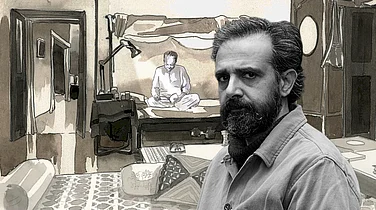
Nikita Grover has been the casting director for various popular OTT series like Kohrra and Paatal Lok.
Her work foregrounds observation, detail and a sustained engagement with the characters.
While some key roles are shaped by the director and writers, it is through casting that the larger world is built, through characters who hold its tensions and everyday rhythms.
In Kohrra, casting shapes how people are seen on screen. It unfolds slowly, through detail, presence and the textures of everyday life.
We enter a version of Punjab that feels immediately familiar. The opening frame of the second season shows an older woman returning from an early morning keertan, only to discover a dead body in a cattle shed. The story moves through homes, extended families and land disputes, in a world where social hierarchies surface through everyday interactions, across rural and urban spaces.
This world does not announce itself. It settles in.
The second season returns to this landscape through Preet (Pooja Bhamrah), an NRI woman whose murder the story circles in a non-linear fashion. It lingers in silences and unresolved gestures, where grief sits alongside routine and violence appears not as spectacle but as something already present, accumulating.
At the centre of this process is casting director Nikita Grover, whose work across both seasons of Kohrra and Paatal Lok (2020-2025) foregrounds observation, detail and a sustained engagement with the characters. While some key roles are shaped by the director and writers, it is through casting that the larger world is built, through characters who hold its tensions and everyday rhythms.


In this conversation with Kamna Singh for Outlook, Nikita Grover reflects on her process and on how casting allows characters to be encountered as people rather than archetypes. Edited excerpts:
How do you approach building lived-in worlds through casting? What do you look for when you first read a script?
With the script, it’s not just imagination. I meet a lot of people. I observe them and realise that a character can look very different from what I first thought.
There’s also a constant back-and-forth with the director. What they think and what I think shapes things.
For Kohrra, I often talk about casting Rannvijay Singha as Sam, Preet’s husband. People might question that because of his Roadies background. But when you look at his life, he is from Punjab, he has worked there, lived abroad and has a family. In that context, it made sense.

What kinds of cinema have shaped your understanding of realism and casting?
I am drawn to cinema that is not performative or loud—filmmakers like Gurvinder Singh, Mira Nair and films like Anhey Ghorhey Da Daan (2011) or Monsoon Wedding (2001), which feel rooted and lived-in.
I naturally gravitate towards that kind of storytelling.

You often meet people in their everyday environments rather than through conventional casting. How does that process work in practice?
It is not always easy. When I was in Nagaland for Paatal Lok season 2, for a long time people wouldn’t speak to me. I was seen as an outsider. I would spend time with people, just be present.
Eventually, I began working with the researcher working with us, Anungla, who helped bridge that gap. If I spotted someone, I would ask her to speak to them. After that, it became a chain. Through conversations, I would meet one person, then another, and it kept building from there. A lot of the process is about building relationships over time.

How do you build trust with actors, especially those who are new or not formally trained?
With actors, it can be quite overwhelming. I receive messages all the time and it’s not always possible to respond. What I try to do differently is create spaces where people can actually come and meet me. I organise meet-and-greets and keep them accessible. I don’t want to do it in a fancy place where people feel uncomfortable.
Sometimes it’s as simple as sitting under a tree where anyone can come.
There is often hesitation, especially among people from less privileged backgrounds and I try to reduce that distance. It’s important for me to maintain a space where people feel seen and heard.
I also come from an acting background myself, so I understand what it feels like to be unsure and I try to create an environment where actors can feel open and just be.

In Kohrra, there isn’t a clear divide between major and minor characters. How do you approach casting across roles?
I take my characters very seriously. For me, they are the most important. They are what build the world. I will travel anywhere for an actor, even if it’s just for a one-day role.
In season one, there’s a character called Satpal, a female constable played by Veerpal Kaur. I kept reaching out to her, but she couldn’t make it. Eventually, I went to meet her where she was.
What you see on screen—it’s worth it. That authenticity is what matters to me.

How do you work against fixed ideas of what certain characters are supposed to look like?
They do come in, but I try not to approach casting through those fixed ideas.
For instance, in season two, there’s a character called Pamma played by Gurjant Singh Marahar, who works as a bouncer. The character was written as a big, muscular man, but I didn’t see him that way. I saw him as a more regular person. That shift comes from spending time on the ground and observing people closely.
With Preet, I didn’t imagine her in a stylised or sexualised way. And with Rajji played by Ekta Sodhi in season one, we consciously avoided the ‘sexualised bhabhi’ trope.
The more you observe, the more those assumptions fall away.

Your characters often feel rooted in lived experience. How does that recognition shape your approach to casting?
I relate to all the women in the show in some way. Preet, Rajji, so many of them.
There was one scene where Amarpal Garundi played by Barun Sobti tells his brother that no matter how many gurudwaras he goes to, he will never find peace. I remember thinking, I’ve seen this in my own house.
When I read that scene, I cried a lot. That’s what makes it feel real. You recognise parts of your own life in them.

Were there any roles in Kohrra that were particularly difficult to cast?
Yes, in season two, a lot of them. Rakesh Kumar, played by Satyakam Anand, was very, very tough to cast because we couldn’t have gone wrong there. If it had gone even a little wrong, it would have become a very ugly portrayal.
We were trying to figure out what we actually needed for that part. It wasn’t something visible on the face. It had to come through the body, the way he sits, the way he holds himself.
It took us a long time to realise we needed someone with a physical theatre or mime background.
Casting begins early in a project but often remains invisible. What do you wish people understood about this work?
Not enough is understood about it. A lot of award ceremonies still don’t even have a casting category. People are not really treating casting directors as a separate department.
We are among the first to start working on a project and we continue till the very last day of the shoot. But that visibility doesn’t always translate into recognition.
At big announcements or events, you will see producers and actors, but casting directors are often not invited.
There is also this idea that anyone can do casting. If you put out a call, you will get hundreds of profiles, but that doesn’t mean casting is easy.
If we want to make better cinema, this work has to be taken seriously.
What does the economics of casting look like and how does it shape the work?
It’s not very sustainable, to be honest. Casting is one of the lowest paid departments.
Because of that, it’s very difficult to work on just one project at a time. Most people have to take on multiple projects to make it work. You are not always able to give each project or each actor the time they need.
I don’t like working that way. I prefer to focus on one project and give it the time it requires. But economically, that’s not always possible.
That’s also why you see many casting directors handling four or five projects at the same time. It’s not necessarily a choice; it’s the structure of the industry.