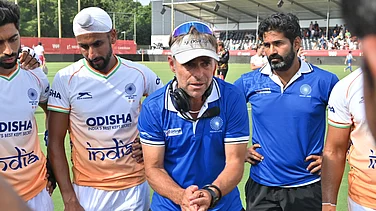
The Tamil Nadu Dragons are built around a defensive-first identity, with Amit Rohidas leading a strong circle defence, supported by experienced goalkeeping and a structured midfield
Penalty corners remain a key weapon, with Blake Govers providing a reliable scoring option in tight matches
Reliance on structure and set-pieces means execution will be crucial, especially against faster, transition-focused opponents
Accord Tamil Nadu Dragons approach the Hero Hockey India League 2026 with a clearly established template. After a semifinal finish in 2025, the franchise has doubled down on what worked, shaping a squad that prioritises circle defence, structured play and efficiency over risk.
The Dragons’ identity is defined less by flair and more by control, with experience and role clarity at the core of their planning. Here’s everything you need to know ahead of the men’s Hockey India League 2025–26 season.
Tamil Nadu Dragons SWOT Analysis
Strengths
Circle defence as the foundation: The Dragons are built around a strong defensive unit led by captain Amit Rohidas, whose consistency and reliability anchor the backline. This emphasis on circle defence allows the team to limit high-quality chances and stay competitive in tight matches.
Proven goalkeeping depth: David Harte brings elite experience as a two-time FIH Goalkeeper of the Year, while Princedeep Singh adds quality support after his shootout performances at the 2025 Junior World Cup. Together, they provide stability in high-pressure situations.


Set-piece reliability: Blake Govers remains a key attacking outlet, with his penalty-corner conversion offering the Dragons a dependable scoring option even when open-play chances are scarce.
Structured midfield play: Mohammed Raheel Mouseen and Paul Kaufmann contribute discipline and balance, helping the team maintain shape and control phases of the game.
Weaknesses
Heavy reliance on set-pieces: The Dragons’ attacking output is closely tied to penalty corners, placing increased importance on conversion rates and umpiring decisions inside the circle.
Limited emphasis on open-play scoring: With the tactical focus centred on defence and structure, the team may generate fewer chances from fast attacking transitions compared to more aggressive sides.
Opportunities
Building on 2025 momentum: A semifinal finish provides continuity and confidence, allowing the Dragons to refine rather than reinvent their approach.
Home advantage early in the season: Opening their campaign in Chennai offers an opportunity to capitalise on familiar conditions and local support.
Growth within a settled system: The mix of experienced internationals and emerging Indian players creates room for individuals to take on greater responsibility within defined roles.
Threats
Transition-heavy opponents: Teams that rely on speed and quick ball movement could challenge the Dragons’ structured defensive approach.
Reduced penalty-corner opportunities: Matches where set-pieces are limited may test the Dragons’ ability to convert pressure into goals.
Conclusion
Accord Tamil Nadu Dragons enter HIL 2026 with clarity and conviction in their style of play. Their success will depend on how consistently their defensive strength and set-piece efficiency hold up across the season as they aim to build on last year’s semifinal run.
Tamil Nadu Dragons Squad
David Harte (Ireland), Princedeep Singh, Amit Rohidas, Paul Kaufmann (Germany), Sander de Wijn (Netherlands), Anand Lakra, Pruthvi GM, Tom Sorsby (Great Britain), Tom Craig (Australia), Mohammed Raheel Mouseen, Sheshe Gowda, Chandan Yadav, Arun J, Adrohit Ekka, Sushil Dhanwar, Blake Govers (Australia), Selvam Karthi, Nathan Ephraums (Australia), Uttam Singh, K Selvaraj.
Hockey India League 2026: Live Streaming
All matches of the Hockey India League will be broadcast live on Sony Sports Ten 1, Sony Sports Ten 3, and DD Sports. Matches will also be live-streamed on Waves and the Hockey India League YouTube channel.