FIFA recognised exiled Afghan team Afghan Women United for official international football
Players overcame threats, opposition, and exile to continue playing
The Cook Islands friendlies marked Afghanistan women’s historic return to the international stage
Imagine being denied the right to study, to work, to travel freely, to speak publicly, and even to play a sport you love -- rights that much of the world considers basic human freedoms. Now imagine that the only reason those rights are taken away is because you are a woman.
For countless women in Afghanistan, that is not a hypothetical scenario. Since the Taliban returned to power in August 2021, women and girls have faced sweeping restrictions that have removed them from classrooms, workplaces, public life, and organised sport.
Yet in the middle of that darkness, a group of Afghan women footballers refused to disappear.
Scattered across Australia, the United Kingdom, Portugal, Germany, Italy, and other countries, they rebuilt themselves in exile and came together under a new name: Afghan Women United.
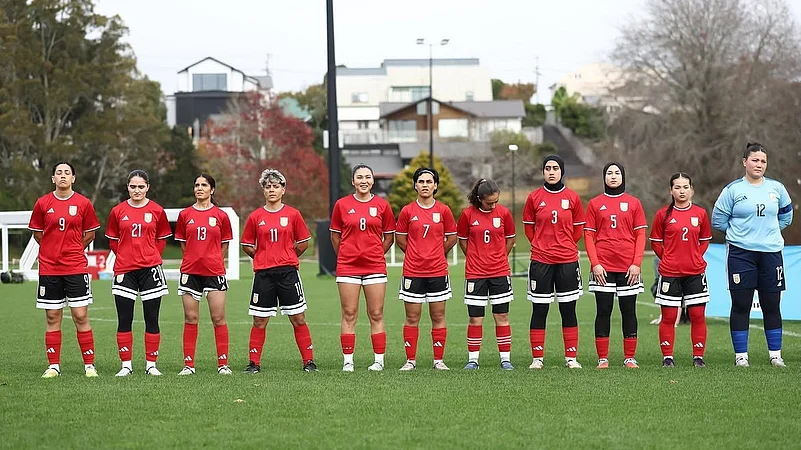
Their recent friendlies against the Cook Islands in New Zealand ended in defeats, 1–0 and 3–0, but the results were secondary. The matches represented something far more powerful, proof that Afghanistan’s women footballers were still standing, still playing, and still fighting for the right to represent their country.
A National Team That Lost Its Country
Afghan Women United is a FIFA-sanctioned women’s football selection representing the Afghan diaspora. The team was formed after the collapse of the original Afghanistan women’s national football team, which had been established in 2007 during the Islamic Republic era.


That national team played its last official international match in December 2018, a 5–0 defeat to Tajikistan at the CAFA Women’s Championship.
When the Taliban returned to power in 2021, women’s sport was effectively abolished. Players who had once worn Afghanistan’s colours suddenly became targets. Many were evacuated from Kabul and resettled abroad, fearing persecution because they were publicly known as female athletes.
For years, those players lived in limbo. They could continue playing club football in their adopted countries, but they could not represent Afghanistan internationally because the Afghanistan Football Federation (AFF), now operating under Taliban control, refused to recognise a women’s national team.
The Campaign That Changed Football History
The road back began with years of lobbying led by former Afghanistan captain and women’s rights activist Khalida Popal, alongside exiled players and human rights organisations.
A first breakthrough came in 2025, when FIFA approved the creation of a women’s refugee programme and appointed Pauline Hamill as head coach. Identification camps were held in England and Australia, and the squad later competed in the FIFA Unites: Women’s Series tournament in Morocco, facing Chad, Tunisia, and Libya.
The historic moment arrived on 29 April 2026.
The FIFA Council approved a landmark amendment to the FIFA Governance Regulations, allowing Afghan female players, including members of the FIFA-funded Afghan Women United squad, to represent Afghanistan in official international competitions without requiring approval from the Taliban-controlled federation.
FIFA said the amendment was designed to ensure that players are not excluded from international football because of circumstances beyond their control, in line with the organisation’s principles of universality, inclusion, and non-discrimination.
For the first time since their exile, these women had a recognised pathway back to international football.
A Dressing Room Filled With Tears And Hope
The significance of that decision became clear during the team’s training camp in New Zealand.
According to the BBC, the dressing room before the opening match was filled with emotion. An Afghan flag hung on the wall, a patriotic song played through the room, and several players struggled to hold back tears as they sang together.
Midfielder Fatima Haidari told her teammates, “Be strong as always because we are representing Afghan women,” according to the BBC.
For a squad scattered across continents and separated for years by visa problems, refugee processes, and financial difficulties, simply gathering together felt like a victory.
The Footballer Who Buried Her Medals
Among the most moving stories in the squad is that of Manozh Noori.
Now living in Australia, Noori grew up playing football with boys on the streets of Kabul. After watching women’s football on television, she secretly joined local clubs and often wore a face covering during matches so relatives would not recognise her.
Her talent eventually made anonymity impossible.
According to the BBC, Noori recalled the fear she felt when teammates persuaded her to remove the face covering for a television interview after a match. She worried that her older brother would discover that she had been playing football instead of attending classes.
As quoted by the BBC, she remembered thinking: “He’s going to see me. He’s going to know.”
She told the BBC that when her brother found out, he was furious and threatened to cut ties with the family, while her mother worried about how they would survive financially.
Noori stopped playing for a period, but eventually returned to football with support from another brother living in Germany.
When the Taliban took power in 2021, she fled Afghanistan. Before leaving, she buried her football medals and trophies in the garden of her family home.
More than four years later, they remain there.
According to the BBC, she said with a brief smile: “One day I will go back and dig them out.”
Football Became Their Route To Survival
For many members of Afghan Women United, football was far more than a game.
Midfielder Mursal Sadat, now based in Australia, told the BBC that without football she might still be trapped in Afghanistan, unable to study or choose her own future. Today she works as a football coach, youth facilitator, and advocate for refugees and women’s rights.
Defender Najma Arefi, who now lives in Doncaster, England, remembered training in temperatures above 45°C because girls were often given the least desirable training slots.
Her perseverance eventually helped a Herat-based team win a national championship. According to the BBC, Arefi recalled that the victory changed attitudes towards women’s football in the city, with billboards featuring the women’s team appearing across Herat and more families allowing their daughters to play.
Today she studies criminal justice, plays football in England, and makes decisions independently, freedoms she once considered unimaginable.
Why FIFA’s Decision Matters Beyond One Team
The April 2026 amendment has significance far beyond Afghanistan.
It created a mechanism allowing FIFA, in consultation with the relevant confederation, to establish or approve a representative team when a member association is unable or unwilling to do so. FIFA has also committed human, technical, and financial support to help build a safe and sustainable structure for Afghan Women United.
The ruling came too late for the team to enter qualification for the 2027 FIFA Women’s World Cup in Brazil, but it could allow participation in qualification for the 2028 Olympic Games in Los Angeles.
In effect, FIFA acknowledged that these players should not lose their international careers because of political circumstances they cannot control.
More Than Wins And Losses
The two matches against the Cook Islands were competitive but unforgiving.
The first was decided by a single goal from Teupoko Tuariki, giving the Cook Islands a 1–0 victory. Afghanistan Women United pushed hard for an equaliser but could not find one.
Three days later, the Cook Islands won again, this time 3–0, completing a convincing series sweep.
From a purely sporting perspective, the results highlighted the challenges facing a team that has had limited opportunities to train together consistently. But reducing the occasion to defeats would miss the deeper truth.
These women have endured exile, separation from their families, political persecution, and years of uncertainty about whether they would ever wear Afghanistan’s colours again.
The fact that they were able to walk onto the pitch together, carrying their flag and hearing songs from home, was itself extraordinary.
The Team That Refused To Disappear
The current Afghan Women United squad includes players connected to clubs such as South Melbourne, Doncaster Rovers Belles, Estoril Praia, São Romão, Brunswick Juventus, Southern United, and Kiveton Park.
They are spread across different countries, cultures, and time zones, yet they remain united by a shared belief that Afghan women belong in football.
Afghan Women United is no longer just a refugee team. It has become a symbol of resistance, resilience, and the refusal of Afghan women athletes to be erased from public life.
Long after the Auckland scorelines are forgotten, one image is likely to endure: a group of exiled Afghan women standing shoulder to shoulder beneath their flag, singing together before kickoff, determined to prove that even in exile, they are still Afghanistan’s team.