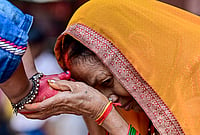
Nirmala Sitharaman’s Budget sarees function as visual political language, using handloom traditions to project seriousness, continuity and cultural rootedness rather than personal fashion.
Drawing on Shefalee Vasudev’s Stories We Wear, the piece argues that clothing in Indian politics is a deliberate semiotic tool, especially for women leaders, signalling authority, belonging and ideological positioning.
From Mamata Banerjee’s performative simplicity to Narendra Modi’s calibrated nationalism and Rahul Gandhi’s anti-power dressing, political wardrobes in India shape how power is read, often before it is spoken.
Nirmala Sitharaman is not too happy about this – but when she walks into the Lok Sabha with the Union Budget in hand, cameras and commentators don’t just focus on her fiscal analysis - they watch what she’s wearing. For her ninth consecutive Budget in 2026, the finance minister again chose a hand-woven Kancheevaram silk saree, a purple-magenta with mustard checks and a coffee-brown border — symbolic of South India’s centuries-old weaving tradition. This sartorial selection had a quiet power, as did Sitharaman’s Budget sarees over the years - from Odisha’s Bomkai and Telangana’s Pochampally ikat to Madhubani handpainted silks, perhaps suggesting that her wardrobe functions less like a personal fashion statement and more like visual policy framing. In a sense, her saree does not distract from the Budget; it fills the silence left by it.
In her new book, Stories We Wear, Shefalee Vasudev — a journalist and cultural commentator — shows how clothing in India operates not just as style but as political language and identity work. She argues that politicians are acutely aware of the semiotics of attire - every kurta, saree, dhoti or angavastram is “deliberate, chosen to reinforce ideology or evoke religious and cultural symbolism,” and calibrated to resonate with specific audiences rather than mere personal taste.
Fashion in Indian politics often signifies belonging, tradition and authority before a single word is spoken. Vasudev’s lens helps decode clothing as a narrative – and why a seemingly modest handloom saree presented by a finance minister can carry outsized meaning. This is especially true for women politicians who continue to prefer the saree not out of casual habit, but because it has been culturally validated as the garment of power in India’s public imagination.


Although most politicians publicly deny that fashion matters, yet their visual choices are purposeful. Avoiding public discussion of sartorial intent is often a calculated move to maintain a narrative of gravitas or connection.

Sitharaman’s saree choices play into a long tradition, tracing an evolving intersection of culture, craft and electoral politics. Indian leaders have for decades curated their appearance to construct and communicate a political self. Vasudev points out that Indira Gandhi’s clothing rejected glamour at a time when women in power were still being judged for appearance. The saree became a protective uniform, insulating her from critique while reinforcing legitimacy. In many ways, this template—saree as seriousness—still shapes how women in Indian politics dress today, including Sitharaman whose Budget sarees reflect a broader Indian fashion-politics continuum — one where what leaders wear is part of how they are read by citizens, media and history.
On the other hand, Mamata Banerjee’s cotton sarees, rubber chappals and minimal adornment are a masterclass in what Vasudev describes as “performative consistency.” This constancy transforms clothing into moral capital—a visible claim that power has not altered her core identity. As Vasudev suggests, in Indian politics, sameness can be more powerful than novelty. Her appearance, which has remained unchanged even after assuming power signals frugality, resistance to elite polish, and solidarity with the street-level electorate of Bengal.
Perhaps the most extensively analysed political wardrobe in contemporary India is Narendra Modi’s. Early in his national rise, Modi’s kurta-pyjama, sleeveless jackets and muted palette positioned him as a disciplined, no-nonsense administrator. Over time, this evolved into bespoke silhouettes, monogrammed jackets and sharper tailoring, mirroring India’s shift toward aspirational nationalism.

Vasudev frames Modi’s sartorial evolution as deeply strategic: an attempt to reconcile cultural rootedness with global ambition. The clothes are Indian in form but global in finish. This is tradition repackaged as power.
Sonia Gandhi’s wardrobe—handloom sarees, muted tones, minimal jewellery—operates differently. Vasudev notes that Gandhi’s clothing performs a soft assimilation - neither drawing attention to her foreign origins nor overcompensating with nationalist symbolism. Instead, her dressing emphasises restraint and continuity, and is more about stewardship rather than dominance. In contrast to Modi’s assertive visual nationalism, Gandhi’s sartorial politics lean toward invisibility as authority.
Even Rahul Gandhi’s sartorial choices, long been read as indecision or lack of polish, are more deliberate anti-power dressing through Vasudev’s lens. The crumpled kurta, white tees, unstyled beard, well-worn sneakers and the refusal to settle into a fixed “leader look” signal a resistance to traditional markers of authority.
Smriti Irani offers a striking counterpoint. Early in her political career, Irani’s wardrobe—bright silks, heavy jewellery, bold bindis—leaned into visibility and assertion, particularly as a woman navigating male-dominated political spaces. Over time, especially during her tenure as a cabinet minister, her style evolved into more restrained sarees and functional silhouettes.
As Irani moved closer to the centre of power, her clothing aligned more closely with bureaucratic seriousness. The transformation underscores a larger truth Vasudev highlights: in Indian politics, women often have to shed excess visibility in order to be taken seriously.
Placed alongside Narendra Modi’s calibrated nationalism and Nirmala Sitharaman’s handloom diplomacy, Rahul Gandhi and Smriti Irani show the breadth of sartorial strategy in Indian politics. Clothing here is not about taste but about positioning—whether one seeks to appear disruptive, approachable, authoritative or embedded within institutions.
We are reminded that Indian political fashion does not chase novelty, rather relies on repetition, restraint and symbolism. Whether through Gandhi’s refusal to dress like power or Irani’s careful negotiation of it, what leaders wear continues to shape how power is read—often before it is heard.

Vasudev notes that in India, power often demands visual certainty. Rahul Gandhi’s rejection of that certainty—especially during the Bharat Jodo Yatra—reframed him as accessible, vulnerable and human, rather than commanding. The clothing mirrored the political message: proximity over dominance, journey over destination.
Seen against this lineage, Nirmala Sitharaman’s Budget sarees begin to read less like personal style and more like institutional costume, aligning her with a long tradition of leaders who use dress to project seriousness over spectacle and continuity over disruption
What distinguishes Sitharaman is that her sarees often circulate after the Budget speech—discussed, decoded and archived—becoming part of the Budget’s cultural memory. Much like Indira Gandhi’s cottons or Mamata Banerjee’s starch-crisp handlooms—they work precisely because they sit at that uneasy intersection. They do not distract from power; they naturalise it.