The ruling party described the Vande Mataram debate as a long-overdue historical correction, arguing that revisiting the song’s past strengthens national unity
Congress and other Opposition parties said the discussion was a deliberate distraction from pressing issues such as unemployment, inflation and social tensions
Regional parties warned against flattening complex histories or turning cultural symbols into loyalty tests, highlighting a deeper disagreement over Parliament’s priorities
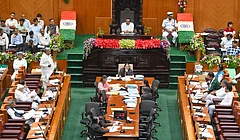
The Lok Sabha and Rajya Sabha debates marking 150 years of Vande Mataram were intended, at least officially, as an act of national remembrance. Yet the discussion quickly widened into a sharp political confrontation over history, identity and, crucially, and Parliamentary priorities.
While the song’s role in India’s freedom struggle was acknowledged across party lines, the House remained deeply divided over whether such a debate was necessary when economic distress, social tensions and governance challenges should take priority.
BJP: Correcting History, Not Revisiting It
The ruling Bharatiya Janata Party positioned the debate as an overdue historical clarification. Speaking in both Houses, Prime Minister Narendra Modi and Home Minister Amit Shah argued that the Congress decision in the 1930s to restrict public singing of Vande Mataram to its first two stanzas weakened its integrative power. According to the BJP, this accommodation emboldened separatist tendencies and indirectly aided the Muslim League’s campaign for Pakistan.


Union Minister Kiren Rijiju rejected Opposition claims that the discussion was politically timed, particularly with West Bengal elections on the horizon. He maintained that the anniversary dictated the debate, not electoral considerations, and insisted that revisiting historical milestones was Parliament’s legitimate duty.
Several BJP members, along with allies such as the Telugu Desam Party, emphasised that Vande Mataram transcends caste, religion and gender, portraying the song as a timeless symbol of national unity that should rise above political disagreement.

Congress: Why Debate the Past When the Present Demands Action?
The Congress, leading the Opposition, questioned not the song’s importance but the need for parliamentary time to be devoted to it. In the Lok Sabha, Priyanka Gandhi Vadra argued that citizens were far more concerned about unemployment, inflation and declining living standards than historical disputes. She accused the government of deliberately provoking controversy to divert attention from present-day governance failures.
Deputy leader Gaurav Gogoi pushed back strongly against the BJP’s historical narrative, accusing the Prime Minister of attempting to recast the freedom movement by repeatedly targeting Jawaharlal Nehru and the Congress. Gogoi argued that it was the Congress that first institutionalised Vande Mataram within the national movement and defended it against boycott calls, while it was the Muslim League — not the Congress — that sought to undermine it. He warned that the ruling party’s approach risked reviving colonial-style “divide and rule” politics.
In the Rajya Sabha, Congress president Mallikarjun Kharge echoed this sentiment, urging the House to focus on current legislative responsibilities. Jairam Ramesh, a senior Congress leader, called for intellectual seriousness in any discussion of national symbols, encouraging MPs to engage with scholarly histories rather than political soundbites.
Responding forcefully, the Congress cited The Collected Works of Mahatma Gandhi (Vol. 66, p. 46), the party maintained that the 1937 decision was not divisive but a considered accommodation by the Congress Working Committee. Its members included Mahatma Gandhi, Jawaharlal Nehru, Sardar Patel, Subhas Chandra Bose, Rajendra Prasad, Abul Kalam Azad and Sarojini Naidu. The committee noted that only the first two stanzas were widely sung and nationally recognised, while the remaining verses contained religious imagery to which some citizens objected. The party also stressed that the decision reflected the advice of Rabindranath Tagore, who had himself sung Vande Mataram at the 1896 Congress session.
Samajwadi Party: A Symbol Should Not Become a Test of Loyalty
Samajwadi Party chief Akhilesh Yadav adopted a cautionary tone, reminding Parliament that Vande Mataram had once been banned by the British precisely because of its unifying power. He argued that no single party could claim ownership over national heritage and criticised what he described as attempts to impose ideological conformity through cultural symbols.
Yadav also pointedly remarked that those who played no role in the freedom struggle were now lecturing others on its values. For him, the song’s true strength lay in its emotional resonance and inclusive spirit, not in its use as a political weapon.
DMK: Historical Complexity Cannot Be Erased
The Dravida Munnetra Kazhagam brought historical discomfort to the centre of the debate. MP A. Raja argued that controversies around Vande Mataram were not invented by minorities but were rooted in early 20th-century political realities. He cited historical accounts suggesting that the song was, at times, framed in ways that excluded Muslims, raising legitimate concerns within the freedom movement itself.
Raja posed a series of questions prompted by the Prime Minister’s speech: whether divisions around the song contributed to national partition, whether divisive thinking truly persists today, and what the original vision of Vande Mataram actually was. Quoting historians critical of fusing religious imagery with nationalism, he said Parliament could not ignore these debates while claiming historical honesty.

Trinamool Congress: Eyeing Bengal Elections
The Trinamool Congress accused the BJP of repeatedly misrepresenting Bengal’s cultural history. MPs from the party described the Prime Minister’s speech as insensitive to the intellectual and pluralist traditions of the state.
Mahua Moitra was particularly critical, alleging that the timing of the debate was designed to yield political dividends ahead of the 2026 West Bengal elections. She argued that the ruling party was hollowing out the meaning of Vande Mataram while failing to uphold its values in governance, pointing to environmental degradation, water stress and social polarisation. According to Moitra, invoking national songs while ignoring these realities amounted to political theatre rather than genuine patriotism.
TDP: Emphasising Unity
Amid the acrimony, TDP MP Byreddy Shabari and others aligned with the BJP attempted to strike a conciliatory note, underlining Vande Mataram’s capacity to unite Indians across social divides. They argued that the song should serve as a reminder of shared aspirations rather than as a flashpoint for political conflict.
The debate revealed a Parliament divided not over reverence for Vande Mataram, but over its instrumentalisation. While the BJP framed the discussion as historical accountability, much of the Opposition saw it as a distraction from pressing economic and social challenges. Regional parties, meanwhile, warned against flattening complex histories or using cultural symbols to consolidate political narratives.
In a time of widespread public anxiety, many MPs argued that symbolism, however powerful, cannot substitute for engagement with the problems citizens face today. Whether Vande Mataram ultimately united or divided the House, the debate underscored that Parliament was spending more time debating about history.