With no active violence for most, Kashmir appears calm but women continue to absorb the aftermath through caregiving, court battles, and emotional labour.
Trauma has shifted from public spaces to private lives, manifesting as anxiety, physical illness, and cognitive decline, often untreated.
From daughters managing broken households to ageing women living with unrecognised grief, endurance has become a burden rather than a choice.
The visible markers of conflict have receded, but its afterlives continue to shape everyday existence in Kashmir. Gunfights have thinned and streets appear calmer. But there are families that continue to live through prolonged trials, incarceration, and absences that stretch across years. In this landscape, women are more visible than ever in the present landscape. Taking smart buses, attending colleges, sitting in cafes, standing in court corridors and outside hospital wards.
Between 2019 and 2023, Jammu and Kashmir saw 3,662 arrests under the Unlawful Activities (Prevention) Act (UAPA), with only 23 convictions.
They move through public spaces carrying private burdens. Many of these women appear outwardly functional, even composed. Like they cook, work, pray, and show up. But beneath this surface normalcy, trauma accumulates slowly, that mental health professionals say rarely announces itself, but embeds itself in routines and in the way families are sustained.
A Life Measured In Doses And Dates
Daughter, 26, handles her father’s UAPA case, cares for an intellectually disabled brother, manages her mother and household, while coping with her own panic and anxiety.


The quiet in her house is heavy. It’s rehearsed over years. Calendars marked with court dates and neatly packed folders of medical records hang on the walls. Photographs are tucked carefully inside notebooks. Medicine boxes line shelves. Every object signals a life measured carefully, and lived in anticipation.
At 26, she is the pivot of her household. Four years ago, her father was imprisoned under the Unlawful Activities (Prevention) Act (UAPA). Since then, responsibility has rested squarely on her shoulders: the legal case, her mother’s health, her intellectually disabled brother, and the daily work of keeping the family afloat. Alongside this, she copes with panic attacks and anxiety, what she calls her “quiet, nasty companions”. She has completed her BA, a quiet achievement carried amid constant pressure.
“All we can do is wait and be patient,” her mother says softly from a corner of the room, her eyes distant. “These medicines are keeping us alive. I don’t know why Allah chose my daughter for so much pressure.”
Her brother, now 32, has grown volatile since their father’s arrest. Panic strikes without warning: shouting, sudden movements, and episodes of self-harm. Recently, during one such episode, he ruptured a retina and lost sight in one eye. She manages his antipsychotic medication, her mother’s sleeping pills, and her own antidepressants. Each morning, she counts the doses carefully, afraid of what might happen if even one is missed. “Each pill feels like a fragile thread holding the household together,” she says.
But the house appears calm from outside. The carpeted floor is swept clean. Sunlight filters through huge windows. Dishes in the kitchen are stacked neatly.
Beneath this order, it’s she who oversees every detail: Checking medicines, tracking court dates, coordinating with lawyers, balancing work, and ensuring the family survive, as she is the sole breadwinner.
She remembers the day her father was taken. She was rushed to Jehlum Valley Medical College after collapsing, the fear reflected in the faces of strangers and in the physical symptoms that followed. She was later referred to Shri Maharaja Hari Singh Hospital (SMHS), where she was diagnosed with severe anxiety and depression, a condition that continues.
Her mother’s worry has deepened her own distress, while her brother’s unpredictable behaviour keeps her constantly on edge. “I have learned to read him like a code. I step in before a crisis escalates.” At night, she sits upright in the dark, counting her breaths, rehearsing appointments, and whispering reminders to herself.
“I feel guilty even thinking of rest,” she says, rubbing her palms together, her gaze fixed on the floor. “There’s no pause when the family depends on you.”
Mental health professionals who have long observed this pattern in Kashmir note that women often carry unresolved grief for years, while daily life continues to demand that they function as if “nothing has happened”.
Clinical psychologist from Social Welfare And Awareness Bureau (Sawab) Aiman Rafiq who works with women across the Valley, describes how trauma often moves inward. “Trauma settles into bodies and routines and women often become emotional anchors in their families, but the cost surfaces as panic and physical collapse.”
“The labour is exhausting. There’s very little room left for my own grief. Even with therapy, the trauma doesn’t loosen its grip. Depression doesn’t pause for court proceedings.”
Sometimes, she admits, her voice flattening, she feels herself fading into the work of survival: “Every day is a calculation. Sometimes it feels like I’m disappearing into the tasks.
The Weight Of Waiting: A Visit She Could Afford Only Once
Crushing travel costs and prolonged separation have pushed her distress inward, where it surfaces as illness rather than words
The day her son was taken is fixed in her memory. It was the week his Class X examination result was announced. Four years have passed since then. In all that time, she has seen him only once. I was a five-minute, tightly monitored visit in a jail in Haryana.
The meeting was not limited by permission alone. It was limited by money. Her husband runs a small tea stall. The visit outside the Valley cost nearly ₹40,000. The family borrowed from relatives. There is no question of repeating it.
“We cannot go again,” she says, voice low, hands twisting the edge of her shawl. “How will we manage?”
The meeting took place through glass, and they spoke over a phone. “I didn’t even hug him.” Her fingers hover over the table as if reaching for him. “I kept looking at his face. I was thinking who is there with him when I am not?”
She refuses to describe herself as anxious, even as she speaks of distress through “migraines that strike like knives behind my eyes” and sleep broken into fragments. She wakes with tight shoulders. At night, the thoughts return without pause: Is he safe? Has he eaten? Does he know we are waiting?
She rises for namaz and organises the day’s documents. Her hours are spent coordinating with lawyers, tracking hearings, and calculating travel costs she cannot afford. Each hearing brings relief and collapse in equal measure; sometimes, hope feels too costly.
She has seen cardiologists, general physicians, and other specialists, but never a psychologist. Dozens of expensive tests have been conducted and reports reviewed. Describing her visits, she says, fingers drumming on the table, “They check my heart, my blood, my sugar. There is nothing wrong with my mind. My chest feels tight; it’s just tension.”
In her area, distress has no acceptable vocabulary, because of the stigma. That’s why the idea of seeing a mental health expert was out of question. So she speaks instead of headaches, back pain, and lowers her gaze, adjusts the folds of her shawl, moves carefully through public spaces. But faith offers moments of structure, when she prays at home, visits shrines when she can, ties threads for her son’s safety. “It seems that even medicines aren’t working on me anymore. All we can do is pray.”
For families like hers, waiting becomes a permanent mental state, and carried alone. Husband has become her shadow, guiding her through offices and hospitals. “We travelled together beyond the Valley for that one prison visit, her first time going so far from home. I feel helpless because I can’t afford to take her again,” he says.

Alone With The Weight
Chronic illness, an undertrial son, and years of invisible anxiety. Widow navigating survival while refusing to call her suffering as mental illness.
This widow moves quickly through the city, always alone. Her pace is brisk, her head lowered, as if speed itself might keep her thoughts from catching up. Smart City buses, free for women, have become part of her routine. When schedules clash with court appointments, she takes an e-rickshaw, clutching a plastic folder stuffed with court papers, prescriptions, and her phone.
“I keep walking even though my whole body aches. If I stop, everything comes rushing in.”
Her only son has been in jail, undertrial, for nearly two years. He asks her not to make the journey. Each visit, a few minutes through a glass partition, speaking over a phone, requires preparation and money she has to “beg” for.
The emotional toll of this separation compounds her own illness. The same month her son was arrested, she underwent kidney removal surgery, and it was he was the one who was there to care for her during recovery. “Now, I face my struggles alone.”
“If I had known it would take this long for the case to finish,” she says quietly, “I would have jumped into the Jhelum and ended my story.”
She cannot begin her day and leave home without her medicines for migraines, body aches and palpitations. But she refuses to acknowledge any mental health issues: “I don’t need a psychiatrist or therapy,” she insists. Some days she forgets doses. On others, she takes more than prescribed, desperate for some relief through the palpitations that strike without warning, especially at night. Insomnia stretches into dawn, and headaches linger through the day. On bad mornings, her hands tremble so much she struggles to pour a cup tea.
“They say my heart is fine,” she says. “But my body won’t calm down.” Faith has always offered a refuge. She visits shrines weekly, sometimes more often. Dastgeer Sahib, Hazratbal, and smaller neighborhood sites. Inside the sanctum, the air is heavy with incense, soft murmurs of prayer calm her down for that brief moments. As women sit side by side, she listens as they recite their griefs aloud. Memorising rituals, and repeating them with discipline.
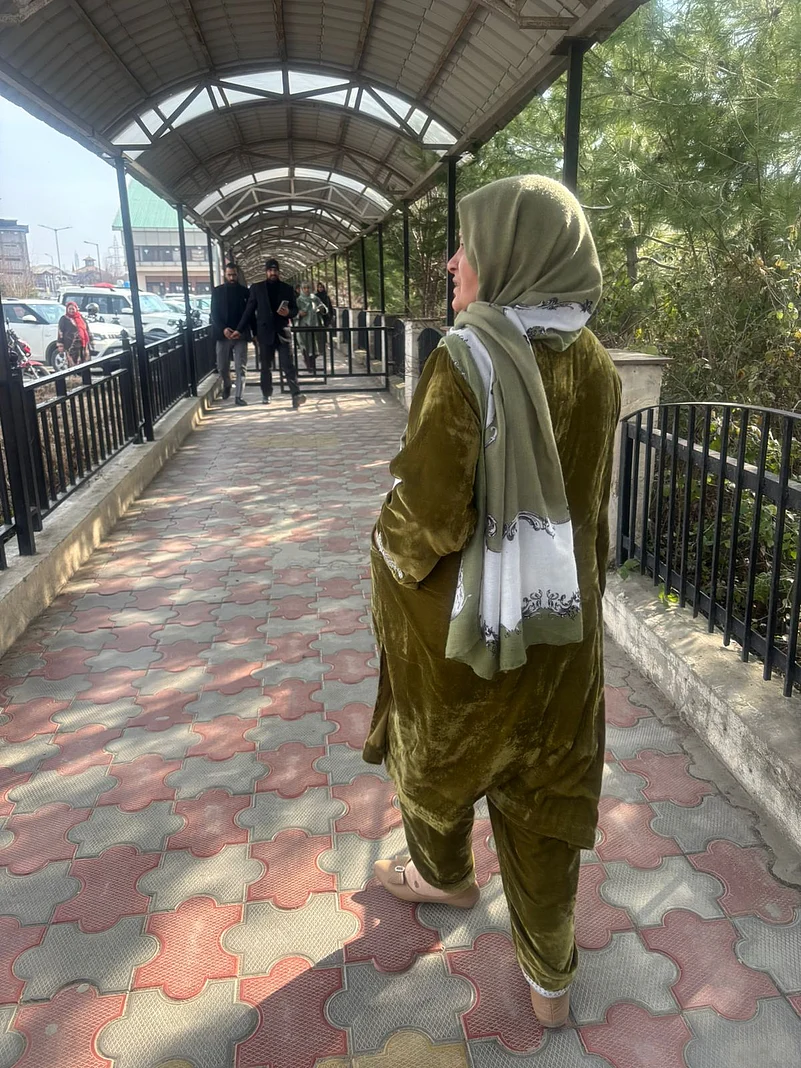
She ties threads for her son’s safety, lights candles, murmuring aayats. Faith, in this life punctuated by court dates, pills, and constant worry, becomes a lifeline. Court visits dominate her existence. She knows which bus reaches the court fastest, which stop is closest to the jail office, and where to stand to avoid crowds. No one accompanies her or helps with paperwork.
People say “this is fate.” And for her, each hearing carries hope and dread in equal measure. Rafiq who observes this pattern frequently, says: “Trauma doesn’t disappear when women are left to manage everything alone. They absorb anxiety into daily labor, household management, and caregiving. For women, survival becomes their only metric.”
Beyond Individual Stories
Beyond the decline in visible violence, these experiences reflect how for women in Kashmir, where many carry everyday responsibilities amid legal uncertainty, prolonged absence, and the invisible weight of trauma.
A total of 2,914 people were arrested under UAPA across India in 2023. Of these, 1,206 arrests around 42 per cent were made in J&K alone. While 227 people were arrested under UAPA in 2019, 346 in 2020, 645 in 2021, 1,238 in 2022. Of the 2,914 people arrested across the country under UAPA in 2023, 41 per cent were from J&K. After the abrogation of Article 370, over 444 people, including politicians, were placed under detention under the Public Safety Act, as per the Ministry of Home Affairs data.
Even when violence is not directly visible, its effects linger, according to experts see trauma settling into homes and routines.
Rafiq explains: “Even when the streets are calm, trauma doesn’t disappear, but moves inward. Women absorb it into their bodies and daily labor. They become the emotional anchors of families, but the cost shows up in other ways and doesn’t resolve on its own.”
“When women finally reach clinics, they rarely come saying they are anxious or depressed. They come with headaches, stomach pain, palpitations, fainting spells. Emotional suffering is unacceptable, so the body carries it. By the time psychiatric care begins, the damage is deep,” says veteran psychiatrist Dr Mushtaq Margoob.
(Names have been withheld at the lawyers’ request, for fear public identification could adversely affect ongoing UAPA cases.)