






Afghanistan says it launched strikes after Pakistani air raids allegedly killed civilians in eastern provinces.
Pakistan claims it targeted militant camps, while Kabul alleges dozens of women and children were killed.
The escalation follows recent suicide attacks in Pakistan and could further strain already fragile Islamabad–Kabul relations.
Tensions between Afghanistan and Pakistan have sharply escalated after Afghan military authorities announced retaliatory strikes in response to Pakistani air raids on eastern Afghan provinces. Officials reported “heavy clashes” late Thursday night, marking one of the most serious confrontations between the two neighbours in recent months.
According to a statement issued by a military corps in eastern Afghanistan, the strikes were carried out in response to Pakistani air operations in Nangarhar and Paktia provinces earlier this week. The fighting reportedly erupted along key border areas, although no official casualty figures were immediately available.
The latest flare-up follows cross-border airstrikes conducted by Pakistan’s military on Sunday. Islamabad claimed that at least 70 militants were killed in the operations, describing them as precision strikes targeting militant infrastructure.
However, Kabul strongly rejected those assertions. Afghanistan’s government spokesperson Zabihullah Mujahid said the Pakistani air raids killed dozens of civilians, including women and children. Afghan defence authorities alleged that airstrikes hit residential homes and even a school in eastern provinces, resulting in significant civilian casualties.
Afghan media outlet Tolo News reported that a civilian home in Behsud district of Nangarhar province was struck, with 23 members of a family reportedly buried under rubble. The broadcaster also stated that a religious seminary in Bermal district of Paktika province was targeted, along with multiple sites in Khogyani district.


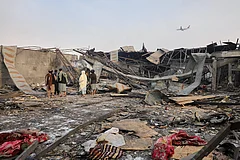
Pakistan confirmed conducting cross-border operations in Bermal and Argun districts of Paktika, as well as in Khogyani, Bahsod and Ghani Khel districts of Nangarhar. Officials in Islamabad maintained that the strikes were aimed at dismantling camps linked to militant groups responsible for recent suicide attacks inside Pakistan.
Pakistan’s ministry of information, cited by Geo News, said the operations targeted seven camps associated with Fitna al Khwarij — a term used by Pakistan for the banned Tehreek-e-Taliban Pakistan (TTP) — as well as affiliates and Daesh Khorasan Province. Authorities described the action as “precise and accurate,” carried out in response to suicide bombings in Islamabad, Bajaur and Bannu during the holy month of Ramadan.
Pakistan’s state minister for interior, Talal Chaudhry, said the country possessed “conclusive evidence” that recent attacks — including a suicide bombing at a Shiite mosque in Islamabad that killed 31 worshippers — were directed by Afghanistan-based militant leadership.
Islamabad has repeatedly urged Afghanistan’s Taliban administration to prevent armed groups from using Afghan territory to launch attacks against Pakistan, citing commitments under the Doha Agreement. Kabul has consistently denied allowing such groups to operate from its soil.
The escalation comes amid a series of deadly incidents in Pakistan’s Khyber Pakhtunkhwa province. A suicide bomber recently rammed an explosives-laden vehicle into a security post in Bajaur district, killing 11 soldiers and a child. Another bombing in Bannu claimed the lives of two soldiers, including a lieutenant colonel. Pakistani authorities later identified one attacker as an Afghan national.
Following those incidents, Pakistan’s military warned it would not “exercise any restraint” and would continue pursuing those responsible “irrespective of their location,” signalling a tougher stance against cross-border threats.















