There is something quite touching in the manner in which the people of Karachi search for humanity in the midst of the violence that so routinely assaults their city. Just over two weeks ago, Karachi held a literature festival. The opening ceremony included a dance-drama called Tagore. Gurudev’s poem Where the Mind is Without Fear was recited to a dance. Included in the drama was a rendition of Mahatma Gandhi’s favourite bhajan, ‘Raghupati Raghav Rajaram, patita paavana Sitaram, Ishwar Allah tero naam...’.
It is pervading hopelessness, more than the banalities of the market, that often brings out the best in the human spirit and its talent for survival. In Karachi, people try to survive at a level that separates their sanity from their circumstances. Even as doctrines of hate jolt the nation, ordinary people seek empathy and compassion. There are individuals in this port city, as across all of South Asia, who still believe in invoking the great humanitarian thinkers of India. “We remember the ideas of your wonderful thinkers and leaders. But does India remember them?” they ask. Most Indians would smile and say this is what India should always be about; and for many of us, this is what India will always be. As Karachi burns and the death toll mounts, its people recite Urdu poetry with easy recall and discuss ideas of the past even as they lament the present.
For the present is always invading. By the time the literature festival ended on February 18, Karachi was under siege due to the protests and the unrest that followed the Quetta massacre of Hazara Shias (death toll—89). The road to the airport was blocked and some international visitors had to leave with security escort. Writers at the venue spoke of “our collective misery”.
I stayed on and discovered a people braving dangers to sit on all-night protests, and marching with placards that say “We are all Shias”. A prudent, fearful note was overheard from a lady who told some youngsters, “Remove those placards. Do you want to be mistaken for a Shia and end up dead?” All around, there’s the fear of the unknown suicide bombers of Pakistan, trained in a lethal interpretation of a religion, driven by demons few can comprehend (and possibly in quest of a paradise of heavenly virgins and angels).
It is a little sobering to return to India and fully comprehend that so much death and destruction in our neighbouring country is now so routine that it is just a little footnote in our newspapers. If we even register the latest death toll, many of us would just shrug our shoulders and say, “Crazy place, crazy things happen.” Some of us, bred on hostility, would nurse a sense of superiority.
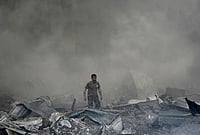
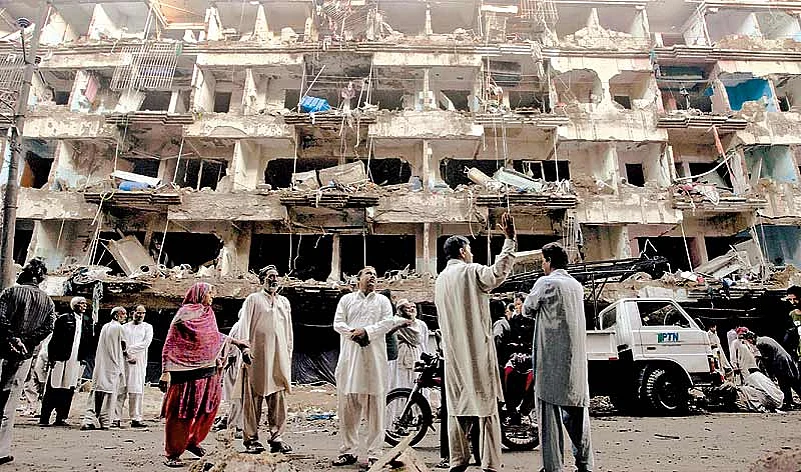
This week there was another massacre in Karachi, targeting the Shia community. On March 3, a powerful blast ripped through the Abbas Town neighbourhood, dominated by Shias. It was a loud blast, and 50 people, many women and children among them, were dead in a flash. The area now looks like a war zone. A resident writes on e-mail: “It’s as if we are getting bombed from outer space again and again. And in our hearts we know the worst is yet to come.”
Crazy place, bloody things happen.
While in Karachi, a pipe bomb exploded in one part just as the protesters left; in another, police opened fire on some residents who were getting violent in a Pathan neighbourhood. Such incidents barely made the news in local papers the next day. A young girl uses a “haalat-o-meter”, or situation meter, on the internet, which gives reports about the violence, peace, protests, shut streets and bomb blasts, about where people should go, where they should not. She says normal life continues in parts of the city but they have to watch the routes they take, the places they go.


No end to it? A protest in Quetta after the Feb 18 blast that killed 89 Shias. (Photograph by AFP, From Outlook 18 March 2013)
Journalists at a TV station say that, unlike their counterparts in India, they cannot just march into a crowd with their microphones, collecting sound bites. “We have to watch and gauge the situation and look out for violence coming from different groups with different agendas,” says a hardened city reporter. They had packed up from a site where, half an hour later, a bomb exploded.
Is this round of bloodletting among the worst that Karachi has seen? Irfan Husain, senior columnist and author of the seminal Fatal Faultlines: Pakistan, Islam and the West, informed me that the biggest single terrorist attack occurred when Benazir Bhutto returned to Karachi in October 2007—she was attacked by a suicide bomber when she was being escorted into the city by a huge welcoming crowd, and narrowly escaped while well over a hundred people were killed. He adds: “While Shias have been targeted for the last 20 years, the recent spate of mass killings (two in Quetta and now this recent one in Karachi) seems to indicate that certain forces might wish to delay elections by creating chaos.” Of course, groups like the Lashkar-e-Jhangvi, an anti-Shia gang, have been given free rein by the state: witness only how Mohammed Ishaq, one of the top leaders of the group, was released in 2011 by the Supreme Court for “lack of evidence” despite being accused of involvement in all of 34 murders.
Those who try to unravel the strands that have led to these great distortions and perversions in Pakistani life find themselves facing a complex labyrinth. Laurent Gayer is a political scientist who has been working on the city since the late 1990s, and his book Karachi: Ordered, Disordered and the Struggle for the City will be published in London this summer. Although local residents don’t venture into some parts, Laurent has become something of an insider in the city’s rough neighbourhoods. He traces the violence to the 1970s and says that for three decades Karachi has been subjected to various forms of collective violence, with the mqm being the central protagonist since the 1980s. As for the current anti-Shia currents, he says that “they emerged right after Partition. For long they remained marginal, but their patronage by the army in the context of the Afghan jehad only reinforced them.”
The current blasts and bombings are taking place as anti-Shia groups now fight turf battles and get enmeshed in sectarian divisions that are now a part of Karachi. Many business families keep a low profile for fear of ending up on the hit list of some group or the other. But, as a businessman explains, the Shia killings are part of a larger picture and not an “ends to a means in itself”. He says that various conspiracy theories are now doing the rounds. “In this great game being played out in the Pakistan theatre, targeting Shias currently serves the extremists very well.”
Arif Hasan is an iconic figure in Pakistan, an architect, planner, teacher, social researcher and writer and the recipient of the Hilal-i-Imtiaz, the country’s highest citizen award. Since the 1980s, he has been associated with the landmark Orangi Pilot Project in the squatter areas of Karachi, a model for the innovative methods to solve the problems of sanitation and safe housing for the urban poor in the developing world. On a short tour of the city, he points out Karachi’s Baloch origins, the Pathan area, the Mohajir lane and then takes us on a walk through a local spice market. He is described as an “urban philosopher”. He believes that underwriting all the so-called sectarian, religious and ethnic wars is simple greed and the tussle for land in Karachi. In the past year alone, 18 property brokers have been killed in Karachi, he says.
From the worm’s eye view of the city, if we zoom out to take a bird’s eye view of Pakistan and Afghanistan, isn’t it the same story magnified on a larger scale? Is it not the greed and strategies of great powers and nations determined to control territory, gateways, potential pipelines and routes that has devastated the region? Combine that with the Molotov cocktail of Wahabi Islam, promoted by the Land of the Pure in collaboration with western powers since the time of Zia-ul-Haq, and we may begin to understand the terrible violence that now taints Pakistan.
In India, we still look at Pakistan through the prism of Mohammed Ali Jinnah and the two-nation theory and have narratives about “us” against “them”. Pakistan is operating at another level and theatre of warfare, where its own children are blowing out its insides, where the Shia is now the infidel to be killed. These days, media experts tell me that “Hindu” India is rarely in the frame of reference. Jinnah is passe, and besides, he was a Shia! The hanging of Afzal Guru was news, but not of grave importance. The Lashkar-e-Toiba (LeT) is not a concern. It is described by an expert as an “ISI-backed operation created to trouble India now and then, but currently a sleeper cell”. It is the Lashkar-e-Jhangvi (LeJ) that is feared.
The violence, people say, is motivated and there is a ready supply of dangerous warriors. The worst is yet to come—that’s the message heard again and again. People keep asking, “Who benefits from the real and proxy wars that have been inflicted on us?”
By Saba Naqvi in Karachi