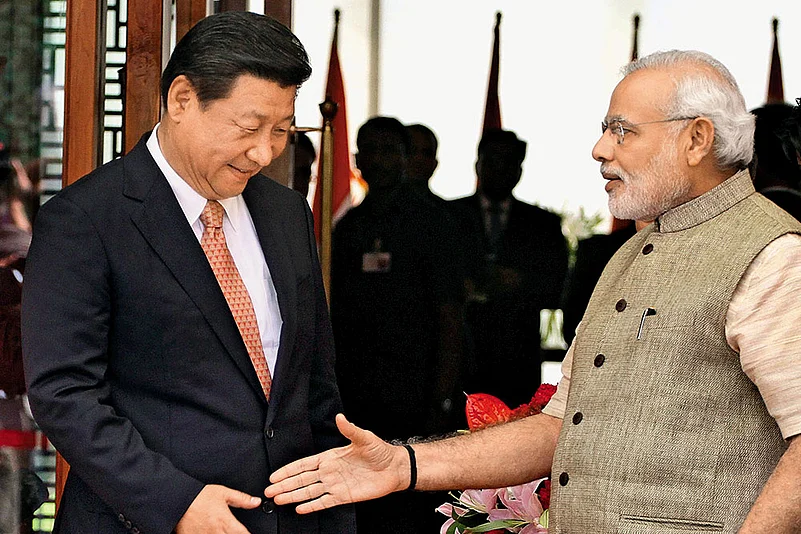
As Robert Burns wrote, ‘the best laid plans of mice and men often go awry’. It’s a line that perfectly describes the situation India finds itself in. Where, in trying to send a message, they wound up shooting the messenger. The GOI had attempted to adopt an aggressive posture on China by inviting a significant number of Chinese dissidents to a conference in Dharamsala this week, sanctioned by the presence of a grey eminence, the Dalai Lama. The tough line was in response to Beijing having blocked India’s attempts to impose UN sanctions on Pakistan-based Jaish-e-Mohammed chief Masood Azhar. But the strategy seems to have backfired, with Delhi having to hastily withdraw visas issued to three prominent Uighur dissidents, one of whom was about to board an Air India flight from New York.
“If it was meant to deliver a signal to Beijing, then it seems like a very confusing and conflicting one,” acknowledges a government official.
The conference in Dharamsala, which began on April 28 and is scheduled to go on till May 2, was not the run of the mill ‘inter-faith’ engagement, though that is how some in the government had tried to describe it. Its unusual nature is revealed in the large congregation of Chinese dissidents—Tibetan, Uighurs, Mongolians, Christians, Falun Gong practitioners, Muslims, Buddhists and delegates from the US, Taiwan, Hong Kong and Macau. Titled ‘Strengthening Our Alliance to Advance the People’s Dream: Freedom, Justice, Equality and Peace’, the conference was organised by US-based outfit Citizen Power for China, led by US-based Yang Jianli, a well-known Chinese activist and veteran of the Tiananmen Square protests. The Tibetan Centre for Human Rights and Democracy, and Students for a Free Tibet India were also among the organisers. Significantly, the conference is a closed-door affair; even the media is not welcome.

Whether there was any real pressure from the Chinese behind the revocation isn’t known, but an assembly of Chinese dissidents in India must have disconcerted Beijing, worried as it has been with New Delhi’s growing closeness with the US. Some in China even fear that the India-US rapport could even lead to a military alliance, something that can work to encircle China and hem in its inexorable rise.
However, if India’s intention was to keep China guessing, then the plan to encourage Chinese dissidents in Dharamsala was perhaps a move not properly thought through. When it had decided to grant a visa to the World Uighur Congress leader Dolkun Isa to attend the conference, it was solely focused on sending a signal to Beijing: if you are not bothered about our concerns, then we could return the compliment. But in the haste it was forgotten that Isa had an Interpol red-corner notice against him. Though many Western countries contest Beijing’s description of him as a terrorist and have ignored the Interpol notice—like Germany, which has granted him asylum, and allowed him to reside in Munich—for India it became tricky. If Isa arrived in India and Beijing demanded that he be handed over to the Interpol, the Indian leadership would have faced a bigger problem. A decision not to honour China’s request would have diluted India’s future stand on terrorism. But if it obliged the Chinese and handed over the Uighur leader to Interpol, it would have created a bigger controversy for the NDA and subjected it to severe criticism from its political detractors. The best way out was to revoke the visa.
“There was obviously a bit of tit-for-tat involved—if you don’t recognise our terrorist, then we don’t recognise yours,” says Alka Acharya, head of the Institute of Chinese Studies at JNU. “But surely the two cases were not equatable and someone in the government must have realised it and developed cold feet.”
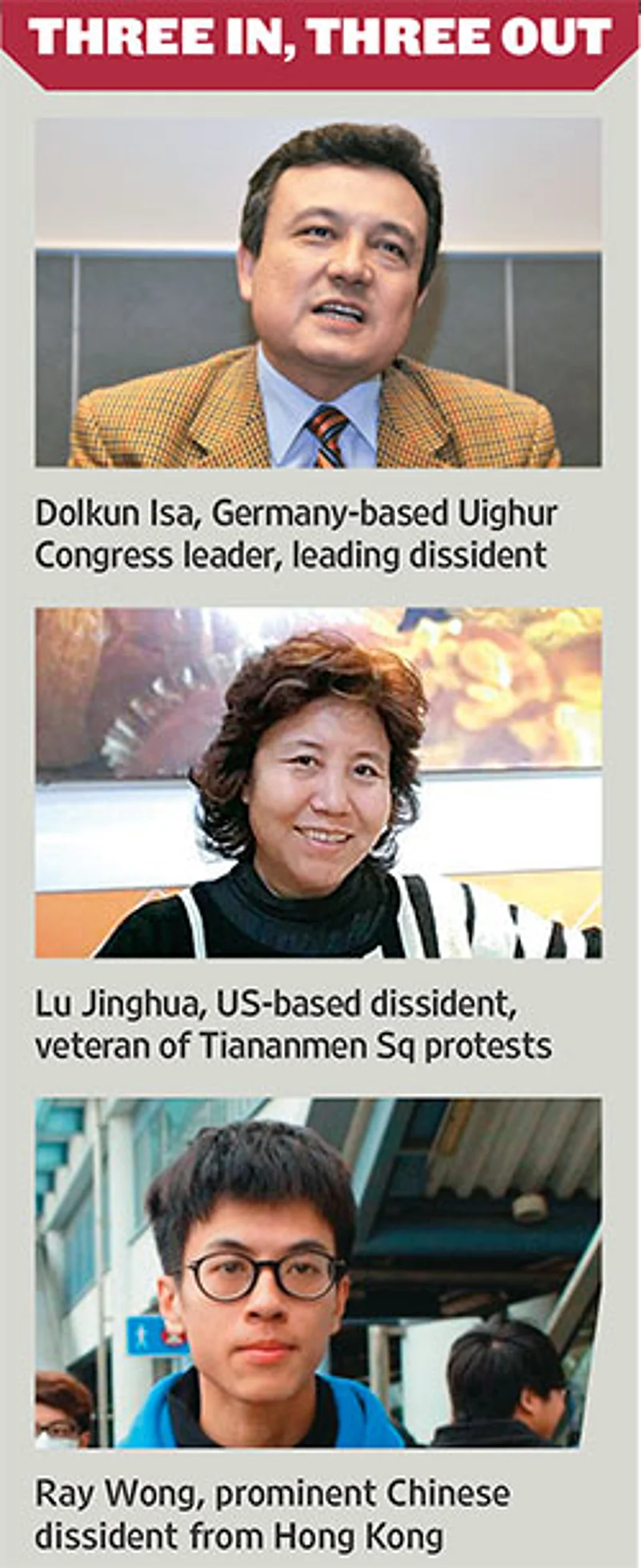

India, however, did not stop at that. It decided to cancel the visas of two other prominent Chinese dissidents—Lu Jinghua and Ray Wong—as well. Lu, a US-based Chinese veteran of the Tiananmen protests, was informed about the visa cancellation hours before she was to board her flight from New York to New Delhi. Wong, another prominent dissident from Hong Kong, also had his visa revoked.
On both cases, India decided to fall back on ‘technicalities’. Government sources explained away the visa cancellation saying the documentation of both Lu and Wong were not in order. However, they insisted that “the question of revocation does not arise” in either of the two cases.
Former Indian foreign secretary Kanwal Sibal, however, thinks that there is some merit in the logic behind New Delhi’s move to encourage Chinese dissidents to attend the conference, despite criticism about the cancellation of a few visas. “By not calling off the conference the signal that goes out from India is clear: if the Chinese attitude towards India, especially on issues relating to its security, does not change, then Delhi can also up the ante in future.”
If what Sibal says is likely to be the Indian strategy, will it work?
Others point to the problem that this strategy may have in future, while it goads China into being more sensitive about India’s security concerns as well as its own international image. Again, India may find itself at the receiving end if China started encouraging and hosting Indian dissidents. With its ties with Pakistan perpetually mired in difficulties, is India planning to open another front with China?
Some feel the US might have enccouraged letting Chinese dissidents attend the conference. Interestingly, much of the planning for the conference coincided with US under-secretary Sarah Sewall’s January visit to India, during which she also visited Dharamsala and met the Dalai Lama.
The fact that in April US defense secretary Ash Carter visited India and along with his Indian counterpart, Manohar Parrikar, agreed ‘in principle’ to have a logistics support agreement—a pact that can even allow American troops the use of Indian bases—was not lost on many in India and, more particularly, in China. India, however, followed this up with a series of high-level visits to Beijing to engage the Chinese, including one by Parrikar, then another by NSA Ajit Doval. It clearly showed that though New Delhi may be trying to expand its strategic space, it was not yet willing to do so at the cost of antagonising China.
President Pranab Mukherjee’s forthcoming visit to China in May, to be followed in a few months by PM Modi’s visit, will be reciprocated when Chinese President Xi Jinping arrives in Goa for the BRICS summit. It shows steps being taken by the two sides towards high-level engagement.
The proposed assembly of the Chinese dissidents in Dharamsala may be regarded by Beijing as a one-off event and even make it more sensitive to some of India’s concerns. But a regular hosting of dissidents, especially on the perceived advice of sections in the US establishment, could drastically reduce India’s strategic space and leave it with fewer friends. Hopefully, the Indian leadership will realise that in a globalised world diplomacy is not the pursuance of a single issue, but a many-splendoured thing that abets each other.