Trump is attending the NATO summit in Ankara, Turkey, where he will hold bilateral meetings with Ukrainian President Volodymyr Zelenskyy and Syrian President Ahmad al-Sharaa.
The Zelenskyy talks carry five years of war, thousands of deaths, and stalled US mediation into a single session.
The al-Sharaa meeting carries a different but equally charged agenda: Trump has publicly floated the idea of Syria fighting Hezbollah in Lebanon, a role al-Sharaa has flatly refused.
On the eve of one of the most consequential NATO gatherings in years, Donald Trump held two phone calls on the Fourth of July — with Volodymyr Zelenskyy and Vladimir Putin separately — and then announced he would meet both Zelenskyy and Syrian President Ahmad al-Sharaa in person three days later, on the sidelines of the NATO summit in Ankara.
Trump told Putin the US would keep pushing for a ceasefire, told Zelenskyy there was a real prospect of peace, and scheduled the in-person meetings for July 8 to turn diplomacy from calls into something on the record.
The summit itself runs July 7–8. Trump arrives in Ankara on Tuesday, July 7, where his first bilateral meeting will be with Turkish President Recep Tayyip Erdogan. On Wednesday, he meets Zelenskyy at 2:30 PM local time for a scheduled hour, then al-Sharaa, then holds a press conference before flying back to Washington. What happens in those rooms will shape US foreign policy on two active flashpoints: the war in Ukraine and the post-Assad political order in Syria.


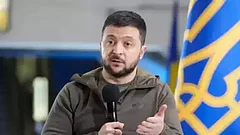

Why Is Donald Trump Holding These High-Level Meetings?
The Ankara summit is the annual gathering of NATO's 32 member states, and Trump is attending it at a moment when the alliance is simultaneously under pressure from within and from the war on its eastern flank. Trump was the driving factor behind a broad target reached at The Hague last year for NATO countries to spend 5% of their GDP on defence over the next decade and this summit is his opportunity to demand follow-through.
The Trump administration has framed its strategic approach as 'NATO 3.0', a vision in which Europe takes on more of its own security burden. That framework shapes everything Trump does at the summit, including the bilateral meetings. With Zelenskyy, it means pushing Ukraine toward a negotiated end to the war rather than continuing to fund an open-ended conflict. With al-Sharaa, it reflects a broader desire to use new Middle Eastern actors to manage regional problems, particularly Hezbollah.
What Are The Key Issues In Trump's Talks With Volodymyr Zelenskyy?
The Russia-Ukraine war entered its fifth year in February 2026 with no ceasefire in sight. Russian advances on the front line have stalled, according to analysts, and Ukraine has escalated its own strikes deeper into Russian territory — hitting oil infrastructure near St. Petersburg. Russia responded with a massive overnight missile and drone barrage on Kyiv in the early hours of July 6, killing civilians and causing power and water outages in multiple city districts.
Zelenskyy, writing on Telegram after his July 4 call with Trump, described the conversation as 'very good' and said the two leaders discussed the situation on the 746-mile front line. He said there was a real prospect of ending the conflict and that American resolve would have a crucial meaning.
Trump met with Zelenskyy less than three weeks ago at the G7 meeting in France, where after their meeting he said Russia 'should make a deal' to end the war, citing mounting casualties. The Ankara meeting will test whether those statements translate into concrete pressure on Moscow.
An Al-Jazeera report said that Kremlin aide Yuri Ushakov said Trump's envoys Steve Witkoff and Jared Kushner stand ready to visit Moscow again and would continue mediation efforts. Whether Putin is genuinely prepared to negotiate, or is simply managing Trump's attention while continuing military operations, remains the central uncertainty.

Why Is Trump's Meeting With Ahmed Al-Sharaa Significant?
Ahmad al-Sharaa is a figure of extraordinary complexity. He led Hayat Tahrir al-Sham, an Islamist rebel group with roots in al-Qaeda, before his forces swept into Damascus in December 2024 and ended the five-decade Assad dynasty. He is now Syria's de facto president, widely referred to as Syria's new leader.
Trump has since suggested, repeatedly and publicly, that al-Sharaa could take on a role fighting Hezbollah in Lebanon. At last month's G7 meeting in France, Trump said al-Sharaa could more effectively combat Hezbollah than Israel, adding: 'He's very good with Hezbollah, does not like them. And I'll tell you what, Israel's been fighting Hezbollah too long and too many people are being killed.'
Al-Sharaa has denied any intention of military intervention in Lebanese affairs, affirming that any Syrian move would only take place through official and diplomatic frameworks in coordination with Lebanese state institutions. He has suggested Trump's comments were misconstrued.
The practical constraints are significant. Syria is still rebuilding from 13 years of civil war. Al-Sharaa's government does not control all Syrian territory. His military capacity is limited and untested against a sophisticated adversary like Hezbollah.
Getting drawn into Lebanon's conflict would risk destabilising a new government that needs to consolidate. What Trump offers in return, sanctions relief, reconstruction assistance, diplomatic recognition, will determine the character of the US–Syria relationship going forward.

What Could These Meetings Mean For US Foreign Policy And Regional Stability?
The Ankara bilateral meetings are happening against a backdrop of simultaneous US military engagement. The US is involved in a confrontation with Iran, Ukraine is in its fifth year of war, and the Middle East remains unsettled after the Israel–Hezbollah conflict in Lebanon. Trump is pursuing deal-making on all these fronts at once.
The Ukraine dimension carries immediate stakes. If Trump's July 8 meeting with Zelenskyy produces even an agreed framework for ceasefire talks it could shift the war's trajectory in ways that matter for European security, NATO cohesion, and the global economic impact of the conflict. If the meeting produces nothing concrete, it will reinforce the view that Trump's personal diplomacy generates headlines without outcomes.