US President Donald Trump was aboard the Marine One military helicopter when it came within one mile of an Envoy Air passenger jet over Washington on Tuesday.
The National Transportation Safety Board and the Federal Aviation Administration have launched investigations into the loss of separation event near Ronald Reagan Washington National Airport.
White House spokesperson Kush Desai and the FAA confirmed that President Donald Trump was never in danger during the flight to Andrews Air Force Base.
US President Donald Trump was aboard a military helicopter that breached safety distances with a passenger plane over Washington on Tuesday, AFP reported. Marine One flew within one mile of an American Airlines regional jet at about 2.30 pm (1830 GMT) on August 4.
The National Transportation Safety Board (NTSB) has started an inquiry into the incident. The agency stated to AFP it is "investigating a reported loss of separation event between Marine One and a commercial aircraft departing DCA (Washington National Airport) that occurred on August 4".
Marine One was travelling from the White House to Andrews Air Force Base, taking Trump to board his plane for California. The commercial aircraft was an Embraer E-170 operated by Envoy Air leaving DCA, as the Wall Street Journal reported.
Official Safety Standards
Aviation protocols mandate a minimum distance of 1.5 miles horizontally and 500 feet vertically between aircraft in such airspace. The military chopper and the passenger jet reportedly breached this threshold, coming within less than one mile of each other.
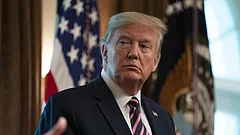


White House spokesperson Kush Desai defended the operation. Desai said, "Marine One flights are piloted by some of the best aviators in the world, and at no point was the president in harm's way."
The Federal Aviation Administration (FAA) also confirmed its oversight during the incident. The FAA stated that "the air traffic controller was in contact with both the commercial pilot and Marine One pilot during the loss of separation".
The aviation regulator stated, "The President was never in danger. We are continuing to review the incident and will implement any appropriate corrective actions based on our findings." American Airlines and the US Marine Corps, which operates Marine One, did not immediately respond to requests for comment.
Marine Corps Defense
The US Marine Corps rejected claims of a near-miss. Marine Corps spokesperson Captain Jacob Sugg said to the Associated Press, "There were no 'close calls' with the routine Marine One movement."
Sugg said, "Washington National Tower did not delay the helicopter crew, ask them to hold, or otherwise alter their flight profile."
The incident followed garbled radio transmissions between pilots and air traffic controllers, as the New York Times reported.
Past Communication Failures
Safety protocols around Washington National airport underwent stringent updates following a major accident in January 2025. A deadly mid-air crash involving an incoming passenger jet and an Army Black Hawk helicopter killed 67 people, prompting the FAA to tighten operational rules.
Communication hurdles between military aircraft and civilian controllers at the airport have a documented history. During safety hearings last spring, investigators found that a direct hotline connecting the Pentagon to the Reagan control tower was inactive for more than three years.
The FAA remained unaware of the severed connection throughout that period.