As Bangladesh votes in 2026, Rahman leads the BNP in a contest against an 11-party alliance led by Jamaat-e-Islami and the National Citizen Party.
Before he went abroad Rahman fought at least four extortion cases and corruption charges alongside his wife
Until late 2025, Rahman lived in self-imposed exile but not removed from politics.
When Khaleda Zia, former prime minister of Bangladesh and matriarch of the Zia political dynasty, died in December 2025, it marked more than the end of a life. It signalled the closing chapter of an era.
For her son, Tarique Rahman, it was the moment to come home and stand at the centre of Bangladesh’s most consequential election in decades. Rahman’s story is one of inheritance and controversy, of political influence and legal battles, of decades in exile and a dramatic re-entry into political life. Now, as Bangladesh votes in the February 12, 2026 general election, his personal journey mirrors the country’s own complex struggle with democracy, accountability, and political renewal.
Destiny’s child
Tarique Rahman was born into one of Bangladesh’s most powerful political families. His father, Ziaur Rahman, was a military ruler turned president who was assassinated in 1981. His mother, Khaleda Zia, went on to lead the BNP and became prime minister in the 1990s, governing at pivotal moments in the nation’s development. Growing up, Tarique was steeped in politics. He took to political life early, becoming a member of the BNP’s local affiliate in Bogura in 1988. By the early 2000s, he had risen to become senior joint secretary general of the party, a central organisational and strategic role that made him an influential figure in the BNP long before he ever sought elected office. In those years, Rahman did not hold an official government post, but his influence was widely perceived to exceed his formal title.



Charges of corruption
When the BNP lost power in 2006 to 2007, an army-backed caretaker government pursued an aggressive anti-corruption drive, and Rahman became a prime target. He was arrested on March 7, 2007, and faced an expanding array of cases including corruption, money laundering, extortion, and more. In some instances, he was accused of being involved in plots tied to high-profile violence, including cases related to attacks on political rallies. One major case alleged that during the BNP government, Rahman and his associate Giasuddin Al Mamun laundered approximately Tk 20.41 crore to Singapore. Initially acquitted in 2013, that verdict was overturned in 2016 by the Bangladesh High Court, which sentenced Rahman to seven years’ imprisonment and fined him Tk 20 crore. The convictions were stayed by the Supreme Court in December 2024, pending appeal.
During this period, numerous other cases were filed, at least four extortion cases which the High Court scrapped, and corruption charges alongside his wife Dr Zubaida Rahman. In a significant ruling in May 2025, the High Court acquitted both Rahman and his wife in a corruption case, effectively clearing them of all convictions that had stood during the previous Awami League administration. The legal pressure culminated in Rahman’s departure from Bangladesh. After being granted bail in September 2008, he left for London with his family for medical treatment and never returned while the Awami League remained in power.
Until late 2025, Rahman lived in self-imposed exile but not removed from politics. From abroad, Rahman remained the de facto leader of the BNP. In 2009, he was elected senior vice-chairman of the BNP, and re-elected in 2016.
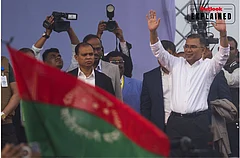
The 2024 student-led uprising that brought down Sheikh Hasina’s long tenure, a period marked by accusations of political repression and democratic backsliding, reset Bangladesh’s political board. The interim government led by Nobel laureate Muhammad Yunus oversaw transitional changes, including barring the Awami League from the 2026 contest. With legal convictions against him dropped, Rahman returned to Bangladesh in December 2025. His arrival was met with a hero’s welcome by BNP supporters and a flurry of media attention. It was a turning point not just for him, but for the BNP, which now stands as the main institutional force contending for power.
Once a figure perceived by some as controversial or even rogue, Rahman has sought to rebrand himself for a new era. In speeches and interviews, he speaks not of vendettas but of reform, institutional rebuilding, economic growth, and reconciliation. He frames his leadership as one that can balance political continuity with fresh governance norms, a message aimed both at older party loyalists and a new generation of voters. Within Bangladesh, Rahman’s image remains deeply contested. Supporters see a leader returning to finish unfinished work, a stabilising force who can bring unity after years of political conflict.
His stance on foreign policy, especially relations with India, reflects strategic nuance. While the BNP historically adopted a more skeptical tone toward New Delhi’s influence in Bangladesh compared with the Awami League, Rahman has emphasised mutual respect and balanced engagement, a posture intended to both reassure regional partners and appeal to nationalist sentiment domestically.
As Bangladesh votes in 2026, Rahman leads the BNP in a contest against an 11-party alliance led by Jamaat-e-Islami and the National Citizen Party. The election is being conducted under heightened security and is seen by many observers as the most credible in decades.