Since 1929, Boroline has travelled through Bengali households as a symbol of care, healing, and emotional continuity—passed from grandmothers to grandchildren across time and geography.
Founded during India’s freedom movement, Boroline became India’s first indigenous antiseptic cream, earning loyalty through simplicity, effectiveness, and unchanged formulation.
From radio jingles and Puja memories to bedside rituals and winter skincare, Boroline occupies a unique space in Bengali cultural memory while remaining relevant across India and even abroad.
“Does your skin pose a problem? Here.. Try Boroline.”
Chunibala was only a fifteen-year-old bride when she arrived in Kolkata from Dhaka, Bangladesh, wearing a golden Meenakari Banarasi saree. A variety of ‘tautou’ (gifts sent to in-laws after marriage or Puja or traditional ceremonies) were sent to her from Dhaka. In her golden jewelled cosmetic box, she found a small green tube of antiseptic cream. When her journey of noviceship in the kitchen started, the cream not only healed her wound but also reminded Chunibala about her early days in Dhaka. “Five years back, when I got married and shifted to Hyderabad, where my husband was posted for his job, I was busy unboxing ‘tautou’ (gifts), where I found a red velvet-wrapped cosmetic box. In it, there was a letter tied with a small green tube with a ribbon. It was obvious that it was the very popular “Antiseptic cream Boroline”. The story was written in the letter, which was a gift from my grandma-in-law Chunibala Devi. Yes, Boroline is not only an antiseptic cream, but it also cares about relationships through generations in India,'' says Shyamali Chakraborty.
“Surobhito (Fragrant) Antiseptic cream Boroline'', a melodious jingle sung by Sravanti Mazumdar was an extremely popular radio advertisement. Almost every young Indian and more precisely, Bengalis belonging to the 1970s and 1980s, have either hummed along with the jingle or read about it in print advertisements at some time or another. She also hosted “Boroline er Sansar,” a thirty-minute program on Vividh Bharati that aired family plays written by distinguished Bengali writers. This program played a vital role in making the Boroline bond invincible with the common man of Bengal. Boroline antiseptic cream, a twenty-gram tube of bottle green colour with an MRP of ₹ 33, could be found in almost every Bengali's dressing table drawer, purse, school bag and on every grandmother's bedside, waiting to be applied before going to bed at night.





Why only Bengalis? Boroline, started by Gaurmohan Dutta, dates back to 1929 as a small business in British Calcutta. When a fiery Bengal was toiling hard, fighting against the British Raj in India, Gaurmohan Dutta felt the necessity of having something made in his own attic, resulting in a firm which gave birth to a company called G.D Pharmaceuticals. Driven by the impulse of the Swadeshi Movement, it gave India its first home-made antiseptic cream. “ It was my grandfather's way of contributing to the freedom struggle,” said Devashish Dutta, the grandson of Gaurmohan Dutta, who is currently running the business. Whether people had dry skin, rash, mosquito bite or a burn, everybody turned to the green tube kept in their house. Boroline is “specifically to be applied as a night cream” according to Dutta, but people used it anyway in season and out of season.

Why did people use it so much, and what was so special in the cream that people kept coming back to it?
As the name suggests, ‘Boro’ is associated with boric powder that gives it its antiseptic quality, and 'olin' a Latin word for oil, oleum. Lanolin, one of its key ingredients, is an emollient that keeps skin moisturised. “Boroline is an inseparable part of my life- a must have!... from healing chapped skin, to acting as an antiseptic skin protective layer. Undoubtedly, any Bong's prized possession is Boroline,” says Shushmita Burman, who has used the product from a very young age of her life up until now, when she is in her forties.
What was it about this product that it only got associated with Bengalis more than any other Indian community? When you ask a Bengali about the nostalgic elements associated with their childhood, one can easily list out Durga Puja, Rosogolla (Sweet), Fish fry, Tagore’s songs and Satyajit Ray’s stories and movies. Within these elements,one such product of nostalgia would be Boroline. Apart from being available in their house, they have also seen at least some old people use it regularly, or they have been advised to use it if there is any kind of skin problem. “As a kid, my grandma used to always buy packs of Boroline at once and store it on her shelves. It was a staple in our house. Whenever I would come home with a bruised elbow or leg after falling down while playing or hurting myself somehow, grandma would first clean the wound and then pull out one of her many Band-Aids, squeeze out some Boroline and apply it,” says Asmita Chatterjee, who has spent most of her childhood days in her grandmother's house.

Whether you are brought up in Kolkata or are a Probashi Bangali (brought up outside of Kolkata) you cannot escape this iconic antiseptic cream. “Boroline is an essential item of my household. During the harsh winter months in Boston, my skin gets very rough. I have used various moisturising creams but nothing works like Boroline. I haven’t found any cream as effective for treating chapped lips,” says Munmun Biswas who has now stayed in the US for more than a decade. Interestingly, when her baby was born there, she continued the tradition with her daughter as well.

Boroline had launched its ‘Ultra Smooth’ a few years back when Dutta had a daughter. Dutta started to make Boroline at home using the utensils in their kitchen, heated it in the slow flame in order to avoid taking it from the factory to use it for their newborn baby. That gave birth to the Boroline ‘Ultra Smooth.’ “And it has the exact same chemical formula and stickiness but with a creme texture,” he says. Interestingly, Biswas had used this very same cream on her own daughter as a form of a baby cream. She had seen her grandmother use only Boroline from her childhood, so she was sure that this brand could be trusted in any shape or form even for a newborn baby.
For a long time Boroline has been associated with Bengalis so much so that people call it one of our cultural products. We cannot deny the fact either, can we? That’s what Shrishti Chatterjee, a sixteen-year-old girl who has been brought up in Delhi, had told her friends when they teased her about her face being acne-free. She said, “ I use Boroline every night before I sleep. I love it. It is the best.”
Despite being labelled a Bong product, a non-Bengali family residing in Jabalpur with their roots in Madhya Pradesh says, “ We have used Boroline for ages now, it's like a running cream in our family. Every night before going to bed it's a must.”
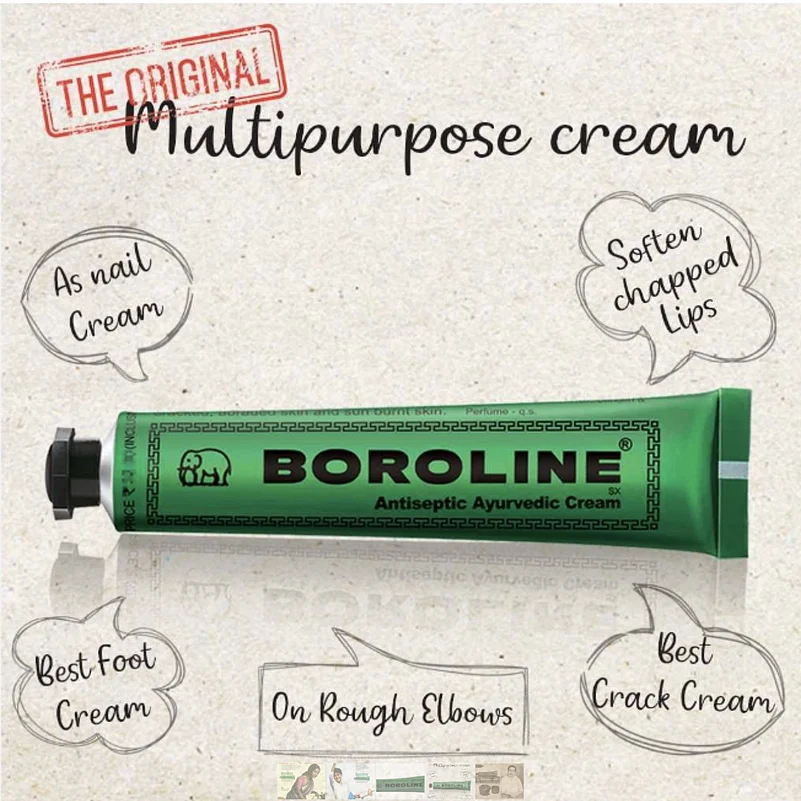
A very interesting fact about this product is that their product packaging more or less remains the same - the very bottle green colour of the tube, white printed ‘BOROLINE’ on the outer cover and exactly the same size of the tube which had been launched with the iconic elephant imprint in white colour. “Well, it is the green colour and the elephant symbol (Haathi wala product as they used to call it initially) that became the hallmark of the company. This image that has been built for years is not only a physical but also a psychological image and a memory that resonates with people. If I were to change the very look of it, people would think twice before purchasing it,” said Dutta. He further added how happy they as a company get each time a new mother, a grandfather or a grandmother, a young teen with her or his own pocket money buys it and it works. That is what gives them joy as a company. The legacy of the company rests on the people who have used it for decades and trusted the brand with every sensitive part of their skin.
“I have seen Boroline being used by my great grandmother and I do know for a fact that the glow that Boroline brought to her face is the same glow that I see on your hands and face whenever you use it,” said my father with a nostalgic smile on his face. My mother never used Boroline, but always had the tube just in case of an emergency. “When I was young, I woke up one winter morning only to discover a rough chapped skin. I quite remember how disheartened I had been as I had a scheduled picnic organised by my school the very next day. That night my mother had applied Boroline on my face and hands and the next morning I woke up with a rejuvenated soft skin,” said my mother. She went on to say how she still remembers Surobhito Antiseptic cream Boroline, a mellifluous jingle.
The late 2000s generation has sung along to the iconic Boroline song sung by Sawan Dutta which was released on YouTube. No force has been able to diminish the glory of Boroline so far. It will not only remain close to a Bengali’s heart but to the entire nation’s, simply because of the mark of patriotism historically attached to it. It is safe enough to say that a green tube with Boroline in bold white font written on the cover will always have a special place in every Bengali’s heart, as a “Bongo jiboner ongo” ( An integral Part of every Bengali’s Life).