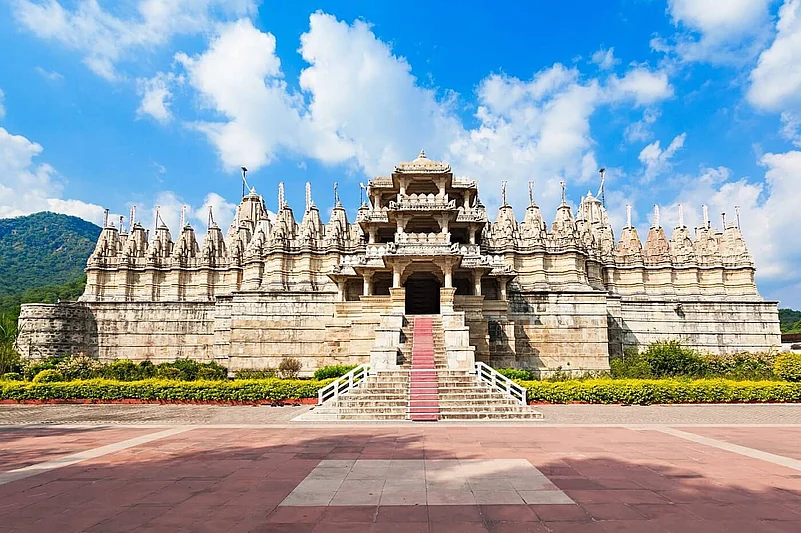
India does not just preserve history; it lives it. And nowhere is this more evident than in the sacred geography shaped by Lord Mahavira, the 24th Tirthankara of Jainism. With Mahavir Jayanti approaching on March 31, 2026, thousands of seekers are preparing to retrace his footsteps. His life, rooted in renunciation, discipline, and non-violence (Ahimsa), continues to echo across temples, hills, and ancient towns that have quietly carried his legacy for over two millennia.
What makes the Mahavira pilgrimage circuit unique is its profound narrative arc. While his life began in the Gangetic plains of Bihar, his teachings traveled far beyond, inspiring devotion across western and southern India. Today, this spiritual trail is not confined to one region; it is a pan-Indian journey of faith.
Kundalpur, Bihar – The Sacred Birthplace
Because Mahavir Jayanti celebrates the birth of the 24th Tirthankara, no pilgrimage is complete without Kundalpur. Located near the ancient ruins of Nalanda in Bihar, this sacred town is revered by the Shwetambar sect as the exact birthplace of Lord Mahavira.
A magnificent temple houses a beautiful idol of Mahavira, and the atmosphere here during Mahavir Jayanti is electrifying yet deeply spiritual. Walking through Kundalpur, one can almost feel the historical weight of the land that nurtured a prince who would eventually renounce the world to become a spiritual conqueror (Jina).
Pawapuri – Where Silence Speaks the Loudest
Every spiritual journey connected to Mahavira inevitably leads to Pawapuri. This is the place where he attained nirvana, marking the final liberation from the cycle of birth and death. The iconic Jal Mandir, set in the middle of a serene lotus pond, stands exactly where his cremation took place.



There is a quiet intensity to Pawapuri. The still waters, the marble pathways, and the rhythmic chants create an atmosphere where time seems to slow down. For pilgrims, it is not just a visit, it is an emotional culmination of Mahavira’s life journey.
Champapuri – A Forgotten Chapter of His Wanderings
While Pawapuri marks the end, Champapuri represents movement, years of wandering, teaching, and connecting. This ancient city was one of the places where Mahavira spent multiple monsoon retreats, engaging with followers and spreading his philosophy.
Unlike more structured pilgrimage centres, Champapuri carries an old-world charm. It feels less like a destination and more like a memory, an echo of conversations that shaped Jain thought.
Osian, Rajasthan – Devotion Carved in Stone
Shift westward, and the landscape changes dramatically, from river plains to desert sands. Yet, Mahavira’s presence remains just as powerful.
The Mahavira Jain Temple in Osian is one of the oldest surviving Jain temples in western India, dating back to the 8th century. This is where architecture becomes devotion. Intricately carved pillars, detailed sculptures, and the temple’s towering structure reflect how deeply Mahavira’s teachings influenced communities far from his birthplace.
Bhandavpur, Rajasthan – Faith Preserved Through Centuries
Another remarkable site in Rajasthan, Bhandavpur Jain Tirth, stands as a testament to enduring devotion. With roots tracing back over a thousand years, the temple houses an ancient idol of Mahavira believed by devotees to be centuries old.
What sets Bhandavpur apart is its atmosphere. It is less crowded, more introspective. The silence here feels deliberate, almost sacred, inviting visitors to reflect rather than simply observe.
Palitana, Gujarat – The Climb Towards Liberation
No discussion of Jain pilgrimage is complete without Palitana. Located on Shatrunjaya Hill in Gujarat, this site is home to hundreds of intricately carved temples. While not directly tied to a specific event in Mahavira’s life, it is deeply connected to Jain philosophy and his teachings.
Climbing thousands of steps to reach the summit is seen as an act of devotion. The journey itself becomes symbolic, mirroring Mahavira’s path of discipline and spiritual ascent. Pilgrims often describe the experience as transformative, both physically and mentally.
Shravanabelagola, Karnataka – The Southern Echo of Mahavira
In southern India, Shravanabelagola stands as a powerful reminder of Jainism’s widespread influence. Known for the towering statue of Bahubali, the site reflects the ideals that Mahavira championed—detachment, non-violence, and self-purification.
Though associated more directly with earlier Tirthankaras, the spiritual philosophy practiced here is deeply rooted in Mahavira’s teachings. The site’s calm lakes, rocky hills, and ancient inscriptions create a meditative environment that resonates with seekers.
Why This Journey Still Matters
What makes these pilgrimage sites compelling is not just their religious importance, but their continuity. They are not frozen in time. Rituals continue, festivals are celebrated, and generations keep returning, carrying forward a philosophy that is over 2,500 years old.
From the stillness of Pawapuri to the desert grandeur of Osian, from the quiet depth of Bhandavpur to the spiritual climb of Palitana, each site offers a different lens through which to understand Mahavira.
A Living Philosophy, Not Just a Pilgrimage
To travel across these sites is to realise that Mahavira’s legacy is not confined to temples or rituals. It lives in ideas, non-violence, truth, restraint—that feel increasingly relevant in today’s fast, restless world.
This is why the journey continues to attract not just devotees, but also thinkers, travellers, and seekers. Because in tracing the footsteps of Mahavira, one is not just exploring India’s spiritual map, one is rediscovering a way of living.
Frequently Asked Questions (FAQs)
1. Where was Lord Mahavira born?
Lord Mahavira was born in the early 6th century BCE in Kundalpur (near ancient Nalanda in present-day Bihar) to King Siddhartha and Queen Trishala.
2. Where did Lord Mahavira attain Nirvana?
Lord Mahavira attained Nirvana (final liberation from the cycle of birth and death) at Pawapuri in Bihar. The famous white marble Jal Mandir, situated in the middle of a lotus pond, marks the exact spot of his cremation.
3. What is the significance of Rajgir in Jainism?
Rajgir is highly sacred because it is the site where Lord Mahavira delivered his first divine sermon (Divya Dhwani) at Vipulachal Hill after attaining absolute enlightenment (Kevala Jnana).
4. When is Mahavir Jayanti celebrated in 2026?
Mahavir Jayanti will be celebrated on Tuesday, March 31, 2026. It is the most important festival in Jainism, marking the birth anniversary of the 24th Tirthankara.