England and Argentina renew one of football's fiercest rivalries, with a place in the FIFA World Cup 2026 final at stake
The rivalry was shaped by the 1982 Falklands War and immortalised by Diego Maradona's iconic 1986 World Cup heroics
Despite football's changing landscape, history and politics continue to cast a long shadow over every England-Argentina meeting
Under the futuristic Atlanta Stadium (Mercedes-Benz Stadium) in the foothills of the Appalachian Mountains, a 60-year-old ghost will be reawakened: England vs Argentina knockout clash for a place in the final of the FIFA World Cup 2026.
On one side stands a 39-year-old Lionel Messi, dragging the La Albiceleste -- the defending champions. On the other is Jude Bellingham, the 23-year-old engine, and Harry Kane, a veteran goal machine, of a very modern-looking Three Lions side managed by Thomas Tuchel.
And this is their biggest meeting since 1986.
However, as thousands of fans descend on the capital city of the southeastern United States of Georgia, the pre-match talk hasn't just been about tactics. Because, whenever these two teams meet, the pitch becomes something much bigger than a playing field. A veritable theatre for a deeper, historical psychodrama!

And here's why.
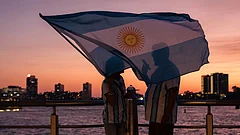
The 1982 Falklands War (April 2 - June 14) permanently reframed this fixture and every single narrative surrounding it. It continues to turn a football match into a bitter proxy game where collective trauma and sporting vengeance collide.
While that 10-week 'undeclared' war, also known as Guerra de las Malvinas, or Malvinas War, is widely considered the ultimate sparking moment of the rivalry, the sporting animosity between England and Argentina began some sixteen years earlier.


During the World Cup 1966 quarter-final at Wembley, England manager Alf Ramsey famously labelled the Argentinian players "animals" following a bad-tempered match and a controversial red card handed to Argentina's captain, Antonio Rattin. After the match, Ramsey even blocked his players from swapping shirts. This sporting grudge simmered for over a decade, but it lacked a real-world catalyst.
The military conflict of 1982 provided exactly that.
Real Blood, Real Scars
In April 1982, Argentina's military junta under Leopoldo Galtieri invaded the British-dependent Falkland Islands. Britain's Prime Minister, Margaret Thatcher, responded with a naval task force. The brief but brutal war resulted in the deaths of 649 Argentine military personnel, 255 British military personnel, and three islanders.
The conflict concluded with a British victory, leaving deep scars on the Argentine psyche. For a generation of young Argentines, the loss was a humiliation engineered by a distant imperial power.
So, the football pitch quickly became the only socially acceptable arena where national vengeance could be pursued and exacted.
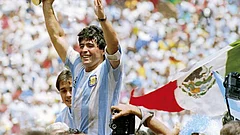
By the time the two nations were drawn to face each other in the World Cup 1986 quarter-finals, the tension became palpable, to say the least. What followed over those playing minutes at Estadio Azteca remains the most mythologised individual performance in football history, mirroring the complex emotions of the war.
'This Was Revenge'
Maradona's opening goal, now known as 'The Hand of God' -- a blatant handball, a punch over England goalkeeper Peter Shilton -- was viewed in England as a cynical, unpunished cheat. In Argentina, it was celebrated as the ultimate act of viveza criolla (native cunning) -- a cultural philosophy widespread in Latin America. It was a poetic revenge against an adversary that possessed superior military hardware.
Just four minutes later, Maradona dribbled past five English defenders to score a breathtaking solo goal, 'the Goal of the Century'. If the first goal was a smash-and-grab act of defiance, it was a display of pure sporting superiority, crafted by a genius.
Argentina won 2-1 and went on to lift the World Cup, their second. For the Argentine public, the victory felt like an emotional reclamation of the islands, reducing the British rule to mere waves, metaphorically at least.

Diego Maradona would later admit in his autobiography that the players lied when they claimed sports and politics shouldn't mix.
"More than defeating a football team, it was defeating a country. Of course, before the match we said that football had nothing to do with the Malvinas War, but we knew a lot of Argentinian kids had died there, shot down like little birds. This was revenge," the legend wrote in El Diego.
Saint-Etienne To Sapporo
The fallout of that 1982 clash ensured that every subsequent meeting between Argentina and England was treated like a war.
In the 1998 edition, a classic World Cup encounter at Saint-Etienne featured a wonder goal from a young Michael Owen and a controversial red card for David Beckham after he retaliated to Diego Simeone's foul. England out, the British press immediately vilified Beckham, treating his dismissal as a betrayal on par with losing a war.
Four years later, in Sapporo, Beckham achieved a measure of redemption by scoring from the penalty spot to beat Argentina 1-0 in the group stage. The narrative arc was heavily laced with nationalistic overtones. And England had conquered their psychological demons.
Changing Landscape
It's a fact, though, that raw geopolitical anger has largely softened, with football's globalisation also playing its part.
Dozens of high-profile Argentine players, from Carlos Tevez to Sergio Aguero and Alexis Mac Allister, have become icons for English Premier League clubs. Remember Martin Tyler's "Aguerooooo!" when the Argentine scored the league-winning goal for Manchester City on the final day of the 2011-12 season.
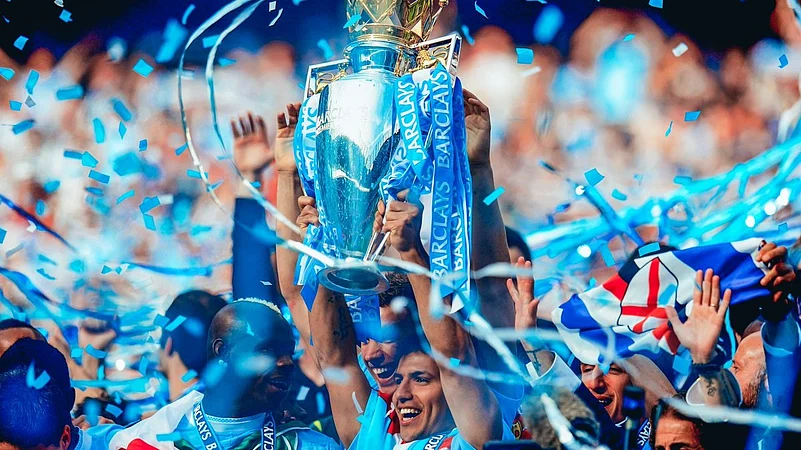
Before him, Juan Sebastian Veron had lifted the EPL trophy with Man United. Others from The Land of Silver to have tasted league success include Hernan Crespo, Gabriel Heinze, Pablo Zabaleta, Julian Alvarez, Nicolas Otamendi, and Leonardo Ulloa.
Yet, the ghost of 1982 is never completely buried, and will never be.
As the two teams walk out under the lights in Atlanta tonight, fans, commentators, and journalists will invariably invoke the spirit of Maradona, the shadow of the Azteca, and the summer of 1982.
The Falklands War might or might not have created the rivalry, but it ensured that England vs Argentina would never be "just a game" -- a very popular phrase now.