


Other than issues like the Babri Masjid demolition, here's why the IM claims it attacked specific targets:
Delhi: September 13, 5 bombs, 8 killed, 130 injured
The Indian Mujahideen (IM) said it targeted the capital to demonstrate its capability to strike at will even in high-security zones
Patilspeak: "Anti-national elements have been trying to disturb peace and create panic among the people in various parts of the country."
***
IM said it was retaliating against the post-Godhra riots, the threat of a new anti-terror law, the targeting of Muslims by the Anti-Terror Squad
Patilspeak: "Anti-national elements have been trying to create panic among the people of our country. Today’s blasts in Ahmedabad seem to be part of the same strategy."
***
IM said it chose the garden city because it is the IT capital, and because of alleged harassment of Muslims in name of fighting terror.
Patilspeak: "Such incidents will not deter the government from pursuing its policy of dealing with anti-national elements in a resolute manner."
***
IM said it chose the Pink City because it’s a popular tourist spot, and because it wanted India to stop collaborating with United States.




Patilspeak: "I appeal to people to maintain calm and foil the designs of anti-national elements."
***
The Delhi e-mail runs into 13 pages in printout and conveys what the terrorists want us to know about themselves. The document uses the same Quranic verses used by international terror groups to justify their bloody acts. Indian clerics have categorically stated that the Quran is always open to different interpretations. Yet it is clearly a distortion to justify such cruelty through a holy book.
The inspiration from pan-Islamic groups now operating across the globe is quite clear from the design and presentation of the e-mail. It could well have been inspired by any of the hundreds of Islamic websites propagating terror—there’s the same rhetoric, the same hatred for kafirs (non-believers), the same declaration of jihad.
Yet the context and arguments presented in the e-mails are wholly Indian. That is what makes them so revealing. Surprisingly, neither the media nor the intelligence agencies seem to be focusing on the content of the mails. The Ahmedabad e-mail had far more Islamic rhetoric than the one sent after the Delhi blast. It had declared the strike a revenge for the Gujarat riots. Yet, it was also a record of perceived injustice suffered by Muslims at the hands of courts, lawyers, state governments and inquiry commissions.
The Delhi mail spreads the ambit further. It is a critique of the media and the Bharatiya Janata Party (BJP), Sangh parivar and the Congress. Indian Mujahideen’s core members seem to be avid readers of one of the country’s leading English dailies, which they accuse of biased reporting. There is a general assault on the media for "the dreadful silence on the origins of bombs dug out from camps of the Sangh parivar". More specifically, there is a complaint with threatening overtones: "Why is it that Sangh parivar violence is never dealt with the same intensity as Islamic terror?" It also says: "The media always uses double standards to measure terrorism. The word terrorism is never used when a story on Sangh violence is told, no matter how large-scale the violence." Besides the many assaults on Muslims, there is an unsettling attempt to link it to the other battles raging in India. For instance, the writers of the mail pose the question: "Why is the Sangh terror on all the minorities including Muslims, Dalits and Christians a rarely noticed idea.?"

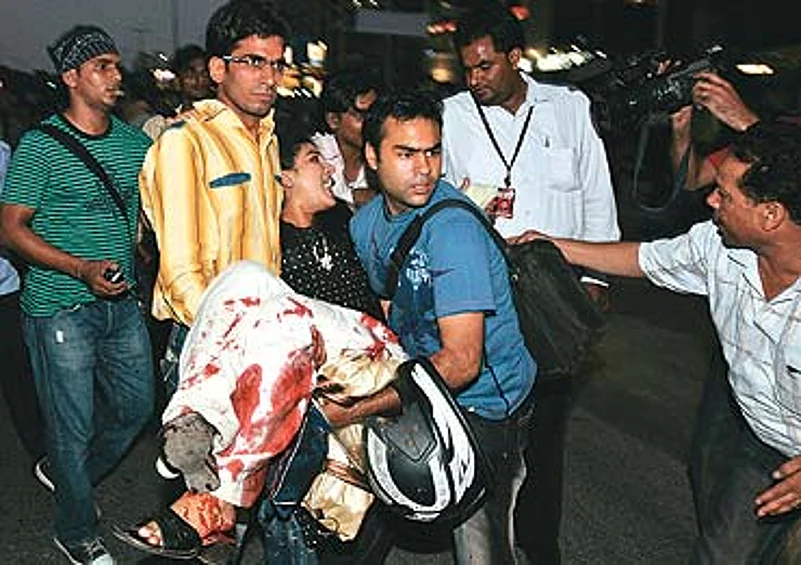
No mercy: A victim of the Jaipur blasts being taken to hospital
Clearly, the terrorists want to justify their actions. They have cleverly juxtaposed with Islamic rhetoric ideas that a middle-of-the-road liberal may spout. It is a dangerous mix. In one fell stroke the terrorists are seeking to give a certain legitimacy to their ideas. To use a phrase usually associated with individuals like Arundhati Roy, the terrorists are a bunch of Islamists aspiring to radical chic.
Radical Islam has after all become one of the most potent ideologies in the world. But in other parts of the globe, it chiefly operates in two frameworks: injustice and occupation by the US or Israel; and revolt against a totalitarian regime, as is the case in Saudi Arabia, the original home of Osama bin Laden. In India, it is quite apparent that neither of those frameworks is present. There is no oppression by any foreign power and there is a democracy in place in which political parties actively pursue the Muslim vote.

Sudden strike: Police investigating after the Bangalore blast
And yet we are now faced with evidence of a potent terror group with the ability to operate in a sophisticated manner, and worse, to strike repeatedly. The root causes are not hard to pinpoint. There is an entire generation of young Muslims who have grown in the post-Babri demolition years. Many are educated, have no romantic notions about the nature of the Indian state, and live in a world where information and ideas about radical Islam travels with the click of a mouse. It has also not helped that the disenchantment with traditional political parties has indeed become all-consuming among the minorities and the poor, especially in the large swathe where Naxalite violence continues unabated.
Equally significant perhaps is the fact that the ideological roots of Islamic fundamentalism lie in South Asia. Radical Islam is usually credited to Sayyid Qutb (1906-1966) of Egypt. But he in turn was inspired, among others, by Maulana Maududi (1903-1979), the founder of the Jamaat-e-Islami in Pakistan. In her renowned book on Islam, Karen Armstrong writes: "Maududi saw the mighty power of the West as gathering its force to crush Islam." To defy the West and its influence, Maududi proposed what some have described as an Islamic liberation theology. He called for a universal jehad by all Muslims to fight what he called the jahiliyah (barbarism) of the West. He also claimed that jehad was one of the central duties of Islam. In the post 9/11 Muslim world, the ideas of Maududi have been rediscovered, and they are providing an ideological framework for many Sunni Islamic fundamentalist groups.

Blood on the streets: At the site of a blast in Ahmedabad
The Jamaat-e-Islami in India is not a force like its Pakistan counterpart. But SIMI was originally the student wing of the Indian Jamaat-e-Islami. And we are now told that the Indian Mujahideen is the offshoot of SIMI. Today, the good men who run the Jamaat could be very devout Muslims, practising a brand of Islam that is highly intolerant of other religions. But they would not be terrorists. Yet the larger point here is that a home-grown terrorist group, with the level of education and articulation that the Indian Mujahideen appear to have, need not look to West Asia or the Arab world for ideological inspiration. Undivided India had produced Maududi, the original ideologue of radical Islam. Now, the men running India’s first computer-savvy Islami terror group want the world to know their arguments and be afraid.