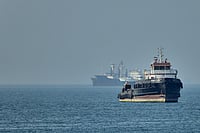
It was touted as India's biggest deep sea operation ever to nab poachers fishing in our waters. The logistics of the ambitiously christened Operation Flushout last July were, indeed, impressive: 200 police and paramilitarymen sailing in a six-vessel flotilla armed with mortars, guns and carbines from West Bengal's Raidighi fishing harbour. The Coast Guard provided air cover.
At the end of a four-day-long sally in the rivers, the bloodless operation returned with decent pickings: five state-of-the-art foreign fishing vessels carrying 144 fisher-men—mostly Thai citizens—and stuffed with fish. For Sunderbans fishermen, this was happy tidings: foreign trawlers poaching in the waters of the Exclusive Economic Zone (EEZ)—a marine life-rich 396-km area strictly off-limits for foreign vessels—along the 455-km-long West Bengal coast was posing a serious threat to their survival.
Now the bad news. A year on, Operation Flushout has turned out to be a major setback for the cops' morale and the fisher-men's fortunes. Three of the five seized vessels along with 80 Thai fishermen have been released on the orders of the Supreme Court. Reason: the West Bengal government has lost a legal battle against the vessels' owners in spite of the police marshalling disturbing evidence.
This is the essence of a confidential report submitted by South 24-Parganas superintendent of police Bansi Dhar Sharma, who led the operation, to West Bengal's director general of police D.K. Sanyal recently.




The case had intriguing twists and turns. Three of the five seized vessels belonged to Delhi-based Swan Fisheries, a joint venture operation with a Bangkok-based counterpart. Last November, the company moved the Calcutta high court to quash proceedings of the case built up by the police for violation of the Foreigners Act and Maritime Zones of India Act. They also sought release of their three vessels and 80 fishermen. The report says Sudipta Moitra, additional public prosecutor in the Calcutta high court, appointed to represent the state in the case, didn't inform the investigating officer "about the dates on which the matters would be heard for final disposal" by the high court. Suddenly, last December, the police got a Calcutta high court order quashing the proceedings and ordering the release of three trawlers and 80 fishermen.
Stung by the verdict, the government filed an SLP in the Supreme Court this January.Next month, the apex court granted a stay on the submission by West Bengal advocate-general Naranarayan Gooptu. Meanwhile, Sanjay Mallick of Swan Fisheries filed an affidavit saying the equity of Indian directors in the company had been raised to from 50 to 60 per cent in April last year, three months before the operation. The implication: the vessels were Indian, not foreign, as the police were trying to prove under the Maritime Zones of India Act.
There was more to come. Investigations at the office of the Registrar of Companies in Delhi by Sharma along with CBI officers revealed, according to the report, a 'startling' fact: the annual returns filed by Swan Fisheries in November '97 said 50 per cent of its equity was owned by Indian directors. "The company," says the report, "had claimed they'd changed the equity participation in April '97." Inspired, the police filed an affidavit in the apex court in March. The advocate-general couldn't appear on the next three dates for hearing in March and April; the state government spent a tidy sum by appointing attorney-general of India Ashok Desai to appear on its behalf.
When Gooptu finally appeared on April 17, the apex court said an "affidavit should be filed by the state of West Bengal for launching prosecution against the respondents for swearing false affidavit". On April 21, Moitra filed the affidavit. Three days later, on April 24, the apex court dismissed the SLP in a one-line judgement. What happened to what the police believed was pretty damning evidence? Nobody is sure; home minister Buddhadev Bhattacharya is peeved with the verdict.
As for the remaining two vessels, one, sailing without papers, hasn't found a claimant still and the case involving the other, belonging to a Chennai-based company, is hanging fire. The upshot: 67 Thai fisher-men sailing on these vessels have been languishing in prison for a year now. Clearly, Operation Flush-out, which cost the state government over Rs 20 lakh, has come to naught. "The verdict," says the report, "is going to adversely affect the livelihood of lakhs of fishermen." But then, who gives a damn?