"Jellyfish Drone" refers to a swarm of drones flying and operating as a single coordinated system
The technology can overwhelm air defences while conducting surveillance and combat missions
Experts see AI-powered drone swarms as a key feature of future warfare
What Is A 'Jellyfish Drone'?
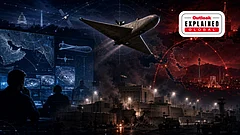
Shortly after ejecting from his fighter jet over Iran and awaiting rescue, a U.S. F-15 pilot witnessed a sight that he initially struggled to believe. Suspended in the sky above him was a cluster of Iranian drones moving in a coordinated pattern that resembled a giant jellyfish.
The incident occurred in April after the pilot's aircraft was shot down during combat operations. He was later extracted by U.S. special forces in what President Donald Trump described as "one of the most daring search and rescue operations in U.S. history."
According to the reports, the U.S. F-15 pilot shared his account with intelligence officials during a debriefing following the rescue operation, highlighting that the unusual formation was not a single aircraft but a swarm of interconnected drones operating together.
Defence analysts have since referred to the system as a "jellyfish drone" because of its appearance and the way smaller drones appeared to move around a central command unit.
The encounter has drawn attention to the rapid evolution of drone warfare and the growing use of autonomous systems on modern battlefields.


Why The Pilot Compared It To An Alien
According to accounts of the rescue operation, the downed pilot initially believed what he was seeing could not be real. The drones hovered and shifted position in a coordinated manner unlike conventional aircraft.
The formation's appearance reminded him of a jellyfish floating through water, while others involved in analysing the footage compared it to something from science fiction. The drones appeared to move as a single organism rather than as individual machines.
How Multiple Drones Can Fly As One
At the heart of swarm technology is a network that allows drones to exchange information continuously. Rather than relying on a single controller, each drone contributes to the group's overall awareness.
Some drones can gather intelligence, while others monitor threats, jam communications or carry weapons. Information collected by one unit is instantly shared across the network, allowing the swarm to react rapidly.
In many designs, a larger drone functions as a command hub while smaller drones operate around it. If one drone is destroyed, the others can adjust their positions and continue the mission.
This ability to function as a coordinated system is what makes swarm technology significantly different from conventional unmanned aircraft.

Why Militaries Are Investing In Swarm Technology
Military powers around the world are investing heavily in drone swarms because they offer several battlefield advantages. Large numbers of relatively inexpensive drones can overwhelm air defences that were designed to intercept a smaller number of high-value targets.
Swarm systems can also conduct surveillance across wider areas and perform dangerous missions without placing pilots at risk. Advances in artificial intelligence have further increased their effectiveness by enabling greater autonomy and faster decision-making.
The sight witnessed by the downed F-15 pilot highlights how quickly such capabilities are moving from experimental programmes to real-world military operations.
Could This Be The Future Of War?
Defence experts increasingly believe drone swarms will become a defining feature of future conflicts. As artificial intelligence and communications technology improve, swarms could undertake missions that currently require multiple aircraft, soldiers and command centres.
The "jellyfish drone" seen over Iran may have appeared strange to the pilot who encountered it, but analysts say it offers a glimpse of warfare's next chapter—one in which dozens of autonomous machines can think, communicate and fight together as a single force.