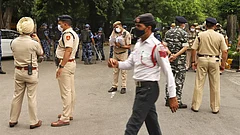
Nearly 9,50,000 security personnel are deployed to maintain law and order.
The government has put in place security cameras and drones to monitor 43,000 polling booths
Both BNP and Jamaat are eyeing Awami League voters since Sheikh Hasina’s party isn’t in the fray
Bangladesh’s moment of political transition after the July uprising is happening on February 12 as 127 million voters – men constituting 50.7% and women 49.2% - choose the next government. Nearly 9,50,000 security personnel, drawn from Ansar, the police, Border Guard Bangladesh and the Army, are deployed to maintain law and order. The government has put in place security cameras and drones to monitor 43,000 polling booths across the country. It is taking extra precautions in 24,000 polling stations that are marked as high-risk. As many as 51 political parties are participating in this election that will be held across 299 constituencies. Voting in one constituency is suspended due to the death of a candidate.
The election is happening after the nearly 18-month rule by the interim regime comes to an end. Along with the election to Parliament, the voters will be asked to cast ‘Yes’ or ‘No’ in the referendum that proposes several constitutional reforms to safeguard Bangladesh’s transition to a sustainable robust democracy with a strong Parliament and an effective opposition to check on executive authoritarianism.
Battle of the coalitions
In this election, two major political coalitions are contesting against each other. One of these is a 10-party coalition led by Bangladesh Nationalist Party (BNP) Chairperson Tarique Rahman. His return to Bangladesh in December after 17 years in self-imposed exile served as motivation to the BNP’s cadre. Rahman took over party leadership after the death of his mother, former Prime Minister Begum Khaleda Zia. He has been addressing rallies across the country promising a welfare-oriented, democratic and clean government.



However, the BNP is accused of corruption and extracting money from small businesses and is involved in alleged forcible occupation of university halls after Chatra League-the student union of AL fled. Tariq expelled around 7,000 party cadres for being involved in corruption and extortion. In spite of this, the party has not been able to shed its past image which its main contender – the Jamaat Islami, is trying to capitalise upon in its election campaigns. Around 90 rebel candidates from the BNP are also fighting as independents.
The 11-party coalition led by Bangladesh Jamaat-e-Islami amir Dr Shafiqur Rahman is hoping for a victory, or at least emerging as a strong opposition.
For Jamaat this is a historic opportunity to show their strength as the party has remained a marginal player in elections with an ability to influence the result in more than 50 constituencies. Its rise is facilitated by a ban on Awami League. Jamaat’s past is tainted due to its role during the liberation of Bangladesh. While the Jamaat accepts that it supported Pakistan during 1971, it denies its involvement in war crimes.
The death sentences to several of its leaders through a war crime trial by Sheikh Hasina have been projected as political killings. It has not apologised for its role in the liberation war and asked for proof of its involvement. The Jamaat was deregistered as a party in 2017 and was banned on 1st of August 2024 as a terrorist organisation by the Hasina regime. Now, the ban has been lifted and deregistration is withdrawn.
Ironically, the Awami League (AL), which led the liberation war, now faces a ban on its activities and is barred from contesting the election. The National Citizens Party (NCP), which asked the AL to apologise for the alleged killing of youth during the July uprising, has remained silent on the role of the Jamaat that is accused of killing AL supporters and sympathisers and minorities during the liberation war.
Many expected that the NCP would emerge as a party of the youth, taking forward their legacy of the July revolution. Yet, after the NCP was formed it faced internal challenges and could not project an ideology that can bind the youth together. Its decision to enter into an electoral alliance with the Jamaat disappointed many youth leaders who left the party. Some of them openly criticised the decision which they said was kept under wraps. Mahfuz Alam, the former adviser and who was one of the main architects of the July uprising, decided to distance himself from the NCP. The fact that the NCP has lost its steam was demonstrated when the Jamaat’s student wing, the Islami Chatra Shibir, won all the student union elections in major universities of Bangladesh. The party has justified its alliance by saying it is "not ideological but purely electoral" – the same argument that the BNP used to defend its electoral alliance with Jamaat in the past.
Fight for Awami League votes
Though the AL has given the slogan, ‘No Boat, No Votes’, referring to its election symbol, there are 30 constituencies in which AL candidates have always emerged victorious. These constituencies can change the electoral landscape in one way or the other. Therefore, it is not surprising that all the parties are trying to win over AL votes. Some of them have promised that if elected they will get AL’s local leaders, who are in jail, released. Some are even visiting the graveyards of local Awami League leaders to garner votes.
Minorities, who are considered the vote bank of the Awami League, are assured of their safety as all the parties speak of a plural Bangladesh. Women voters may play a crucial role. The Jamaat has alienated women voters when its Amir said women cannot take a leadership role as they are constrained by their biological limitations. The BNP has tried to capitalise on Jamaat’s statement while wooing women voters.
The result of the referendum on constitutional reforms and how the political parties take it forward within 180 days would define the contours of Bangladesh’s politics and its future democratic journey. This election could prove to be a defining moment in Bangladesh’s history.
Dr Smruti S Pattanaik Is Research Fellow, Manohar Parrikar Institute for Defence Studies and Analyses.
Views expressed are personal