You have described education as a pyramid. In the age of artificial intelligence (AI), should India focus first on correcting the current inversion—where higher education receives greater attention than primary education—or continue expanding capabilities at the top to secure a competitive edge?
In the first 30 years after Independence, India built an education structure that I summarised as a double cylinder, with the top cylinder representing higher education and the bottom one representing schooling. Such a structure is very unstable and must be corrected. According to the constitutional design, schooling is a state subject, and states can, and must, shift the focus from credentials or certificates [passing everyone] to learning and skilling.
The Union government, on the other hand, has more direct constitutional authority over higher education and R&D institutions. It can and has propagated the learning of AI as a job skill and must continue to do so. The two things are not mutually exclusive and can, and must, be done simultaneously.
If we speak of the resources available to the government, then, as a veteran economist who has worked with several governments, what has been the bigger problem for India: lack of money or the allocation of money?
I have struggled to find experts who have done data-based research to identify the source of the problem and the best solution to solve it. There is a new scheme for every political problem, but little interest in finding out whether it increased the income or welfare of beneficiaries, or the benefit-cost ratio.
Let me give you an example. Years ago, research showed that the most important cause of child [under the age of five] stunting and underweight/wasting in India was poor sanitation and the absence of a modern sewage system. Recent research has reinforced this and gone further to show the link between sanitation and sewage and child mortality. Yet, despite the evidence, there is little interest among state bureaucracies to revamp the sewage and sanitation systems in the states, which continue to spend the money on nutrition programmes.
So there is enormous scope to improve outcomes through evidence-based policies that shift funds from programmes and projects with low benefit-cost ratios to those with high benefit-cost ratios.



.jpg?auto=format%2Ccompress&fit=max&format=webp&w=240&dpr=1.0)
For decades, policymakers have spoken about numerical targets like raising education spending from about 4 per cent now to 6 per cent of GDP. Is that still the right benchmark, or should the focus be on outcomes rather than expenditure targets?
Everybody is an expert at spending money. After every budget, every man on the street will tell you that the government should spend more money on health, education, or whatever his or her pet interest is. Do we need experts to tell us to spend more money? These numbers are based on World Bank’s World Development Indicators data to derive an average of some set or subset of countries, without reference to problems and solutions. They are devoid of even the basic knowledge of the constitutional division of responsibilities between the Centre and the states and the norms and practices that have governed the Concurrent List during the past 75 years. Health is a state subject. Education was a state subject until the mid-1970s, when it was put on the Concurrent List. Every Finance Commission takes account of the disparity in income and tax capacity across states.
My recent work shows that the minimum reading ability of school students is uncorrelated with the Net State Domestic Product. How many people connected with education in this country know that half of the children who have completed primary school can’t read a sentence and about three-fourths can’t do division? Uttar Pradesh, Jharkhand and Odisha have shown during the past 10 years that minimum learning outcomes can be improved significantly with little or no extra expenditure.
In the first 30 years after Independence, India built an education structure as a double cylinder, with the top cylinder representing higher education and the bottom one representing schooling. Such a structure is very unstable and must be corrected.
How can India radically redesign its education system so that degrees become less important than demonstrated skills and competencies?
Learning starts at the bottom of the pyramid. Awareness and observation are the foundation of thinking. They give rise to questions in the minds of the observer. Seeking answers to these questions is the third step. Unless this learning takes place at the school level, the majority of children will not learn how to think in college; only the exceptional ones will learn.
The second critical element is to relate academic learning to job skills. Internships and apprenticeships are critical to job skilling. Germany has made it profitable for companies to provide on-the-job learning to engineering and other students. We should make it mandatory for companies to use a certain percentage of their corporate social responsibility [CSR] funds to provide on-the-job training. The government should phase out degree-based training and define job-specific skills. Recruitment can then be for specific jobs based on job-specific skills.
How would a genuinely successful vocational and skilling ecosystem look like in India and which countries offer lessons worth emulating for policymakers?
The size of the vocational education and training system is a fraction [1/10] of what is needed for our per capita GDP level. We know from the study of the manufacturing economies of East and South Asia that skilled blue-collar workers are critical to the fast growth of manufacturing supply chains. There are some very good private training institutions in the states, but they are generally strapped for funds. States need to incentivise the private sector and non-profits to undertake a huge increase in the quantity and quality of the training that is provided. CSR funds should be allowed and encouraged to be used for this purpose. Tax incentives can also be provided to exporters and innovative micro, small and medium enterprises to invest in training institutions.
One of the most difficult problems one has encountered is the paucity of trainers with modern skills. Collaboration with countries like Germany, Australia and Canada would be extremely fruitful to train the trainers in the frontier areas of manufacturing. The status of trainers and skilled workers also needs to be enhanced, for instance, through public recognition and awards.

MORE FROM THIS ISSUE

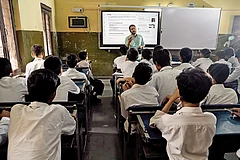


Awareness and observation are the foundation of thinking. They give rise to questions in the minds of the observer. Unless this learning takes place at the school level, the majority of children will not learn how to think in college.
Many developing countries became rich by moving workers from farms to factories and then to offices. If AI automates a significant share of office work to suit the needs of countries with falling populations, does it make India’s demographic dividend more valuable or more vulnerable?
Recent research shows that jobs in companies using AI intensively have increased, while those using it modestly have remained largely unchanged. This builds on more aggregate research showing that certain tasks are being eliminated by AI, but workers learning how to use AI are being reallocated to different tasks. So pessimism is unwarranted.
The demographic condition of India is very different from that of China and most developed countries such as the European Union, Japan, four states of the European Free Trade Association, Australia, Canada, the UK and the US. India’s share of the global labour force will rise, while that of these countries will fall.
As we show [in a forthcoming study], India will become the human-capital supplier to the world for high-, medium- and low-skilled workers. We must be wary of copy-pasting their analysis and solutions. They will use AI and robots to replace labour; we will use it to enhance the learning, skilling and the overall quality of our young workers in factories and offices. We can develop the human-AI interface to compete with pure AI/AI-intensive solutions. We will also use AI to build our comparative advantage in social services—health, education and government.
(This story appeared in Outlook magazine’s August 3 issue, 'The AI Divide', which focuses on how India's AI education ambitions are colliding with the reality of inadequate digital infrastructure, undertrained teachers and AI tools that are not built around Indian students' cultural context)