The Chhota Nagpur plateau, part of the Bengal Presidency during colonial times, covers the present states of Jharkhand, Orissa, Bengal, Bihar and Chhattisgarh. Earlier, this mineral-rich area was also the mother lode of Indian hockey. The Chhota Nagpur area has thrown up some brilliant exponents of hockey, like Jaipal Singh Munda, captain of the team that won India’s first Olympic gold in 1928, the legendary Michael Kindo and Sylvanus Dung Dung, and, more recently, Dilip Tirkey, a former captain.
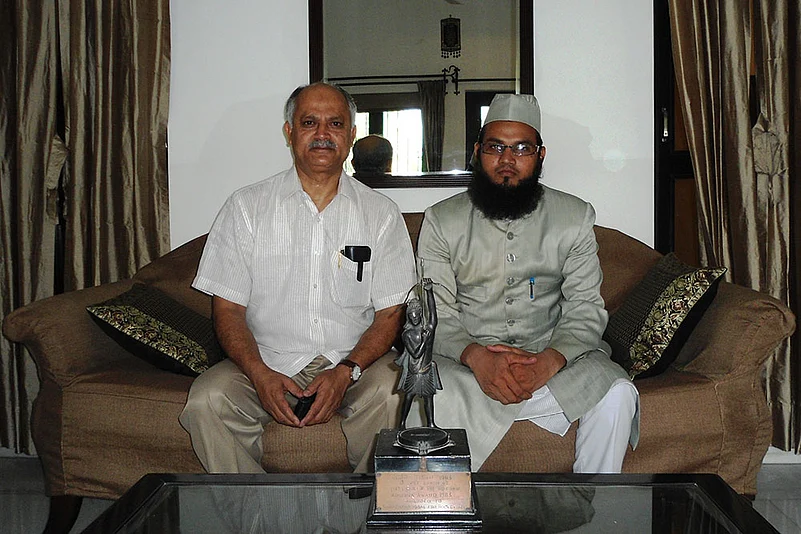
Despite these prominent names, little is known about Chhota Nagpur’s contribution to hockey in a cricket-obsessed country. It took research by renowned former India coach Ajay Kumar Bansal to dig up this unique history. The Dronacharya award-winner was smitten by the charm and the rich hockey legacy of Chhota Nagpur when he was a Sports Authority of India coach in Sundargarh, Orissa, from 1987-1992. Students of hockey would do well to peep into Bansal’s PhD thesis, titled ‘Socio-Cultural and Educational Influence on Sports: A Case Study of Tribal Hockey Players of Chhota Nagpur Region’. Bansal was under the supervision of Popinder Singh Kullar, a former professor at Jamia Millia Islamia in New Delhi and brother of former India player Col. Balbir Singh.
Interestingly, Kullar himself has done a PhD on Punjab’s Sansarpur village, on the outskirts of Jallandhar Cantonment, often referred to as a ‘hockey nursery’. The village, says Kullar, has produced 14 Olympians, 19 internationals who represented India and other countries, besides 110 national-level players who represented 20 states and 132 who represented various army teams.
These are just two examples of the several PhDs on hockey. Their subjects include hockey great Dhyan Chand, his son Ashok Kumar, Zafar Iqbal, and M.K. Kaushik, to name a few. Some more is in the works. For instance, athlete Poonam Taneja is working on former India captain and goal-keeper Ashok Diwan, a member of the 1980 Olympic gold-winning team, former Rajasthan and Haryana hockey player Sunita Ahlawat’s focus is, interestingly, Ajay Kumar Bansal, and Raipur’s Rahul Kumar Prasad is researching on former Olympian Syed Ali.

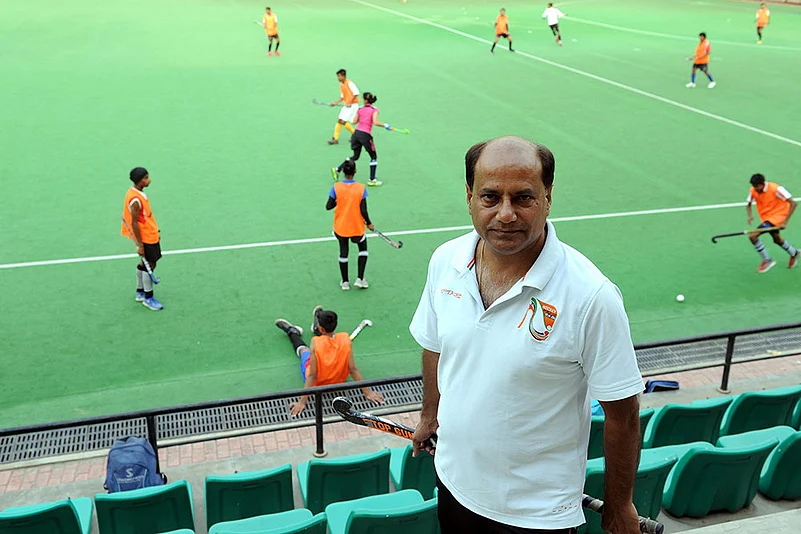

The former India coach wrote his PhD thesis on the role of tribal players in Chhota Nagpur in Indian hockey
Surprisingly, other sports haven’t attracted the same academic attention. “It’s so because hardly any information is available on the internet or elsewhere, and today’s people, generally, don’t want to work hard,” says Dr Suresh Kumar Lau, a retired associate professor at Delhi University.
Those who have earned doctorates on sports topics have hardly got their due. But that hasn’t deterred some institutions. Aligarh Muslim University (AMU) is a place that is churning out research scholars at an amazing frequency on a wide variety of sports-related subjects. According to Ikram Hussain, chairman of the Department of Physical Education at AMU, 41 PhDs on sports have been awarded to students recently. Another 25 students are pursuing such research. One of the most fascinating of them was ‘A Critical Evaluation of the Organisational Structure, Administrative Framework and Facilities of Sports in Uttar Pradesh Jails’. It was done by Riyaj Uddin, now an assistant professor in the Department of Education at O.P.J.S. University, Churu, Rajasthan.
Other interesting topics include ‘Exploring the Dark Side of Manufacturing Cricket Equipment’ (by Arshad Hussain Bhat), ‘Analysis of the Performance & Reliability of Materials To Be Used in Cricket Bat Handles’ (by Ashish Kumar Katiyar), ‘Biomechanical Analysis of Drag Flick in Field Hockey’ (by Saleem Ahmed), ‘Analysis of Penalty Corner of Indian Team as Compared to Foreign Counterparts in Field Hockey: A Biomechanical Study’ (by Arif Mohammad).
Apart from these, Pune-based cricket coach Atul B. Gaikwad has done his PhD on ‘Study of Illegal Bowling Action in Cricket: Causes and Remedial Program’; Allahabad resident Virendra Singh’s subject was ‘A Psycho-Physiological Study on Shuttler Abhinn Shyam Gupta’, an Olympian and former multiple badminton champion; veteran Mumbai journalist Makrand Waingankar researched on ‘150 years of Mumbai Cricket’. Multiple PhDs have been done on legendary athlete P.T. Usha. “Three people have done research on Usha. But I want to reveal now that none of them have returned all the material they took for the research. After that some more people approached us, but she declined,” Usha’s husband V. Srinivasan tells Outlook.
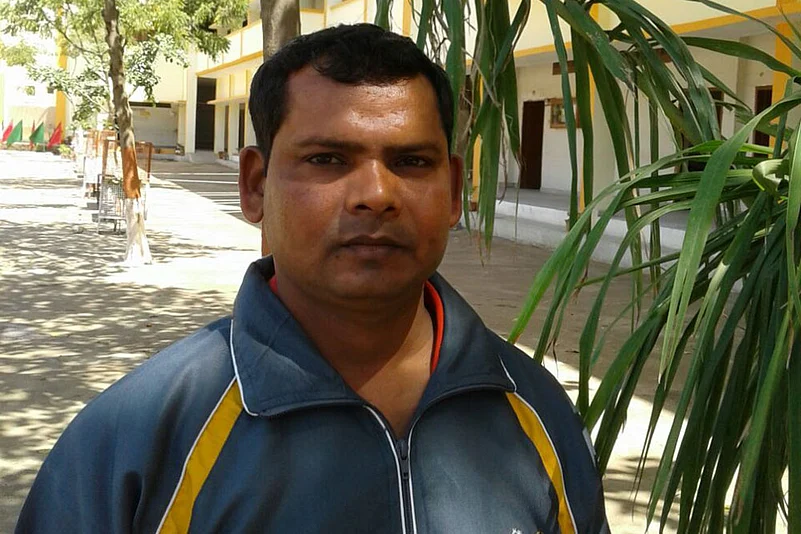
A former AMU scholar, now with O.P.J.S. University, he did his PhD on the sports facilities for inmates in UP’s jails
Unbelievably, not much research has been done on that mass opiate, cricket. A bigger surprise is that no one seems to have worked on arguably India’s greatest sports icon, Sachin Tendulkar, though one has been done on Sunil Gavaskar. “I’m sure nobody has done a PhD on Tendulkar, though more books have been written on him than on any other cricketer,” says Theo Braganza, owner of Mumbai-based Marine Sports, India’s oldest and most revered sports bookshop. Tendulkar was, however, among the 10 India captains on whom Arjunsinh Rana, a former trainer with the Indian team, based his research on.
The other big surprise is that only one PhD seems to have been based on Dhyan Chand—Kuldeep Singh Jhala’s ‘Major Dhyan Chand and His Family’s Contribution in World Hockey: A Case Study’. Jhala was was awarded his degree in 2012—76 years after Dhyan Chand won his third successive Olympic gold medal in 1936. “I enquired with several universities and friends across the country, but no one was aware of any other PhD on Dhyan Chand,” says Jhala, assistant director, Physical Education & Sports at Mohanlal Sukhadia University in Udaipur.
However, two theses have been written on former national hockey captain Zafar Iqbal—by Bahraich’s Mohammad Tanveer Khan, a former hockey player from AMU and presently with Lucknow’s Integral University, and Bhopal-based Azeemuddin Ansari. “I’m happy as well as surprised to know that I was so popular. But only others can recognise your actual contribution to the game,” an amused Iqbal, a brilliant left-winger and a civil engineer from AMU, tells Outlook. “Dhyan Chand stopped playing about 50 years ago and research on him has been done now. The PhD is, nevertheless, an honour for him—and also for other sportspersons who have been the subject of research,” says Iqbal. “These PhDs also show that the value of sports is on the rise, and I feel these efforts will lead to improvement in India’s sporting standards.”
Iqbal says the other advantage of doing research is that it eventually gets people jobs. But Bansal was already a SAI employee when he did his PhD on Chhota Nagpur’s contribution to hockey. While posted in Sundargarh, he discovered that even tribal Christians of that area had made a significant contribution to the sport. “The contribution of St. Mary’s High School in Simdega, now the district headquarters, is particularly significant. It had an ingrained hockey culture. For instance, it was mandatory for both boys and girls seeking admission in the school hostel to bring hockey sticks with them,” points out the 57-year-old Bansal.
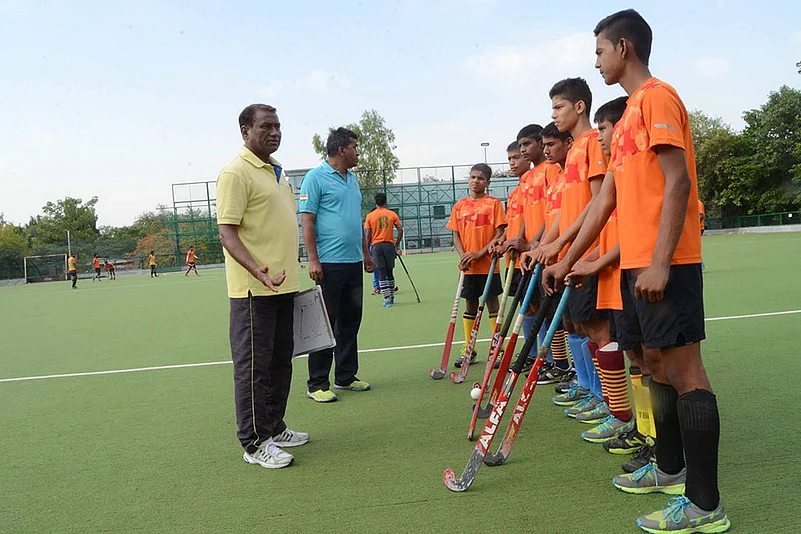
The son of the legend of world hockey, Dhyan Chand. The hockey great is the subject of a PhD, as is his father, on whom Kuldeep Singh Jhala has researched.
Legendary Michael Kindo, also a qualified coach, and right-full back Dung Dung are among the alumni of St. Mary’s, which had eight hockey fields—an unthinkable luxury in the present. The school, says Bansal, now even has an astro-turf field. Saleem Ahmed and Arif Mohammed of AMU, who did PhDs on the drag flick and the penalty corner respectively—a topical subject, for penalty corner conversions have long been the bane of Indian hockey—both interviewed former India drag flick expert Jugraj Singh, among others. “Not everyone who wants to consult me can meet me in person [due to distances]. These youngsters can benefit from these researches in times to come,” Jugraj says, saying that a research was being done on him as well.
The aforementioned Riyaj Uddin’s highly unusual subject was sports facilities in Uttar Pradesh’s prisons. He visited prisons in all 18 divisions of the state in 2009-10, and was horrified by the abysmal sports facilities for inmates. “There were no physical educators in the jails despite the Model Prison Manual 2003 prescribing one instructor in every jail. There were hardly any sports equipment available there. In some jails, inmates just watched sports on TV,” says Riyaj Uddin. Even now, there are no physical instructors in UP prisons, says Devendra Singh, current ADG Jails, Uttar Pradesh. “It is so because the Model Prison Manual doesn’t apply to the states. Appointing instructors is not part of our [UP] manual, as law and order is a state subject,” Singh, a keen cricketer, tells Outlook.
Riyaj Uddin found that most jails had volleyball facilities, though, perhaps because the sport requires little investment. “In one prison, I met a former national-level volleyball player from Uttar Pradesh who was serving a life term for committing murder,” he recalls. The rate at which academic sports-lovers are going about, ploughing the field methodically and with rigour, we will probably see many more PhDs being awarded in future. And, as Zafar Iqbal and Jugraj Singh say, all this painstakingly assembled scholarship would only be deemed worthwhile if it enthuses youngsters to strive for greater glory on the playing fields.