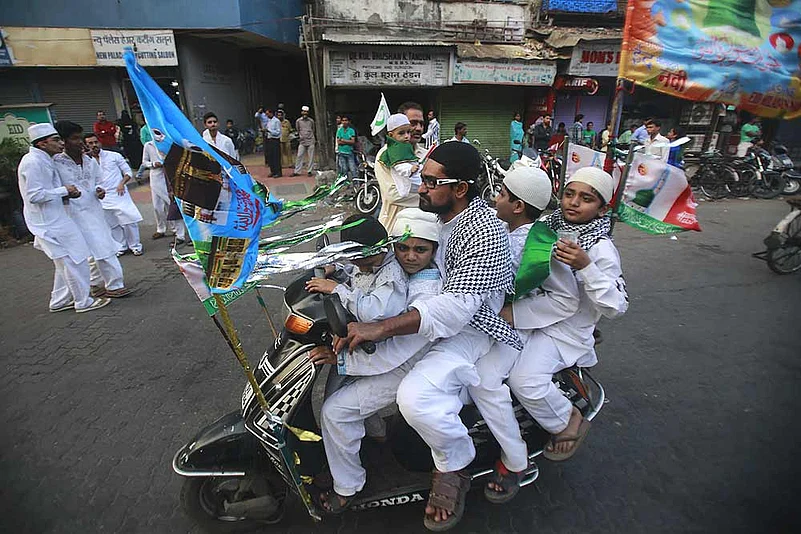
In the recent state elections, the Congress not only lost its other old vote-blocs but also the Muslims. The edifice it had built with Muslim support, which had of late been crumbling with their shift to regional parties, eventually collapsed. But does that mean Muslim identity politics has crumbled too? For years, the Congress fostered Muslim identity politics, in alliance with orthodox and feudal elites of the community, to counterpoise it against Hindu hegemonic competition. It was through these elites that the party communicated with the Muslim masses. It would have been against the natural instincts of these elites, even a mite self-destructive, to fight for real issues affecting the Muslim masses, such as poverty, education and employment. Religion was the rope they used to keep a diverse community—comprising the rich and the poor, Sunni, Shia, Deobandi, Barelvi, Sufi, Salafi, Bengali, Malayali or Kannada- or Telugu-speaking—thinking as one. They all had to protect the Shariah, promote Urdu, keep the government off madrassas, lead life by fatwas. The elites projected the interests of Muslims as distinct from those of Hindus. That way alone could they perpetuate their power and authority.
If Muslims started supporting regional parties instead of the Congress, it wasn’t because of social churning but because of a self-perpetuating switch of elite patronage: identity politics moved from one house to another. The real issues were still kept from coming into prominence. Where is the voice of the Muslim poor in the self-proclaimed Muslim voice of the country? Where is the assertion of the liberal values of the Muslim middle class?
In the last few years, undercurrents running contrary to the surface flow have been threatening to shake the foundations of Muslim identity politics. For one, post-liberalisation, opportunities for life improvement have opened up. And two, a middle class espousing liberal values and challenging orthodoxy in several Islamic countries is influencing Muslims in India. The focus of Indian Muslims is slowly turning to economic interest. Seeing the progress of other communities, they have begun to ask: “What have we got? Why are we lagging?”


The setting up of the Sachar committee was a recognition of these undercurrents by Congress. It seemed the party was moving from identity politics to concentrate on real-life issues. The party accepted all the committee’s recommendations, and in 2007-08 launched a multi-sectoral development programme for 90 districts with a 25+ per cent minority population. It also introduced the prime minister’s 15-point programme for education, skill development and other enabling measures for the community. But in trying to reach benefits to the minorities without antagonising the majority, there was poor delivery of both programmes, especially because there was no targeted delivery and monitoring. This failure to make any post-Sachar impact, coupled with the shrinking of opportunities due to the global slowdown and UPA-II’s mismanagement of the economy, led to Muslim disenchantment with the Congress. They looked for alternatives; so much so, it wasn’t uncommon to hear Muslim voices in the bipolar states of Rajasthan and Madhya Pradesh saying they could vote for the BJP for better job and business opportunities. Post-poll reports suggest some sections actually did.
Will it be right to infer from this that the lines between the Congress and BJP are blurring in the Muslim eye as they are in the Hindu eye? Will Muslims too see the difference between the two as only about who manages the economy and governs the country better? Are Muslims going to see their interests as not distinct from those of the Hindus? If they do, that would be cause for celebration for the BJP. For, will it not prove what they have been saying all these years—that Muslims should not be treated as a separate social, political or economic category? Narendra Modi has been speaking almost like a Marxist to make the point: poor Muslims should not fight poor Hindus but fight poverty in solidarity with them.

What about security? What about identity? On security, there is little for Muslims to choose between the Congress and the BJP. They have been as much insecure in a Congress regime as in a BJP regime. Modi deserves denunciation for the 2002 slaughter of Muslims of course, but communal violence did not begin in Gujarat with Modi. The first major slaughter of Muslims took place in 1969, when Congressman Hitendra Desai was chief minister and Indira Gandhi was PM. Muslims were killed in large numbers in 1985 under Congress CM Madhavsinh Solanki. Four years later in Bihar, hundreds of Muslims were butchered in Bhagalpur under a Congress-run Bihar government.
Whether a state was under a Congress or BJP government, communal violence followed an identical pattern: first, an explosive climate was allowed to build up; then a trivial incident lit the fuse, as the forces of the law absented themselves; rumour fanned the fire, with government measures inadequate to stanch them; and then, mobs killed people, set homes and shops on fire, aided or abetted by a partisan police. Post-violence, the pattern everywhere was the same: a judicial probe to calm things down, but no action on its recommendations.
For the first time, the Congress thought of differentiating itself from the BJP in the eyes of Muslims by promising a bill to deter communal violence in its 2004 manifesto. The idea was obviously triggered by the 2002 Gujarat riots, and the Congress could possibly have gained some Muslim sympathy had it managed to get it passed on assuming office, but it took almost a decade to bring it up. The bill was opportunistic as well as inadequate. Legal safeguards can never be enough to stop communal violence. In fact, they are the last defence. The first should be social safeguards. Committees with representatives of all communities need to be formed and strengthened for resolution of conflicts. Community policing must become an integral part of thana policing, with personnel picked and trained to establish relationships of trust with communities. Such measures could help offset the creation of charged climates, defuse the triggering event (usually petty), and check rumour-mongering. In effect, they could prevent major riots from breaking out.
With just a bill and no solid institutional foundations to back it, the Congress might find it hard to convince Muslims in the run-up to the Lok Sabha polls that it is serious about protecting them from Hindu violence. Apart from other issues, the Congress lost the support of Muslims in Rajasthan because there were no conflict resolution mechanisms at the grassroots to tackle minor disputes that flared up into communal violence in about a dozen places in the state during Ashok Gehlot’s tenure. What drove the last nail in the Congress coffin was the brutality of the Hindu-partisan police.
Who do the Muslims turn to for their security then, the BJP? It might sound like the lamb seeking the tiger’s shelter, but what is the choice? The Congress failed; now the regional party in Uttar Pradesh has failed too. In recent elections, the BJP got the votes of sections of Muslims in Rajasthan and Madhya Pradesh. Of course, this also had to do with the soft image of Vasundhararaje and Shivraj Chouhan and the fact that there has been no major communal violence associated with their tenure. But in the Lok Sabha elections, it will be Modi the Muslims have to decide about. Will they go to him? Modi is not just another BJP leader: he has become a metaphor for the worst fears of Muslims. He is out to frustrate the Congress move to get the communal violence bill passed—naturally, because it provides for major penalties to communal ‘associations’ and negligent or partisan government officials. Will Muslims vote for someone who now promises better economic opportunities but no security of life and property? If you lose your life and all that you might build with better incomes, what is the point? Will it not be self-destructive?

Yet illusion and perception play a role in a voter’s choice: on his part, Modi has been trying to position himself as a better guarantor of progress and security to Muslims than the Congress. His plea is that no violence has taken place against Muslims in Gujarat after 2002 and they have benefited from economic growth in his state as much as other communities: he poses like a Santa Claus tossing chocolates and anyone can take as many as he wants. It is well known that Modi has worked hard to conceal the 2002 taint with the paint of development, to change his image from that of a religious bigot to that of an economic reformer. In his blog on December 27, 2013, a day after a court rejected a petition challenging a probe report clearing him of complicity in the Gulbarg Society riots case, he said he was “shaken to the core” by the “mindless violence” in 2002. He suffered much more than “grief”, “sadness”, “misery”, “pain”, “anguish”, “agony”—“mere words” could not capture the “absolute emptiness” he felt on witnessing such inhumanity, he said.
Modi’s game obviously is to influence Muslim voters who might be torn by this dilemma: to vote for economic interest or security? Yet, despite his assurance of equitable gains from economic growth as well as security, Modi will not have answered a critical question of Muslims: will he not work, with all the powers of the country’s chief executive’s post, as the RSS’s chief executive for fulfilment of the organisation’s mission of cultural conversion of Muslims to Hinduism? After all, the real question in Ayodhya was not only to undo the historical injustice of destruction of a temple by an intolerant Muslim ruler but to force the Muslims to accept Ram as a cultural hero. The essence of the ideology of the RSS, as enunciated by Hedgewar and Golwalkar, lies in a condition put to Muslims: accept the glory, philosophy, heritage, literature and way of life of 5,000 years that political Hinduism stakes claim to if you wish to deserve acceptance as members of this nation.
The difference in the Muslim policy of the Congress and BJP was clear: the Congress stood for nationalist uniformity and cultural diversity and the BJP for both nationalist and cultural uniformity. But the Congress’s Muslim policy has proved to be self-serving. Protection of cultural diversity has come to mean patronage by a liberal party to illiberal sections of Muslims, who have used it to keep the masses from thinking beyond Islamic commandments as they interpret them, which has meant preservation of institutions, dogmas, customs and practices that bar their participation in gains from movements for social justice, gender equality, modern education and equal employment. The Congress’s own electoral interest has thus only promoted the self-isolation of Muslims, creating space for the RSS to win increasing support among Hindus by projecting their self-isolation as proof of separatism and existence of an “enemy within”. Much of the RSS’s growth is actually Congress work: the RSS might have been the mason of its grand edifice, but a lot of building materials to it was supplied by the Congress.
Today, the Congress finds itself in a pitiable situation. In the past two decades, it has helped the BJP grow in reaction to its fostering of Muslim illiberalism and it has lost the illiberal Muslim sections to regional parties too. It has tried soft Hindutva to check Hindu mobilisation by the BJP and failed. It has tried to placate Muslim illiberalism and failed. It does not know how to regain the Muslim vote now.
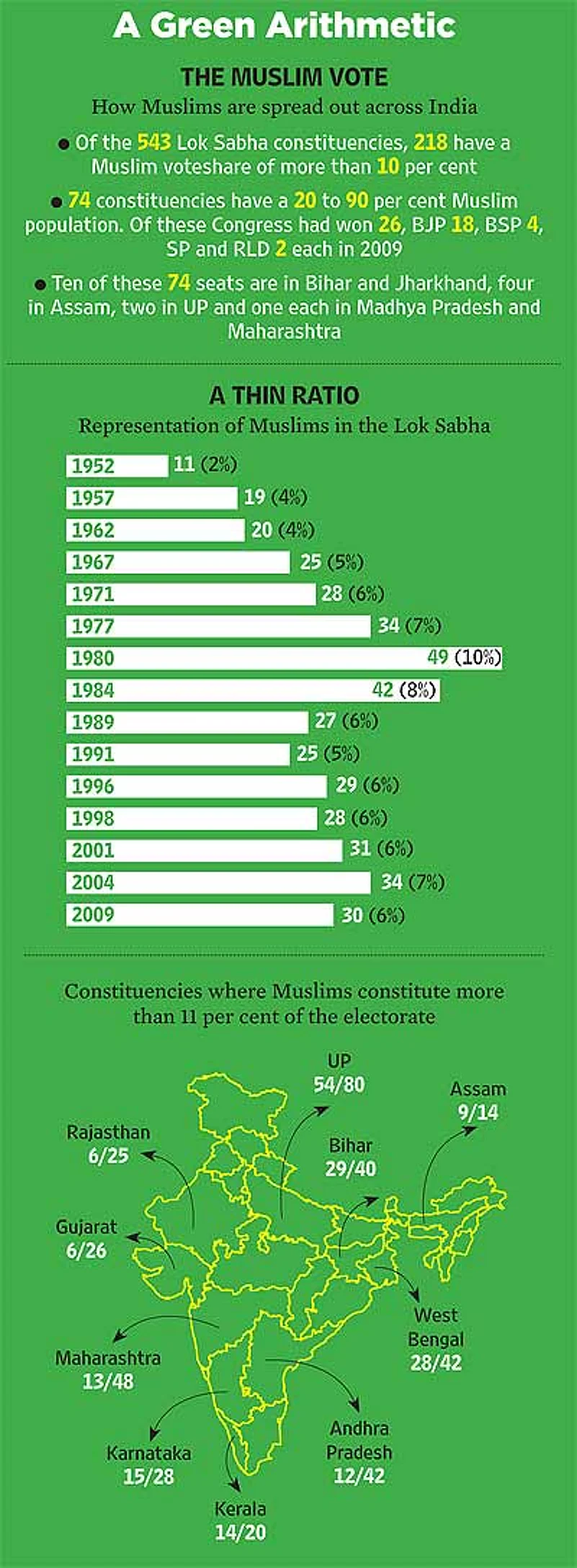
Muslim politics thus stands at a turning point. Even though the trend may still be subterranean, economic compulsions are driving more and more Muslims to think of the BJP as an alternative. This could suggest that Muslim identity politics, which thrived on the premise that the interests of Muslims were distinct from those of Hindus, may be on a downslide. In a not-too-far future, economic identity might override their religious identity. Already, despite odds, a Muslim middle class has been emerging. The literacy rate among Muslims, even though far below the general average, is not insignificant at 60 per cent. What this means is that an increasing number of Muslims are seeking general education and job and business opportunities in the open marketplace. The impact of this is exposure to broader intellectual and social environs that is bound to promote liberal and human values, shrinking the constituency of the orthodox elites.
The Congress, if it can see the writing on the wall, should reinvent its policy vis-a-vis Muslims and build up alliance with the broader Muslim masses, whose members are yearning for gains from economic growth. It has to de-emphasise Muslim identity politics and put emphasis on the economic interests of the middle class and underclass of the community. It has to realise that the interests of the Muslim masses are not the same as the interests of the orthodox elites. In fact, these interests may often run contrary to each other.
If the Congress throws its political weight behind the broader Muslim masses, it will weaken the power and authority of the orthodox elites over them, which in turn will reduce the scope for the RSS and BJP to excite Hindu fears of Muslim separatism. It will shift the focus from differences to similarities between Hindus and Muslims. A reinvention of the Congress’s Muslim policy will therefore be good for the Congress, for Muslims and for the country. And what is more: it might be good for the BJP too, for it will have to reinvent its politics in the absence of fears of a ‘Muslim conspiracy’ and truly become a secular party.
(Arun Sinha, a senior journalist, is the author of Nitish Kumar and the Rise of Bihar, a Penguin book.)