The App-Based delivery is not just a logistics innovation but a labour regime that compresses time, erases safety margins, and pushes workers into risk-taking behaviour
The failure of delivery-worker strikes reveals a structural shift that platform work is designed to neutralise collective action and worker organization.
Gig workers are formally excluded from social security, insurance, and labour protections, With this model, where productivity is detached from rights, activists says India is sleepwalking into a future of work stripped of rights
At 10:15 pm, Bhupendar, a 36-years-old delivery rider accelerates through a traffic red light at New Friends Colony in India’s national capital Delhi. His phone vibrates again. “Delay risk: order at 7 minutes.” His heart skips a beat. He has already crossed two red-lights without slowing down. The app does not tell him to break traffic laws, but it does not need to.
The countdown clock does the work. Bhupendar is delivering groceries promised in ten minutes—a guarantee he did not make, for a speed he does not control, under risks he alone must bear. For the order, he will earn Rs. 27. The app’s incentive chart flashes bonuses for “high efficiency,” penalties for cancellations, and complete silence on what happens if he is hit by a car. There is no insurance card in his wallet, no paid sick leave to fall back on, no union office to call if something goes wrong.
By the end of his shift—nearly thirteen hours—he has delivered groceries faster than any kirana shop ever could. He has also skipped meals, ignored a growing pain in his knee, and driven in ways he knows are unsafe. Tomorrow, he will log in again.This is what work looks like in the ultra-fast service delivery model in which labour is infinitely replaceable. As part of a faceless crowd working in the gig industry Bhupender had to surrender his individual rights when he chose to work as a delivery agent. It was not as if there was much option. With increasing unemployment, this was the last resort. India’s quick-commerce market grew from a marginal segment pre-2020 to an estimated $5–6 billion market by 2025, driven largely by 10–15 minute delivery promises. Despite revenue growth, per-order payouts for delivery workers have either stagnated or declined in many cities since 2022, according to worker collectives and platform pay screenshots.




A Strike That Didn’t Matter
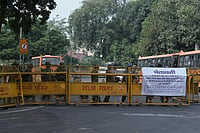
On December 31st, 2025 he along with tends of thousands of delivery workers participated in a strike, demanding higher per-order pay, accident coverage, and limits on algorithmic penalties. The strike barely registered. Orders continued to move. New riders logged in. Customers noticed nothing. Social media posts circulated urging riders to log out en masse. The platforms barely flinched.Orders continued to be fulfilled. The apps sent notifications offering temporary incentives to those who stayed logged in. A steady supply of new workers—many recently unemployed or underemployed—filled the gaps.India’s ultra-fast delivery boom has been sold as innovation. Ten-minute groceries, instant commerce, hyperlocal logistics—these are presented as triumphs of technology and efficiency. Companies like Zepto, Blinkit, and Swiggy’s Instamart have turned speed into a brand promise, competing not just on price or selection but on how quickly goods can materialise at a customer’s doorstep.What is less discussed is that speed in such a service delivery model is not simply a technical achievement. It is an organising principle for labour. Ten-minute delivery compresses time in ways that fundamentally alters working conditions. Warehouses are placed closer to residential areas. Inventory is algorithmically optimised. Routes are calculated to the second. Every delay—traffic, weather, fatigue, injury—is treated as a personal failure of the worker rather than a structural constraint. It normalizes working conditions which are risky and dangerous and offers nothing in return to the delivery worker.
Life Inside the Timer
For delivery workers, the economics are unforgiving. Pay is calculated per order, with small incentives layered on for completing a certain number of deliveries within a fixed time window. Fuel costs, vehicle maintenance, mobile data, and protective gear are borne entirely by the worker.A delivery rider in Noida describes the system bluntly: “If you slow down, you lose money. If you rush, you risk your life. Either way, the app wins.”Algorithmic management replaces human supervision. Workers receive automated warnings for “inefficiency,” their ratings fluctuate without explanation, and penalties are imposed with no appeal mechanism. A low rating can mean fewer orders. Fewer orders mean less income. There is no formal termination letter—only a gradual disappearance of work.
Structurally Impossible to Organise A Strike in Gig Economy
Several riders interviewed for this story spoke of colleagues injured in crashes who were unable to work for weeks. Without paid leave or medical coverage, they simply stopped earning. Some borrowed money. Others dropped out of the platform entirely, replaced within days by new sign-ups.The system relies on this churn. Workers are not meant to stay.For labour historians, this moment is telling. Strikes are effective when workers can disrupt production. The failure of these strikes was not due to apathy but to structural design. The gig economy has been engineered to make collective action almost impossible.Workers rarely meet each other. They are classified as “partners” or “independent contractors,” excluding them from traditional labour protections. There is no shop floor, no shared break room, no stable workforce.
Work Without Social Citizenship
At the heart of this model is a redefinition of what work entitles a person to. For much of the twentieth century, employment—even precarious employment—was tied to social citizenship: access to welfare, insurance, legal protections, and the recognition that labour created obligations beyond wages.
The gig economy severs this link.Delivery workers are not employees. They are service providers. The language matters. As non-employees, they are excluded from provident fund contributions, employee state insurance, paid leave, and formal grievance redressal. Injuries are personal misfortunes, not workplace hazards.
The state has largely accepted this framing. India’s labour codes gesture toward gig-worker welfare, but implementation remains weak and voluntary. Registration schemes exist on paper, while enforcement is minimal. Responsibility is diffused across platforms, aggregators, and contractors.
What emerges is a future of work stripped of social citizenship: labour without rights, productivity without protection.
Normalising Dangerous Working Conditions
What makes ultra-fast delivery particularly revealing is how quickly its dangers have been normalised. Riders speeding through traffic are treated as minor nuisances rather than symptoms of systemic pressure. Accidents are framed as individual recklessness, not algorithmic coercion.
Consumers play a role in this normalisation. The app interface shows progress bars, cheerful icons, and countdown timers. There is no visual representation of risk, fatigue, or injury. Speed feels clean, frictionless, and morally neutral.But speed is not neutral. It is enforced.
A ten-minute promise compresses the margin for safety to almost nothing. Any delay must be absorbed by the worker’s body—through faster driving, skipped breaks, or ignored pain. Efficiency is achieved not through technological magic but through human exhaustion.Those who can afford to opt out rarely see this. Convenience creates distance. The rider remains invisible.
The Cost of Choice—and the Absence of It
Delivery platforms often argue that workers choose flexibility. They can log in and out. They are not forced to work long hours.This argument collapses under scrutiny.
Most delivery workers interviewed said they work long shifts not because they want to, but because they have to. Earnings are unpredictable. Incentives push them to stay logged in. Logging out means losing income for the day.Choice exists only in theory. In practice, economic necessity dictates behaviour.The dangerous truth is that this system depends on people who do not have alternatives. Migrants, young men from working-class backgrounds, those pushed out of other forms of employment—they are the ones bearing the costs of “innovation.” Speed is a luxury enjoyed by some, subsidised by the precarity of others.
A Preview of the Future
The app-based ultra-fast service delivery system should be treated as a preview of what labor will look like in future. As more sectors adopt platform models—logistics, care work, education, media—the same logic spreads: classify workers as contractors, manage them by algorithm, externalise risk, and frame precarity as flexibility.Delivery workers are not an exception. They are the testing ground.If strikes fail to disrupt these systems, if accidents fail to slow them down, if public outrage never quite materialises, then a dangerous precedent is being set: that work no longer guarantees dignity, safety, or security—only the opportunity to keep logging in.At the end of another shift, the Delhi rider checks his phone. The app congratulates him for “excellent performance.” His earnings are just enough to cover fuel, food, and a small transfer home. There is no acknowledgment of the risks taken, the laws bent, or the body worn down to keep a promise he never made. Tomorrow, the timer will start again.
The failure of strikes has shown that the gig economy is no longer an experiment—it is an infrastructure built to function without workers having any rights. We are looking at a future where labour is present everywhere but rights are nowhere, where citizenship ends at the login screen. The danger is not that this model will collapse. It is that it will succeed—and spread.