Diminishing returns
Despite massive investments, irrigation is in a mess
- Rs 99,610 cr spent but area covered shrinks by 3 million hectares in 1992-2004
- Political pressure creates unviable projects. Opacity and kickbacks is the norm.
- Lack of ample canal desiltation means Rs 4 cr worth stored water lost per day
- Use of groundwater is on the rise. But very little investment made to recharge it.
- Yet, another Rs 1.65 cr has been sought in the 11th FYP for surface irrigation
***
"For 16 years, we have poured out money. The people have got nothingback—irrigation, no water, no increase in production, no help in their dailylife."
Rajiv Gandhi, addressing state irrigation ministers in August 1986.
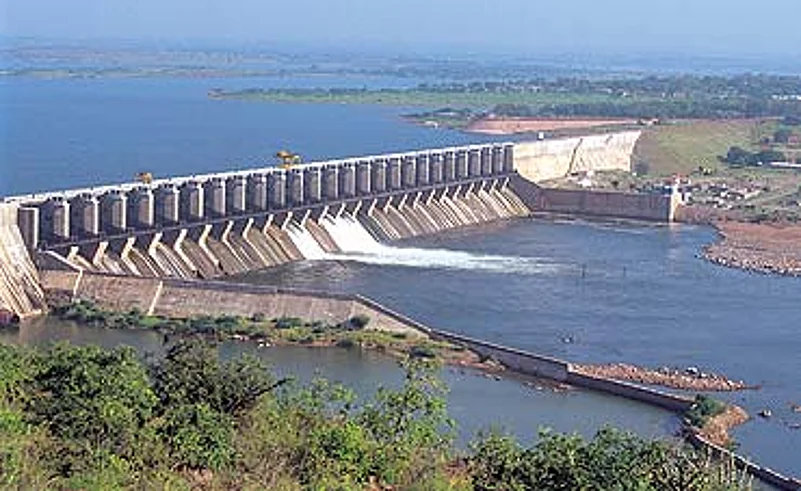
Several unviable projects come up in areas due to political pressure. For example, a dam in Andhra Pradesh was okayed despite reports from the chief engineer of the project that it would dry up during lean season. Similarly, irrigation canals are built to ensure water is diverted to one section of farmers like sugarcane croppers at the cost of others—again because of political lobbying. Of course, controversy kept shrouding the awarding of contracts, allocation of funds and periodic reviews of projects.

Siltation of dams and canals:
A mid-term appraisal of the 9th finance plan in October 2000 underlined the "urgent need to review the status of reservoir sedimentation". This warning was ignored. Again, a report of the National Commission of Integrated Water Resources Development cautioned that as much as 65 billion cubic metres of water would be lost by 2050 if sedimentation wasn't taken care of urgently. Given that the government spends Rs 1,448 crore to create every 1.3 billion cubic metres of water storage, it means losing Rs 4 crore due to siltation every day! The World Bank, in its 2005 report on India's water economy, had this to say about the country's irrigation systems: "Much of what is being built is not being maintained, and that which still does function delivers services of a low quality."
Optimistic hydrological predictions:

Before any major irrigation project gets under way, engineers predict the availability of water from it in the next 10-15 years. But, as the Sardar Sarovar Project (SSP) revealed, these are optimistic predictions. The Narmada Water Disputes Tribunal allocated 8 million acre feet (maf) of water to Gujarat on the assumption that the Narmada has 28 maf of water. But actual measurements showed it has only 22 to 23 maf. Similarly, the SSP also claimed an irrigation efficiency of over 60 per cent. But now even the ministry of water resources (MOWR) concedes that the highest water availability has never been above 35-40 per cent.
Over-exploitation of rivers: There are a number of claimant states who want a share of a river's water. The burden of catering to several states means each project's ability to generate irrigation water is considerably reduced. The dispute between Tamil Nadu and Karnataka over Cauvery water is well documented. Sharing of river water is a contentious issue between other states as well. When Madhya Pradesh built a large number of small check-dams in the Chambal basin, Rajasthan complained that this had reduced the water flow into the Gandhi Sagar dam. In fact, Rajasthan even went ahead and demanded that Madhya Pradesh demolish the dams.
Now with the working group on irrigation demanding Rs 1.65 lakh crore, Thakkar fears that data and projections may have been fudged by the MOWR to push for additional funds. "They seem to be indulging in exaggerating the potential of canal-irrigated areas," he says and cites the case of Maharashtra.
The working group chaired by secretary, MOWR, Gauri Chatterjee, stated in its report to the Planning Commission that Maharashtra covered 2.147 mha in 2001-02 and 2.313 mha in 2005-06 through major and medium irrigation projects. But the figures supplied by the Maharashtra government in its five-year benchmark report has it that in 2001-02 it managed to cover only 1.25 mha and in 2005-06 1.617 mha. So the MOWR was exaggerating figures. Hidden behind these statistics is the story of how various governments at the Centre as well as the state have been pushing for more investments while water availability has been steadily going down. According to several experts, India needs to take the focus away from irrigation to recharging groundwater. Says Dr Tushar Shah of the International Water Management Institute: "We must stop investing huge sums in surface irrigation, instead spend the same money in recharging our groundwater reserves." His study based on the irrigation census conducted every five years shows that there has been a clear deterioration of irrigation systems across the country.
The MOWR needs to do a rethink on its water and irrigation strategy. But, Indra Raj, commissioner, MOWR, feels the agriculture figures are unreliable and "underreported." But Thakkar, author of the study, says the MOWR has no figures while the agriculture ministry figures are based on ground measurements and field reports. Many experts stress the need for an objective assessment of the policy being adopted in the last 20 years. Perhaps, the Planning Commission could take the first step by refocusing the national water policy in the 11th plan.