Public Money...
- 10 per cent hike in DA for state government employees, bringing them on par with central government employees
- Five eggs a week for schoolchildren covered by the midday meal scheme
- More rice, dal and oil in the meal scheme
- Rs 15,000 more per unit for the Indira Awas Yojana, raising the state government’s share per unit to Rs 75,000
***
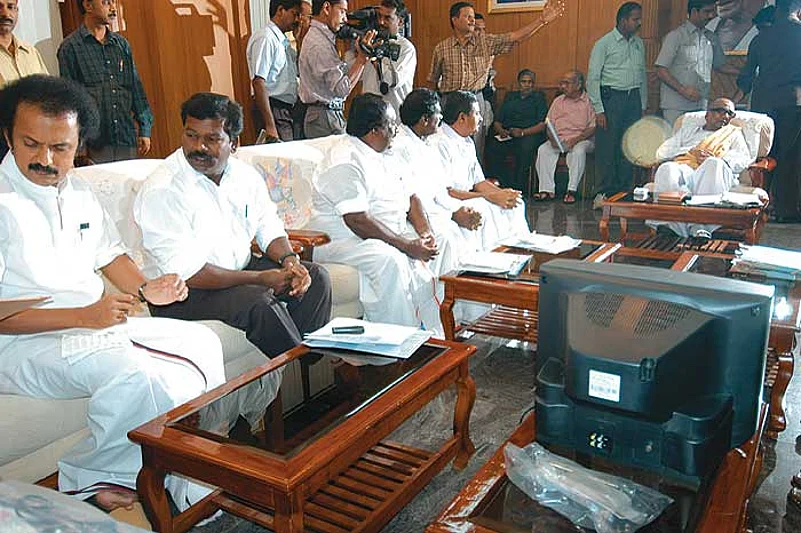
From any other atheist, this might seem unusual, but the politics of sops and facile justifications is second nature to Tamil Nadu chief minister M. Karunanidhi. “Irrespective of criticism,” he declared, announcing some freebies recently, “we will continue with our pro-people programme, because we believe that serving people is like serving God.” To those who criticise his spending of state money with an eye to the assembly elections next year, Karunanidhi says, “It’s the policy of the DMK to wipe people’s tears. What’s needed for a project is not panam (money) but janam (people).”
And since he needs the janam for the votes, he has announced sops for everyone—a 10 per cent hike in dearness allowance, bringing them on par with central government employees (cost: Rs 2,190 crore per year); five eggs a week for children covered by the mid-day meal scheme (cost: an extra Rs 125 crore over the Rs 924 crore); more rice, dal and oil under the meal scheme (cost: Rs 74.33 crore). He has also raised the state’s share per unit under the Indira Awas Yojana from Rs 60,000 to Rs 75,000. A fortnight before that, he raised the per-unit funding for the state’s own Kalaignar Housing Scheme to the same amount. The total cost of converting three lakh of the targeted 21 lakh huts to concrete houses in the first phase is Rs 2,250 crore, while the hike in unit cost for Indira Awas Yojana means the government has to fork out an additional Rs 153 crore.


Prof C. Lakshmanan of the Madras Institute of Development Studies (MIDS) says the sops are in tune with the DMK’s syndrome of “feudalism, nepotism, sycophancy, hypocrisy, and keeping people from asking questions”. Jayalalitha, he says, was no different.
While there is concern that the largesse might bankrupt the state, there’s good news too. The commercial taxes collected from April to August this year was Rs 12,477 crore (Rs 9,797.57 crore was last year’s figure). Collections could cross Rs 30,000 crore by the fiscal year-end, bringing the state’s revenue to a little over Rs 63,000 crore and consequently revenue deficit, which was projected at Rs 3,396 crore in the budget, will decline.
Politicians have picked holes in this sop opera. AIADMK chief Jayalalitha says the scheme offering two acres each to the landless poor “is a total failure”. She claims the needy were bypassed because DMK party workers grabbed the land. To which Stalin, Karunanidhi’s son and deputy chief minister, reparteed: “The CM thinks only of the welfare of the state. For him Tamil Nadu is Tamil Nadu, not Kodanadu (where Jayalalitha has an estate in the Ooty hills).”
Some economists, like Dr Padmini Swaminathan of MIDS, however, back the state government’s programmes. “Financially, the state is not doing so badly,” she says. “There is media hype about populism, but there has been some impact—although there’s no hard data to substantiate it.” She says even the Planning Commission’s blueprints have flaws as far as job creation goes. But in Tamil Nadu, she says, delivery of sops is monitored: people benefit, despite leakages owing to corruption.
Lakshmanan says the focus on sops papers over the real problem. “The drain on the exchequer is not because of sops, but because of the concessions the government is doling out to mncs and industrialists,” he says. “It’s cakes for the rich, lollipops for the poor.”