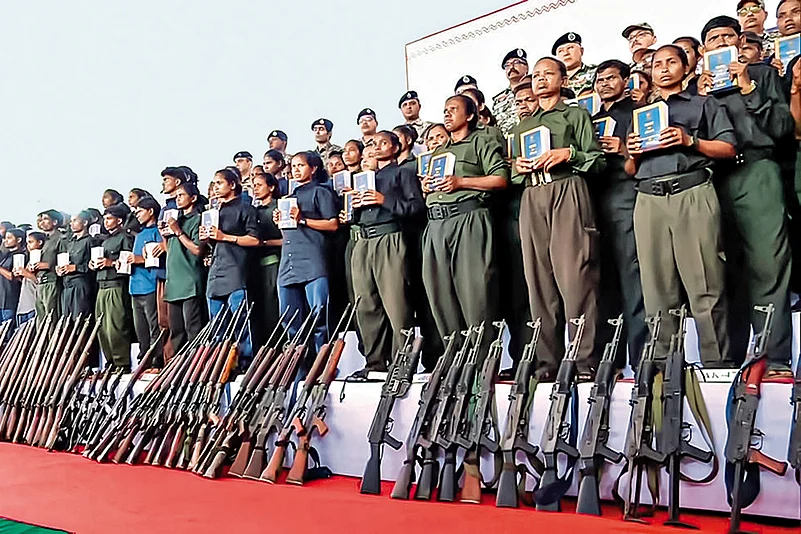
Wearing a Casio watch on his left wrist, Mohan walked into the office of the Dantewada Superintendent of Police, along with his wife, and surrendered in January 2026. It was a message from his mother that melted his heart. “Son, if you don’t come back, who will light my pyre?” she said in a video released to the media towards the end of 2025 after Mohan, famous as Azad Kadti, escaped an encounter in which Maoist leader Urmila, wife of senior operative Papa Rao, was killed.
The world around Mohan has changed during the past six months. But two things remain unchanged: the Casio watch on his wrist and his wife Sumitra by his side. “This is not a regular watch. It was very helpful. It has an alarm and a torch. It was an essential part of my life, when mobiles were not allowed [during Naxal days]. It is still very useful,” he says, while talking to Outlook at his college where he is learning plumbing work.
His wife completed a sewing course from the same place, Livelihood College in Dantewada, Bastar division, around mid-July. He is waiting for July 31 when his course comes to an end and he goes back home to his mother and wife. The duo got married in 2018 in the camp and had rewards of Rs 8 lakh each on their heads when they surrendered.
They are both happy to start a new life. For the past three months, they were living in separate hostels in the campus and could meet each other only during the college hours. “I spoke to her last night. She has already started sewing. She earned Rs 500 by investing only Rs 50 in threads,” says the 32-year-old.



Several men and women across Bastar and Dantewada, once considered a Naxal hotbed, are trying to build a new life after surrendering during the past eight to 10 months.
Twenty-three-year-old Faguni surrendered before the Chhattisgarh police in 2025, after spending almost five years with a Naxal squad. Her eyes hold a vision for a colourful future, one without any violence and full of promise. Wearing a mustard yellow uniform of the Pandum Nukkad Cafe in Bastar’s Jagdalpur, she says she wants to lead a happy life. With a reward of about Rs 1.50 lakh, Faguni was among the last recruits before a massive crackdown on Naxalism changed her mind. “I was told more people from the village would join me later, but they never came,” she says. When asked as to what she really wanted to do in her life, she says she is yet to discover her liking, but right now she wants to earn some money and continue her education.
Several men and women across Bastar and Dantewada, once considered the Naxal hotbed, are trying to build a new life after surrendering in the last eight to ten months.
Though their time of entry and specific reasons differed, all of them say that they went to the ‘organisation’—the Communist Party of India (Maoist)— CPI (M)—because they were unhappy with the atrocities and had no money and food to survive. The same police and administration that once were the villains of their stories are now helping them to build a new life.
Lakman, Faguni’s friend from the camp, is also part of the cafe that started in November 2025. While she has been part of the cafe since the beginning, Lakman joined in July 2026. Carrying a reward of Rs 8 lakh on his head, he now works as a cleaner in the cafe due to lack of formal training in the hospitality business.
He was the bodyguard of Rupesh, a former high-ranking central committee member of the CPI(M) and military intelligence chief. Lakman was among those who surrendered along with Rupesh in October 2025 in Jagdalpur, Chhattisgarh.

In their fight to protect ‘Jal, Jangal and Jameen’ (water, forest and land rights), the former Naxalites were accustomed to using weapons and faced direct combat with security forces for many years. Today, they are learning how to brew coffee, stitch clothes, repair electrical appliances and weld, rebuilding their lives one trade at a time.
For Lakman and Faguni, just like Mohan, the family was their motivation to quit, but for Lakhmu (25), another surrendered Naxal who works in the cafe, it was the budding romance in the camp that made him quit everything. “She [his partner from the camp] was not happy there. One day, she expressed that she wanted to leave. I wanted to make her happy. It was during a conflict with the police that I wrote a letter to the leader and ran away with her,” says Lakhmu.
Rehabilitation Initiatives
The cafe is a part of the Surrender and Rehabilitation Policy and is operated under a partnership between the Bastar police and the Team Nukkad cafe. It employs about 20 people from families that have suffered from Naxal violence and those who have surrendered.
While these are some who have found a way forward, many of their former comrades are still in rehabilitation camps awaiting training and inclusion in the real world.
India won its battle against Naxalism officially in March 2026 when the government declared the country ‘Naxal-free’ after a mass-scale surrender and crackdown. About 4,000 Naxals have surrendered between 2024 and March 2026, but that has made their rehabilitation challenging. Shalabh Kumar Sinha, Bastar’s superintendent of police, acknowledges that rehabilitation is a major challenge.
Sinha, who has held the position since February 2024 and witnessed the mass-scale surrender, says that thousands from the cadre have surrendered in the past couple of months.
“A number of cadres have joined the mainstream in a very short period of time. We have a very elaborate rehabilitation policy. What makes it challenging is the fact that we are expected to provide them these facilities as soon as possible. We are doing everything in a very structured way,” he says.
Sinha says that the end of Naxalism has put pressure on the administration to take development to the last mile and into the interiors of Bastar at the earliest. “It is important that people must have faith in the administration that is working to make their lives better,” he says. Guiding the youth in the correct direction and engaging them in a productive way is an important task for both the police and the administrative department, says Sinha.
Connecting to Development
Bastar’s district magistrate and collector, Akash Chhikara, says that numerous efforts are being undertaken by the administration to take development to the people with better roads and connectivity and the setting up of schools and health centres in areas that lacked these facilities due to Naxalism.
“The areas that were not developed due to the situation so far have a number of expectations. We have to get not only the approvals quickly, but also monitor the development of the projects,” he says. On rehabilitation, he says that the authorities are engaging with various sectors where these surrendered Naxals can be utilised. “For that, connected training is essential,” he says.
The rehabilitation underway at the Pandum Cafe and the Livelihood College is aimed at those who have already lived through the conflict. But Sinha and Chhikara are equally focused on a harder and quieter task: making sure that the next generation of Bastar’s youth never has a reason to walk into the forests.
The two officers inducted a new batch of youngsters to a coaching centre launched by the district administration at Gyan Gudi, Bastar. About 50 students from the centre have qualified for the recently-concluded National Eligibility cum Entrance Test (NEET) out of the 90 who appeared in the undergraduate exam.
Aryan and Bharti are two NEET aspirants who say the initiative is allowing students like them to pursue education. Aryan was among several students who qualified the NEET exam by only attending a special one-month crash course before the exam.
Bharti’s rank was 305. She says that students coming from government schools lack a number of opportunities, but places like Gyan Gudi help them with a platform to compete in various entrance examinations. Alexander Cherian, programme in-charge of Gyan Gudi, says that between 2020-21 and 2024-25, 379 students have enrolled in NEET and 240 have qualified and 152 were admitted to government colleges.
Just like Bastar, Dantewada too has a similar coaching centre since 2011 called Choo Lo Aasman (touch the sky). Deepa, hailing from a very small village, Potali, has also qualified the NEET exam with the help of the coaching centre.
The administration now has a harder and quieter task: making sure that the next generation of Bastar’s youth never has a reason to walk into the forests.
Potali village did not have a dispensary. It was only last year that a health centre was built near the village, which is about 5 km from Deepa’s house. With initiatives such as Gyan Gudi and Choo Lo Aasman, the focus is shifting beyond rehabilitation. While surrendered cadres are being trained for new livelihoods, the state is also investing in the next generation through education and creating economic opportunities for women, hoping to rebuild trust in a region where decades of conflict had weakened the relationship between the people and the administration.
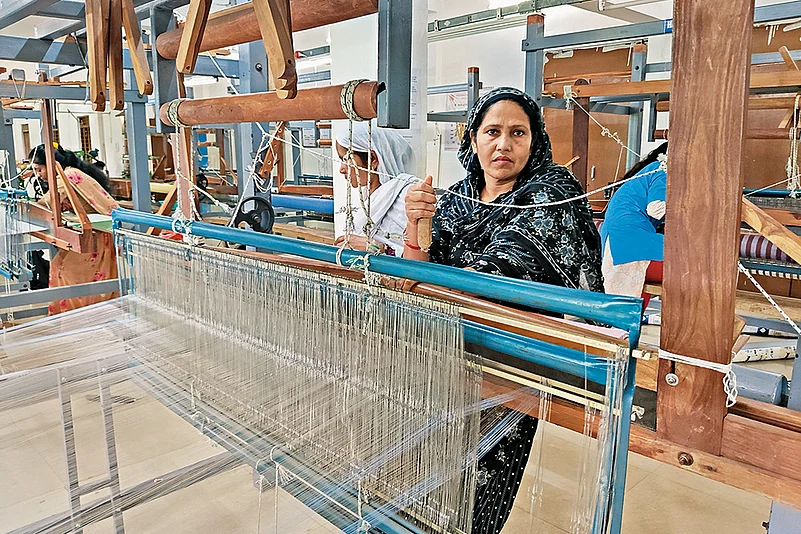
For the uneducated women, the main occupation in regions like Bastar and Dantewada is agriculture. Since it is a collective work, women were not given any money. But the government is now working to change this. For a long time, villagers stayed away from security camps that were established across the region to end Naxalism. But these are now being converted into community centres. “My dadi always used to say that I should stay away from these camps and police and security personnel. But now I spend my whole day here,” says 21-year-old Shami, who is learning stitching at the newly inaugurated ‘Seva Dera’.
Welfare Schemes
The security camp in Netanar village in Bastar was converted into a ‘Seva Dera’ in May 2026 by the Union Minister for Home Affairs Amit Shah. He said that there are about 200 camps in Bastar, and out of these, the government would convert 70 camps into service centres for tribal welfare—as of now only one is functioning in Netanar.
A part of this security camp has been converted into three large halls named Shaheed Veer Gundadhur Seva Dera, where women are being given training for sewing and rice processing, and one room is kept to enroll people for various government schemes and documentation.
Surrounded by women and working on a laptop is Sumani Baghel. She completed her masters in education, but could not pursue any job because of “some situation at home”. Now, she is married and has children too. But she has her own identity: manager didi.
Baghel is not associated with a bank in particular, but works on a commission basis. As she types on her laptop, Baghel consoles a rice-processing worker, 36-year-old Ramia, that her wages would be reflected after her paperwork is completed. Baghel says that all women working in the rice processing unit are given Rs 200 per day.
“They cannot run to the bank every day. So I come here thrice a week with my laptop to help them with their bank work. They can withdraw money, deposit money and even check their balance. Money has really empowered the women in the rural belt,” she says.
Married women in the state are being given Rs 1,000 every month under the Mahtari Vandan Yojana. Whatever they earn from their work is an additional amount. Koyali, working in the rice-processing unit with Ramia, says that earlier all women were contributing to the same work at home, but with no income. But now, they are given around Rs 6,000 per month for the same work. “We come here around 9-10 am and work till 4-5 pm. The work is not new, but the only thing that has changed is that we spend the whole day together and work does not feel tiring as we sing and enjoy our time here,” she says. Many of the women, with extra money in hand, have been able to send their children to English-medium schools in the area.
So, while every attempt is being made from all sides to ensure that the trust gets strengthened between the surrendered Naxals and the authorities in the Naxal-impacted villages, all are walking on eggshells.
Several surrendered Naxals say that they have so far received only Rs 50,000, though many are entitled to larger rehabilitation packages depending on the rewards on their names. Many are also still awaiting land and housing benefits. The administration says the rehabilitation process is taking longer only in places that witnessed mass-scale surrenders, where processing of thousands of cases has slowed implementation, but officials say that all promised benefits will be delivered on priority.
Bastar is changing, much like the lives of people such as Mohan. He never replaced the Casio watch he wore in the jungle. He simply changed the life around it. The watch that once helped him survive in the forests now tells him when to report for plumbing classes, return home to his mother and build a future with his wife. Bastar, too, is trying to reset its clock. The guns may have fallen silent, but whether this new chapter lasts will depend on whether promises of trust, livelihoods and opportunity reach the last village.
Nivedita Singh is senior correspondent, Outlook
MORE FROM THIS ISSUE

(This story appeared in Outlook magazine’s August 17 issue, 'Parliament on Street', which takes an incisive look at the student protests against recurring examination paper leaks, the zing of Gen-Z politics and the Jantar Mantar protest at Delhi which triggered a strong response all across India, sending out a clear reminder that while governments are formed in Parliament, democracies remain alive on the streets)