Belief in love and the purity of political movements comes naturally to the young, especially when it is their first encounter with either. Both demand a certain innocence—a willingness to place hope above experience and ideals above practical calculation. It is often said that the first experience of love is less about the person than the idea of being in love. Political movements inspire a similar faith. Their earliest followers are drawn not merely by the logic of their demands but by the possibility of the world they promise to create.
Yet, in this temporary world, innocence is transient, and so is the belief in love and in the idea that a political movement can make the world any better than the one we inherited.
The struggle for India’s independence culminated in Partition. The faith invested in the JP Movement gave birth to a government that lasted less than two years. Those who rallied behind Anna Hazare’s call for a Lokpal and a corruption-free India eventually realised that movements may change governments, but they rarely change the character of the republic.
Yet, heartbreak never kills the heart. It makes it wiser. Political disappointment works much the same way. The long arc of failed movements does not extinguish the possibility of change; it tempers the expectations with which we pursue it. The freedom movement could not prevent Partition, but it did give birth to a republic on the eastern side of the Indus where every individual, at least in principle, stood equal before the state. The leaders who emerged from the JP Movement failed to live up to the expectations of political purity and the chastity of public life they had inspired, yet, they ensured that no political leader would again romance the idea of dictatorship without fearing not only the loss of power but also history’s unforgiving judgement.


To the millennials who proudly wore Anna Hazare’s white caps, the movement eventually ended in disappointment. Its leaders publicly fought among themselves for political power, and many of the promises that had once inspired millions became objects of ridicule. Yet, the movement left behind something that continues to breathe beneath the debris of that dream: a grammar of resistance that compels those who sit inside Parliament to listen to the voices of those who sent them to the temple of democracy.
For a country that has spent less than half as much time as an independent nation as it did under the shackles of colonial rule, India has done remarkably well. Many of the countries that emerged from the collapse of the British Empire alongside India have since slipped into dictatorships or democracies that bear little resemblance to the aspirations of their freedom movements.
India, for all its failures in delivering equality of opportunity, justice and dignity to all, has continued to learn from its mistakes and, in doing so, has managed to keep alive the ideals of its founders.
Nothing illustrates that resilience better than the latest movement led by a motley group of Generation Z. They believed that Indian democracy still possesses the capacity to correct itself after the first flush of arrogance born of an overwhelming electoral majority. Their faith has been rewarded. The resignation of Dharmendra Pradhan is not merely the fall of a minister. It is a reminder that in India, governments may command majorities in Parliament, but they continue to govern only so long as they retain the confidence of the people.
Beware, idealists! Like every movement before it, this one too will have its heartbreaks. Its leaders, much like those who emerged from the embers of earlier movements, are human. They too will stumble, compromise and, perhaps, betray some of the ideals that brought them to prominence. In search of power, just like their predecessors, these believers in the possibilities of today will question the intentions behind the dreams of tomorrow. For today’s conformists are yesterday’s revolutionaries. The idea of justice is important to the unprivileged. But if the pursuit of justice is to get aboard the ship of the privileged, sin must consume the ideal. Paradise is always easier to imagine than to govern.
Yet, that will not be the failure of our democracy; it is the way we mature as a country. These are the footprints that future generations will follow with caution, improving upon the mistakes of previous generations. The disappointments of our democracy leave behind institutional memories, giving birth to political instincts that outlive the movements responsible for them. These are merely agents of maturity through mistakes in the long journey of a nation still learning to negotiate between the powerful and the powerless, the faithful and the atheists, the liberals and the conservatives, the advocates of discipline and the champions of anarchy.
India has come this far not because its ideals were free of contradiction. If anything, they often pulled the republic in opposite directions. Yet, it is precisely this dialectic that has generated the political energy to carry the country through the food shortages of the 1960s, the balance-of-payments crisis of the 1990s, communal violence, caste conflicts, violent uprisings against the state and countless other moments of national uncertainty. Every crisis in Indian democracy has left behind a wiser republic, better equipped to negotiate the many identities this nation carries.
As a nation, we have remained committed to the Discovery of India in its civilisational identity alongside its modern aspirations. It has required a delicate balance between the love of the past and the possibility of the future; between Gandhi’s village republic and Nehru’s modernity; between Ambedkar’s unrealised dream of annihilating caste and the Mandal era’s embrace of caste identities; between Vajpayee’s optimism of India Shining and Manmohan Singh’s politics shaped by the realities of persistent poverty; between Modi’s pursuit of Viksit Bharat and the impatience of those yet to experience its promise.
These competing ideas of raising the republic were perhaps inevitable for a nation whose very existence many believed was an impossibility. They continue to unsettle and inspire in equal measure.
Navigating these complexities has required marriages of convenience that make no promise of “till death do us part”. In some of the unlikeliest political coalitions, we have seen communists join hands with conservatives to unseat a prime minister committed to socialism. We have seen champions of swadeshi advocate the free flow of foreign capital to revive India’s economy.
Contradiction and role reversal are not aberrations in Indian politics; they make the wonder that is India. It’s here that Iqbal’s Hindustan metamorphosed into a heartbreak for the Ganga-Jamuna tehzeeb.
India is decades young, but its traumas are centuries old. This is why the only enduring constant in Indian democracy is the continual emergence of new love-hate relationships between ideas, ideologies and communities. That is what makes India a democracy unlike any other.
Here, much like our mortal lives, political movements, leaders and coalitions carry an expiry date. Our choice of leaders, our faith in policies and our rejection of governments trace the many paths that love itself takes before teaching us that there is no single idea of love that lasts forever. There are only desires that speak to the needs of their time. Politics, like love, survives not because it escapes disappointment, but because every generation discovers reasons to believe again.
MORE FROM THIS ISSUE

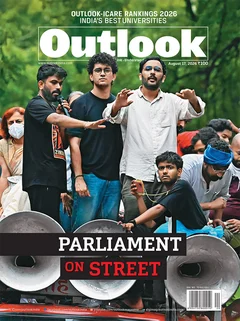
(This story appeared in Outlook magazine’s August 17 issue, 'Parliament on Street', which takes an incisive look at the student protests against recurring examination paper leaks, the zing of Gen-Z politics and the Jantar Mantar protest at Delhi which triggered a strong response all across India, sending out a clear reminder that while governments are formed in Parliament, democracies remain alive on the streets)