To Ladakh, Sonam Wangchuk is the man who helped turn a long-standing demand for recognition into a political reality. But to his critics and political observers, he is a more contested figure, someone whose political positions have shifted with the changing tides around him.
Irrespective of whether people support him or not, his style of protest has stood out because he chooses hunger strikes. It’s a trait he inherited from his father, Sonam Wangyal. Long before the 59-year-old educationalist turned to fasting as a form of protest, Wangyal had used the same Gandhian method to raise his voice for public causes, passing down not just a strategy of resistance but a political tradition.
Over the past few years, Wangchuk has carried that legacy forward, undertaking four hunger strikes, three for his home, Ladakh, and the latest one in solidarity with the Cockroach Janta Party.
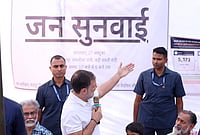
When he started his hunger strike at Jantar Mantar, it evoked a range of emotions. But by the time the protest ended, people were strongly divided. After he broke his fast, his images with Bharatiya Janata Party member J.P. Nadda became a moment of sharp political interpretation. The photograph captured the contradictions that have come to define Wangchuk’s public life.
“It is difficult to understand what his ideology actually is and what he stands for because there have been contradictions,” says Mustafa Haji, who has been working closely with Wangchuk in recent years. “As an activist and educator, he understands many things, but Indian politics is extremely complicated. I think he does not understand it deeply,” he adds.

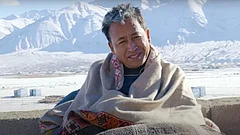


The Politics of Wangchuk
A mechanical engineer, education reformer, innovator and environmental activist from Ladakh, Wangchuk came to be known for founding the Students’ Educational and Cultural Movement of Ladakh (SECMOL), developing the ice stupa artificial glacier technique and co-founding the Himalayan Institute of Alternatives, Ladakh (HIAL). But over the years, his public role expanded beyond education, first into climate activism and later into politics.

His transformation mirrors Ladakh’s own political journey after 2019, when the former state of Jammu and Kashmir was reorganised and Ladakh was carved out as a separate Union Territory without a legislature following the abrogation of Article 370.
Wangchuk Wears Multiple Hats—he is an Educator, Climate Activist & Politician.
Initially, Wangchuk welcomed the government’s decision. He believed that it would give Ladakh greater political attention and autonomy. “People in Ladakh, including him, later realised how much damage followed the abrogation. Our democratic rights have been taken away. We no longer have a meaningful political voice,” says Sajjad Kargili, a political activist.
A Ladakh-based political observer says Wangchuk’s position must be understood in the context of changing circumstances. “Many Ladakhis believed separation from Jammu and Kashmir would empower them. But it weakened their position. Their approach changed from cooperation to confrontation,” he explains.
According to him, Wangchuk’s political evolution followed Ladakh’s own disillusionment. “Earlier they welcomed the BJP’s initiative. Later, when they realised Ladakh had lost in terms of status and internal power dynamics, they started distancing themselves.”

While one can give Wangchuk a benefit of doubt in the case of Ladakh, his backing of several major decisions of the BJP government puts the ball back in his court. Wangchuk described demonetisation as an economic reform. He first hailed the National Education Policy as transformational, but later opposed it for its systemic failures.
Commenting on the contradictions surrounding his recent involvement in the CJP protest, academic and political commentator Apoorvanand questions Wangchuk’s decision to immediately adopt a maximalist position by going on hunger strike. “Taking water from the hands of government representatives is a significant political decision. The people who came here were outraged by the same government removing Wangchuk. They felt betrayed,” he says.
The Educator
Wangchuk’s influence in Ladakh rested on a different kind of leadership—one built around classrooms and communities. He was a teacher who challenged the very structures that had once alienated him. “Before anything else, he was known as a teacher. He inspired people and became an intellectual whose ideas were revolutionary for the people of his community,” says Ghulam Mehdi Shah, one of his close aides.
Born in 1966 in Uleytokpo, a remote village in Leh district, Wangchuk received his earliest education at home from his mother, Tsering Wangmo, as there was no school in the village. His understanding of education shifted when his family moved to Srinagar after his father, Wangyal, entered politics. Thrust into a school system dominated by Urdu and English, he struggled with language and cultural barriers—an experience that later shaped his critique of Ladakh’s education system.
After graduating in mechanical engineering, Wangchuk co-founded SECMOL. His work expanded through initiatives such as Operation New Hope, which sought to improve government schooling in Ladakh through collaboration between communities, educators and the administration.
Championing Ladakh
For Wangchuk and civil-society groups like the Leh Apex Body and Kargil Democratic Alliance, the promise of empowerment after 2019 never translated into reality. Instead, Ladakh was placed under a lieutenant governor-led administration with limited public participation.
His entry into the movement raised its profile. “The moment he joined and became part of the Apex Body, our voice also got amplified. Before that, national and international media did not cover the Ladakh issue that much. He has supporters across the world and that helps amplify our demands,” says Kargili.
In 2023, Wangchuk undertook a five-day climate fast highlighting the ecological vulnerabilities of the Himalayas. A year later, he launched a 21-day hunger strike in Leh.
In September 2024, Wangchuk took the movement beyond Ladakh with the nearly 1,000-km Delhi Chalo Padayatra from Leh to Delhi. Carrying the movement’s four-point agenda—statehood, Sixth Schedule status, a dedicated public-service commission and greater parliamentary representation—the march sought to bring Ladakh’s demands to the national stage. When the march reached Delhi’s Singhu border, Wangchuk and several supporters were detained by the Delhi Police before being released.
In 2025, Wangchuk was detained following protests in Leh. He was released six months later after the Centre revoked his detention under the National Security Act.
Despite his sacrifices, Wangchuk remains a deeply contested figure. As one political observer puts it: “People in public life change depending on changing circumstances, new experiences, hopes and aspirations. This is part of political calculation.”
Zenaira Bakhsh is an Assistant Editor at Outlook. She covers governance, minority rights, gender and conflict
MORE FROM THIS ISSUE

(This story appeared in Outlook magazine’s August 17 issue, 'Parliament on Street', which takes an incisive look at the student protests against recurring examination paper leaks, the zing of Gen-Z politics and the Jantar Mantar protest at Delhi which triggered a strong response all across India, sending out a clear reminder that while governments are formed in Parliament, democracies remain alive on the streets)