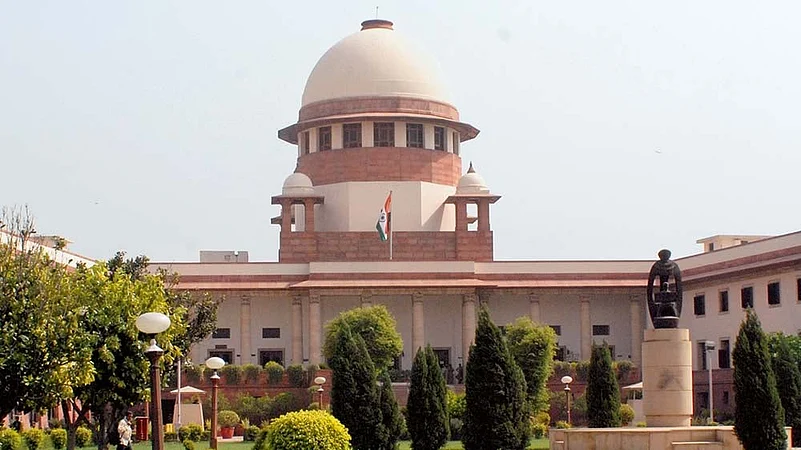
In a significant order aimed at improving access for persons with disabilities, the Supreme Court on Wednesday asked the Centre to consider "threadbare" the suggestions of experts and litigants to make lacunae-free robust rules to ensure that such people have easy access to public places and services.
The top court, on November 8, 2024, had directed the Centre to frame mandatory rules as required under Section 40 of the Rights of Persons with Disabilities (RPWD) Act, 2016 for ensuring that public places and services accessible to persons with disabilities.
A bench of justices JB Pardiwala and KV Viswanathan took note of the submissions on framing of rules and asked Additional Solicitor General Aishwarya Bhati, appearing for the Centre, to consider the suggestions of experts and the litigants before the draft rules are notified in the gazette to make them more robust, error-free and workable.
"The counsel for the petitioner would submit that before the draft rules are finalised and published in official gazette, their suggestions be considered so that no lacunae or deficiency are left behind and .. this will make the provisions of the (RPWD) Act more effective to subserve the object of the law," the bench said.
The top court also took strong note of the fact that eleven states and union territories including Delhi, Haryana, Rajasthan, Himachal Pradesh, Karnataka, Andaman and Nicobar and Tamil Nadu have not appointed state commissioners as mandated under the RPWD) Act to oversee rehabilitation of persons with disabilities.




"We direct all the states to appoint state commissioners under section 79 of the RPWD Act within four weeks. This direction shall be strictly complied with and no state should exhibit any laxity," the bench said, adding that any lapse will be viewed seriously.
The bench also took a strong view of the Centre not appointing a regular chief commissioner as mandated under the RPWD Act to oversee rehabilitation of persons with disabilities.
The bench directed the Centre to also appoint two commissioners to assist the chief commissioner as mandated under the law to ensure rehabilitation of persons with disability within four weeks.
The bench has now posted the PIL filed by Rajive Raturi in 2025 for hearing in January next year.
It asked the Centre and others to file compliance affidavits.
Section 40 of the law deals with accessibility and says, "The Central Government shall, in consultation with the Chief Commissioner, formulate rules for persons with disabilities laying down the standards of accessibility for the physical environment, transportation, information and communications, including appropriate technologies and systems, and other facilities and services provided to the public in urban and rural areas." Earlier in 2024, the top court had directed the Centre to implement mandatory accessibility standards within three months, in a significant order aimed at improving access to public spaces for persons with disabilities.
The order had come in response to slow progress on the accessibility directives issued by the court in a judgement on December 15, 2017.
The bench had underscored the necessity of "meaningful access" for disabled persons to public spaces and mandated a two-pronged approach: adapting existing infrastructures to accessibility standards, and ensuring that all new infrastructure is designed to be inclusive from the outset.
The bench had found that one of the rules of the RPWD Act does not establish enforceable, compulsory standards, but rather, it relies on self-regulation through guidelines.
While acknowledging that accessibility rights are subject to progressive realisation, it stated that a baseline of non-negotiable standards is essential to make public spaces truly inclusive.
It had recommended that these mandatory rules be distinct from broader guidelines, with specific standards that can be legally enforced.
The Center for Disability Studies at NALSAR University of Law, in Hyderabad, was tasked with assisting the government in developing these new standards.
The guidelines will also need to ensure compliance through mechanisms such as withholding completion certificates and imposing fines for non-compliance.
The bench had adjourned hearing on the PIL seeking directions to ensure meaningful access to public spaces for persons with disabilities.
It asked the Centre to report on the progress made toward implementing the directives.