What were the key political, economic and social factors that triggered the protests in Sri Lanka, and what lessons can neighbouring countries like India learn from the crisis?
There were both internal and external factors—economic mismanagement, Covid, the foreign-exchange crisis and policy mistakes. Socially, there was growing frustration over inequality, corruption, lack of accountability and the feeling that ordinary people no longer had a meaningful voice.
It was the inability of the political leadership—not only in Sri Lanka, but to varying degrees across South Asia—to keep pace with the aspirations of a new generation. We are trying to govern a digital society with institutions that belong to another era.
The lesson for India is to ensure that institutions evolve as society evolves. Governments and protest movements are not always on opposite sides. Very often, there’s common ground for reforms that strengthen both democracy and stability.

Do you believe the Sri Lankan government could have handled the crisis differently?
Of course. Economically, there were decisions that could have been taken much earlier—going to the International Monetary Fund sooner, securing external financing earlier and reversing the fertiliser policy before the damage became too great.
But I don’t think the crisis was only about the economy. People also wanted greater accountability, stronger institutions, better governance and respect for the rule of law. If we had only fixed the economy, aragalaya [the struggle] might have subsided for a while, but the frustration would eventually have resurfaced since the deeper issues were not addressed.
Technology has given people a voice. The challenge for governments now is to make sure that people also feel that they have a stake in how decisions are made.




How important was the role of young people, students and civil society?
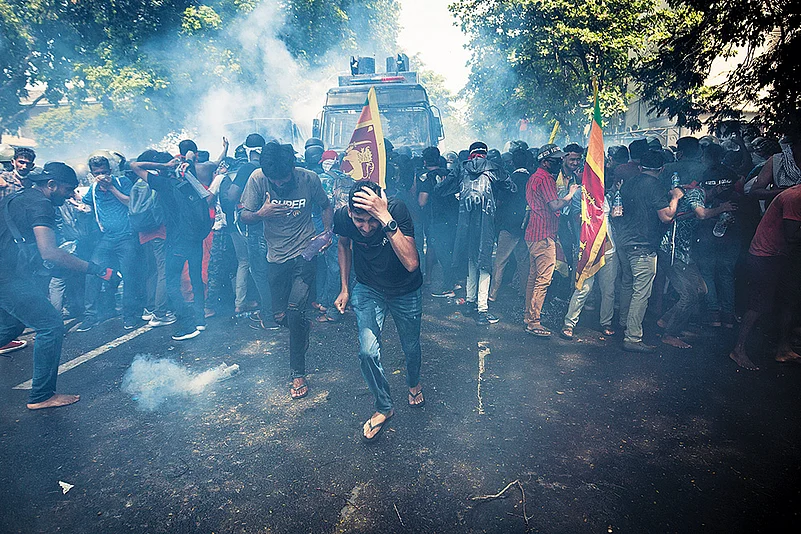
It was absolutely central. Young people, students, trade unions and civil society drove the movement in its early stages. Later, political parties became more involved. Young people were among those who were worst hit by the economic crisis, but they were also frustrated by years of governance failures and a political system that they felt wasn’t responding to them.
India has a stronger tradition of civic engagement, although it is often more issue-based and decentralised. Sri Lanka’s protests became a national political movement. India’s size and federal structure probably make a similar nationwide movement less likely, but civic engagement itself is alive and well.

What advice would you offer to policymakers?
I’m not sure I’m in a position to give advice, but if I had to make one observation, it would be this: building a public narrative is no longer enough. Technology has fundamentally changed how citizens engage with politics, so our institutions have to evolve as well.
Governments should be willing to engage with protesters, understand their concerns and separate the demands that genuinely improve the country from those that don’t. You won’t be able to implement everything, but if good ideas emerge from outside government, there’s no reason not to adopt them.
MORE FROM THIS ISSUE

Do you believe foreign governments played a significant role?
I think it’s unrealistic to assume that major powers have no interest in influencing developments in strategically important countries. History tells us that states constantly pursue their national interests. Having said that, I think it is important to distinguish between possible external attempts to influence events and the genuine aspirations of citizens. The fundamental drivers of the aragalaya were domestic—economic hardship, governance failures and growing public frustration. External actors, if they existed, may have acted as a catalyst, but they were not the root cause. Ultimately, resilient institutions and good governance remain the best defence against both domestic instability and external influence.
(This story appeared in Outlook magazine’s August 17 issue, 'Parliament on Street', which takes an incisive look at the student protests against recurring examination paper leaks, the zing of Gen-Z politics and the Jantar Mantar protest at Delhi which triggered a strong response all across India, sending out a clear reminder that while governments are formed in Parliament, democracies remain alive on the streets)