Did Tagore or Didn’t Tagore?
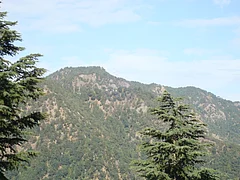
We were on our way up a steady incline that wound its green way around a cliff to Tiger Top. It sounded like the route to an exclusive boutique resort but Tiger Top was what the Ramgarh locals called Tagore Top since they couldn’t get their tongue around the ‘Tagore’. Rabindranath Tagore had moved to a bungalow there in 1914 because his daughter Renuka was suffering from tuberculosis and he thought the hill air would do wonders for her lungs.
The ‘we’ consisted of a Kashmiri geographer, Vaibhav; and Vijay, an old friend of mine whom I had caught up with after years. It was on the final day of a reunion-cum-birthday celebration in Ramgarh she and I had decided that, as the great granddaughter of Tagore’s first publisher, it was my duty to make the walk up the cliff. The bungalow was derelict and inhabited by leopards and the occasional bear who presumably took in the ghostly harmonies of Tagore’s Gitanjali that wafted around the walls. More to the point, Tagore was reputed to have planted a ginkgo biloba tree on the slope so even if we couldn’t reach the bungalow, chances of reaching the tree were more promising.
Tagore Top was on the top of the hill; a four-kilometre hike upwards, growing gradually steeper. It had been raining and the path was mossy and slippery so risking it was unadvisable unless we were real Tagore fanatics. On the other hand, it was two kilometres to the tree. “It’s gently sloping,” Vaibhav, who knew the region, promised. I had my doubts about what people called gentle slopes in these hills but decided that one had to make the attempt for the sake of literary history.
The car went up the road as far as it could and dropped us off at the start of the green trail. Vaibhav had thoughtfully brought a bamboo staff in case it was needed. Since my friend had her stick, I took charge of the staff and cautiously pushed past an uprooted tree trunk and shuffled through the leaves. The trail wound around the hill. Vaibhav had brought a bell with him which he occasionally tinkled to warn any interested bears that people were coming.



Butterflies flitted past us. “That’s a Cabbage White,” he pointed out. “There’s a poem about a Cabbage White,” I said, trying to take my mind off the drop to my left.
It wasn’t that the path was narrow; it was wide enough to walk on. My friend moved ahead, musing all the while on her exploits at the Madhuban Ashram in Talla Ramgarh which she managed despite stiff joints. I channelled my inner mountain goat, clutched the staff and trudged forward, listening to Vaibhav’s anecdotes about the white starry flowers of daisy fleabane and the fact that Sanskrit had no names for butterflies barring the ubiquitous prajapati.
The Flourishing Tree
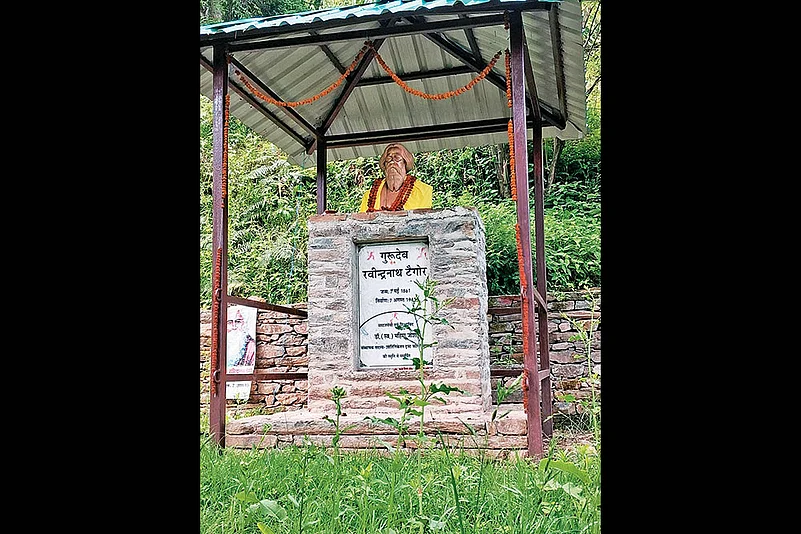
Rather more easily than I had imagined, we reached the bust of Tagore that faced the biloba tree. The children from nearby schools came here on May 8 to sing to the bust and listen to speeches tailored to the Bard’s birthday. The bust itself had seen better days—the nose was chipped and there were dark dust rings around the eyes. The tree, on the other hand, was flourishing. After a burst of Rabindra Sangeet from my friend and Vaibhav to set the mood, selfies were dutifully clicked and promptly sent to various WhatsApp groups.
My cousins, who had no idea where the biloba was, indignantly texted that the tree was probably a colonial import with no Rabindric links and would I just tell them where I was instead of playing guessing games? There was no point arguing that all of Ramgarh was convinced that Tagore had planted the tree with his own hands and meditated under a nearby oak while waiting for the biloba to grow.
So, did Tagore plant the tree or not? The usual suspects are quiet on the issue but circumstantial evidence suggests that a poet who loved travelling to the Far East and planting trees would most probably not have resisted the temptation. Vaibhav plucked some of the leaves with their small fans for souvenirs in case the selfies weren’t evidence enough. Tree pilgrimage over, we returned triumphantly to where we had started, with Cabbage Whites looping the loop in our tracks.
Anjana Basu is a Kolkata-based advertising consultant and author. Her recent works include The House the Press Built and Translating for Rituparno

MORE FROM THIS ISSUE




(This story appeared in Outlook magazine’s August 17 issue, 'Parliament on Street', which takes an incisive look at the student protests against recurring examination paper leaks, the zing of Gen-Z politics and the Jantar Mantar protest at Delhi which triggered a strong response all across India, sending out a clear reminder that while governments are formed in Parliament, democracies remain alive on the streets)