Sonam Wangchuk's hunger strike over the NEET paper leak ended with hospitalisation.
Delhi Police cited health concerns, while family disputed the High Court's interpretation.
Wangchuk protest united students, opposition parties and Ladakh statehood campaign supporters.
Sonam Wangchuk has been on a hunger strike at Delhi's Jantar Mantar since 28 June. On the morning of 18 July, the 21st day of his fast, Delhi Police arrived at the protest site and shifted him to Safdarjung Hospital, citing deteriorating health and a Delhi High Court order for medical monitoring. By that point he had lost considerable weight, dropping to around 56.55 kg, and was showing signs of dehydration. He refused intravenous fluids at the hospital.
His wife, Gitanjali J Angmo, disputed the police's reading of the court order, saying the HC had directed regular health monitoring, not hospitalisation. The next few hours turned a protest over exam irregularities into a national political flashpoint.
How the protest started
This time, Wangchuk's fast is not about Ladakh. He joined an agitation led by the Cockroach Janta Party, a Gen Z-led movement founded by Abhijeet Dipke, which has been camping at Jantar Mantar demanding the resignation of Union Education Minister Dharmendra Pradhan over a NEET paper leak that occurred in May 2026 and affected millions of aspiring medical students across the country.

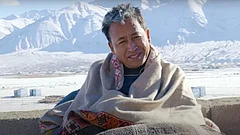


Wangchuk described the fast as solidarity with students whose futures had been upended by what he called systemic failures in the examination system. He said he was ready to continue for six weeks and, if needed, go on a fast unto death unless the government addressed what he called two failures of governance, the handling of public examinations and the long-pending constitutional demands of Ladakh.
The Ladakh angle has not gone away either. Since Ladakh was carved out as a Union Territory in August 2019 following the abrogation of Article 370, Wangchuk has led an unbroken campaign for statehood and inclusion under the Sixth Schedule of the Constitution, which would provide tribal communities with protections over land, resources and local governance. He did a 21-day climate fast in March 2024, a 1,000-kilometre march from Leh to Delhi in September 2024 during which he and around 150 Ladakhis were detained under the National Security Act at the Singhu border, a 35-day fast in 2025, and was only released in March 2026. None of those protests produced a firm commitment from the Centre.
What happened at Jantar Mantar
The CJP's Abhijeet Dipke alleged that police personnel arrived at the protest site early on the morning of 18 July and dragged Wangchuk away while hurling abuses. "A 60-year-old man, who had been on a hunger strike for 20 days and hadn't eaten anything, was forcibly dragged away by the Delhi Police," Dipke alleged. Delhi Police said Wangchuk was shifted for essential medical care following expert medical advice and in compliance with the High Court's orders, adding that some protesters tried to create obstruction, leading to a brief commotion, but that police exercised maximum restraint.
Wangchuk's wife disputed the framing, saying the HC order never mandated hospitalisation and had simply stated that an individual's health is paramount and must be monitored at regular intervals. At the hospital, Wangchuk was conscious with stable pulse, blood pressure and oxygen saturation, but refused all intravenous fluids, oral rehydration fluid or any other medication.
The BJP justified the hospitalisation, with national spokesperson Shahnawaz Hussain saying the High Court had directed that Wangchuk's health be properly monitored, and questioning whether opponents would have preferred his health to deteriorate merely to sustain a political spectacle.
Congress's Pawan Khera said the Constitution guarantees the right to dissent but the home ministry appears determined to deny it, adding that it was a shame that the world's largest democracy was being ruled by the most undemocratic political party in the world. Samajwadi Party MP Dimple Yadav called the police action an assault on democracy and the Constitution. AAP's Manish Sisodia alleged the government was suppressing protests instead of addressing the issue. Shiv Sena UBT chief Uddhav Thackeray said the government does not value the life of citizens. Rahul Gandhi also weighed in on social media, according to The Federal's live coverage of the day.
Democratic mobilisation in India
The comparison being drawn most widely is with Anna Hazare's 2011 fast for the Lokpal Act, which shook the UPA government. As Al Jazeera reported this week, the protest at Jantar Mantar is being described as a rare show of defiance against Prime Minister Narendra Modi's 12-year rule. What makes the Wangchuk moment different from earlier protests is the convergence it has produced across demographics, a climate activist from Ladakh, a Gen Z political outfit, national opposition parties and student bodies all occupying the same space and pushing the same grievance forward.
Whether that convergence survives the hospitalisation or fades, as protests against Modi governments often have, remains the real question. The Centre has so far not moved on the NEET demand, and Wangchuk, lying in Safdarjung and refusing fluids, has given no indication he intends to accept that silence as an answer.