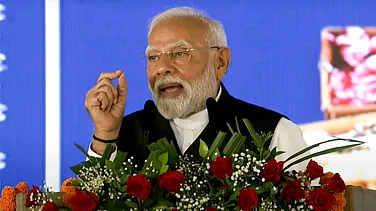
India inaugurated the India-AI Impact Summit 2026 in New Delhi, hosting over 100 countries.
The country positioned itself as a key player in shaping global AI governance and cooperation.
At a key discussion on the future of work, speakers argued that AI can enhance job matching, skilling and reskilling, rather than replace workers, if integrated proactively into policy and industry frameworks.
The India-AI Impact Summit 2026 began in New Delhi on Monday, February 16, marking the first time a global artificial intelligence summit of this scale is being hosted in the Global South.
India, the world’s most populous country and among the fastest-expanding digital markets, sees the five-day event as a measure to reinforce India’s position in shaping international conversations on AI governance and cooperation.
More than 100 countries have been invited, with over two lakh participants registering online. World leaders from 20 nations are scheduled to attend, including French President Emmanuel Macron, Brazilian President Luiz Inácio Lula da Silva, Spanish President Pedro Sánchez Pérez-Castejón, Swiss President Guy Parmelin, Dutch Prime Minister Dick Schoof and UAE Crown Prince of Abu Dhabi Sheikh Khaled bin Mohamed bin Zayed Al Nahyan.
The summit takes place at a critical juncture, with artificial intelligence accelerating economic change, disrupting employment patterns and intensifying debates over governance, safety and ethical boundaries. Previous summits were held in France, the UK and South Korea, albeit at a lower scale than 2026.





Prime Minister Narendra Modi will also inaugurate India AI Impact Expo today at Bharat Mandapam, New Delhi, which will be held alongside the India AI Impact Summit. “The AI Impact Summit will enrich global discourse on diverse aspects of AI, such as innovation, collaboration, responsible use and more,” he said on X, expressing confidence that the outcomes of the Summit will help shape a future that is” progressive, innovative and opportunity-driven.”
According to the Ministry of External Affairs, ministerial delegations from more than 45 countries will join the discussions, along with the UN Secretary-General and senior officials from several international organisations.
The Summit is guided by three foundational pillars, namely: People, Planet, and Progress, while the deliberations are structured around seven interconnected thematic areas, including Human Capital, Inclusion for Social Empowerment, Safe and Trusted AI, Science, Resilience, Innovation, and Efficiency, Democratizing AI Resources and AI for Economic Development and Social Good.

At ‘AI and the Future of Work: Employability, Skills, and Labour Market Transformation’ panel discussion held on Monday, the speakers explored the ways in which artificial intelligence is transforming labour markets, from new job creation and shifting skill requirements to the role of education and public policy.
It brought together voices from government, research, industry and academia, the discussion focused on AI-enabled employment platforms, emerging skills, workforce strategies and how education systems can adapt to prepare people for an AI-driven economy.
Panellist Ajoy Sharma, Joint Secretary in the Ministry of Labour and Employment, said the Government of India is working to integrate AI into the job market by linking jobseekers more effectively with employers.
He noted that platforms such as the National Career Service Project, the e-Shram portal and the EPFO are being aligned to account for the skill sets of jobseekers, including their ability to access AI tools and the internet. Efforts are also being made to incorporate vernacular languages and regional dialects to ensure wider accessibility.
Sharma mentioned that the data on e-Shram portal will be made available to private companies soon in order to bridge the gap between job seekers and providers.
He rejected the notion that artificial intelligence will eliminate jobs, arguing instead that it can reinforce the core pillars of the employment ecosystem — effective job matching, skilling and reskilling, and proactive policy integration by the government rather than a reactive approach.
“AI is a double-edged sword that needs to be built for our own use,” he said, adding that technology should augment human capabilities, even as human skills continue to shape and refine technological development.
Kartik Narayan, CEO of Apna, concurred with Sharma, asserting that industry must actively shape the development of AI rather than passively be shaped by it. He emphasised that AI should be deployed to augment frontline workers and bridge access gaps, ensuring that rural youth have the same opportunities as urban graduates. Properly harnessed, he said, the technology can support and empower the country’s six crore jobseekers.
Finally, panelist Kusum Aggarwal highlighted challenges in building robust AI infrastructure within the education system. She stressed the need to engage students early, equipping the curriculum not just to use AI but to shape it, and argued that pedagogy must be revised and integrate AI in ways that resonate with Gen Z through innovation and interactive learning.
She added that educators themselves must continuously upgrade their skills to keep pace with rapid AI advancements. In conclusion, she called for mandatory impact assessments of AI initiatives in education, emphasising that such evaluations must have structural integrity rather than remain optional exercises.