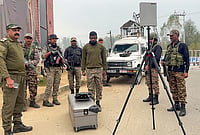
Ajit Pawar died in a plane crash on Wednesday, January 28, while on his way to a address a public meeting in Baramati ahead of Zilla Parishad elections.
His career was defined by shifting alliances, administrative authority and political survival, rising from his uncle Sharad Pawar’s shadow to become Maharashtra’s longest-serving Deputy Chief Minister.
His career saw dramatic turns—from the short-lived 80-hour BJP government in 2019 to the NCP split in 2023.
Ajit Pawar’s decades-long political career was marked by drama, shifting alliances and, above all, remarkable personal continuity.
In the early years, guided under the formidable shadow of his uncle, Sharad Pawar, he gradually carved out an identity of his own, ultimately rising to not only become Deputy Chief Minister of Maharashtra, but the longest-serving Deputy CM.
Political leaders from across the country have expressed grief over his demise on Wednesday (January 28), when his private-charter plane crash-landed in Baramati, where he first entered electoral politics in 1991 when he was elected MP from the constituency.
Currently, he was serving his sixth term as Deputy CM in the BJP-led Mahayuti government, headed by CM Devendra Fadnavis, alongside Deputy CM Eknath Shinde.
His legislative journey in Maharashtra took off in 1995 with his election to the Assembly from Baramati, a seat that had been a Pawar stronghold for decades. He successfully defended the constituency in every subsequent election—1999, 2004, 2009, 2014 and 2019—cementing his stature as a dominant political force in the state, especially western Maharashtra.


In 1999, he began serving in the Maharashtra Cabinet after almost a decade of being a junior minister, later holding major portfolios including Water Resources and Finance, Irrigation and Rural Development; also serving as the national president of the Nationalist Congress Party (NCP).

The state, which has one of the most complicated and haywire political realignments and repositionings, was carefully manoeuvered by Ajit Pawar, manifesting a stronghold over his administration and building loyalists across the way. He also served as finance minister of the state both in the MVA and Mahayuti governments.
Pawar is widely regarded as an effective and decisive administrator, known for his command over governance and deep understanding of Maharashtra’s complex administrative machinery. Over multiple tenures as Deputy Chief Minister, Pawar is often credited with pushing stalled projects, streamlining fund allocation, and ensuring time-bound implementation, particularly in infrastructure, irrigation, and rural development.
He was one of the rarest mass leaders who knew the functioning of bureaucracy and all the departments inside out. His quick decision making, insights of the bureaucratic procedures of implementation of programs made him the best administrative leader. Also known for his rigorous election campaigns, he used to conduct dozens of rallies, public meetings a day ahead of elections.
However, the recent defeats in Pune and Pimpri Chinchwad municipal corporation were massive and his political career was being criticised and questioned.
Pawar used to start his work day at 6 am, often conducting meetings with district collectors and officials early in the morning starting at 7 am. Most days, he used to address the media early in the morning around 7.30 am.
His no-nonsense approach and ability to cut through bureaucratic delays made him a formidable troubleshooter within government. Even critics acknowledged his grasp of files, budgets, and ground-level realities, shaped by years of political experience and close engagement with district administrations. Pawar’s focus on execution over rhetoric appealed to sections of farmers, cooperative institutions, and local bodies that value administrative efficiency. While his political style was assertive and sometimes controversial, his reputation as a strong administrator who prioritises delivery and governance outcomes remained one of his defining strengths in Maharashtra politics. His mastery in co-operative's politics of Maharashtra including banks, sugar factories was commendable.

One of the most dramatic incidents of his career unfolded in November 2019. As the NCP was in talks with the Congress and the Shiv Sena to form a post-election coalition, Ajit Pawar broke ranks and joined hands with the BJP to stake claim to power. In a surprise pre-dawn ceremony, Devendra Fadnavis was sworn in as Chief Minister, with Ajit Pawar taking oath as Deputy Chief Minister.
The experiment unravelled within 80 hours, after it became evident that Ajit Pawar did not have the backing of the NCP legislature party. He soon returned to the NCP and reconciled with his uncle, later assuming office once again as Deputy Chief Minister in the Maha Vikas Aghadi government formed by the Shiv Sena, NCP and Congress in December 2019.
In 2023, the NCP split into two factions after Ajit Pawar broke away to align with the BJP-led Mahayuti alliance. Sharad Pawar retained the remaining faction and declined to back the BJP–Shiv Sena government in the state. Ahead of the 2024 Lok Sabha elections, the Election Commission recognised the Ajit Pawar-led faction as the “real” NCP, granting it the party name and symbol, while Sharad Pawar’s group continued as NCP (SCP). Though Pawar joined NDA, he didn't fuel the divisive politics and remained secular leader. He did not support the Islamophobic narratives of the NDA during elections campaigns.
However, his career was not without hiccups and interruptions. He had to resign as an MLA and avoid the media after the Enforcement Directorate named him and Sharad Pawar.
In September 2019, the ED registered a money-laundering case under the Prevention of Money Laundering Act (PMLA) against NCP chief Sharad Pawar and Ajit Pawar. Both were named in connection with the alleged ₹25,000-crore Maharashtra State Cooperative Bank (MSCB) scam.
Ajit Pawar had also faced allegations in the ₹70,000-crore irrigation scam. In 2019, the ACB formally cleared Ajit Pawar of wrongdoing in the irrigation scam, shortly after the Maha Vikas Aghadi government—comprising the Shiv Sena, NCP and Congress—assumed office in Maharashtra. Between 1999 and 2009, Ajit Pawar served as the state’s Water Resources Development Minister and chaired the Vidarbha Irrigation Development Corporation, which had approved the irrigation projects under scrutiny.
However, the Maharashtra ACB later denied any link between the evolving political developments in the state and the closure of the cases.