Ukraine said a "serious shortage" of interceptor missiles meant none of the 23 Russian ballistic missiles fired at Kyiv overnight were shot down.
The large-scale Russian missile and drone attack killed at least 18 people.
It included 12 in Kyiv and six in the surrounding region, while dozens were injured.
A large-scale Russian missile and drone attack on Kyiv killed at least 18 people overnight into Monday, after Ukraine's air force said a "serious shortage" of interceptor missiles prevented it from shooting down any of the 23 ballistic missiles launched at the capital.
Twelve people were killed in Kyiv and 49 others were injured, while six more people died and 16 were wounded in the surrounding Kyiv region, according to Ukrainian officials.
The overnight assault came just days after another deadly strike on the Ukrainian capital and ahead of this week's NATO summit in Ankara, where Ukrainian President Volodymyr Zelensky urged allies to make "strong decisions" on supplying more air defence systems.
Speaking after the attack, Zelensky said Ukrainian forces successfully intercepted Russian cruise missiles and drones but were unable to stop the ballistic missiles.

Ahead of the NATO summit, Zelensky said it was "critically important" that the United States and Ukraine's European partners arrive "with strong decisions in support of our air defense, and thus the protection of ordinary people's lives".



"The United States and Europe have enough power to stop this terror," he said.
European Commission President Ursula von der Leyen said Ukraine's "urgent" need for additional air defence systems would be a key topic at the summit.
Russia launched its full-scale invasion of Ukraine in February 2022 and currently controls about one-fifth of Ukrainian territory.

According to the president, Sunday's "massive Russian attack" involved 68 missiles and 351 strike drones. Ukraine's air force said it shot down or electronically suppressed 37 missiles and 326 drones, but confirmed that none of the 23 ballistic missiles targeting Kyiv were intercepted because of a shortage of interceptor missiles.
Zelensky warned that Moscow would continue striking residential buildings as long as Patriot interceptor missiles "remain in our allies' stockpiles".
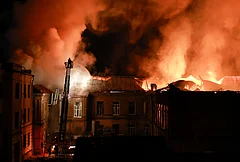
The overnight barrage triggered repeated explosions across Kyiv as air defence systems attempted to repel the attack. Helicopters ferried water from the river to help extinguish fires burning across the city.
In Kyiv's Podilskyi district, rescue workers searched through the wreckage of an apartment building torn apart by a missile strike. Sniffer dogs were deployed to locate survivors as cranes lifted massive concrete slabs from the collapsed structure.
Hours before the attack, Zelensky had warned that Russia was preparing a second "massive strike" on Kyiv after Thursday's assault, which killed 30 people.
Following that earlier barrage of drones and missiles, tens of thousands of residents sought shelter in Kyiv's metro stations as air raid sirens sounded through the night.
Ukraine accused Russia of deliberately targeting civilian areas in Thursday's attack. Moscow said it had struck military and energy facilities in retaliation for recent Ukrainian attacks on power stations and energy infrastructure inside Russia.

Ukraine has meanwhile continued its drone campaign against Russian energy facilities. Power was temporarily cut in Sevastopol in Russian-occupied Crimea, while the Baltic oil terminals at Vyssotsk and Ust-Luga, north and west of St Petersburg, were also targeted.
Zelensky is expected to meet US President Donald Trump on the sidelines of the NATO summit, which opens in Ankara on Tuesday, according to multiple media reports.
(With inputs from BBC)