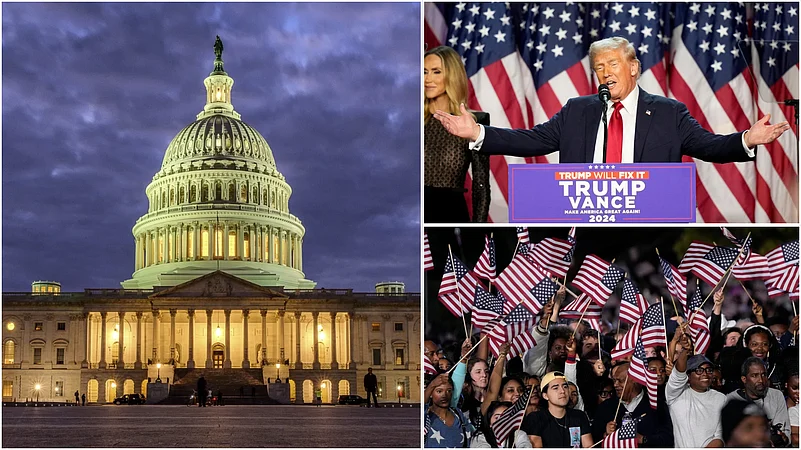
Senate Republicans defeated a war powers resolution aimed at limiting President Trump’s ability to conduct further military action in Venezuela.
Senators Josh Hawley and Todd Young reversed their earlier support after intense pressure from the White House, forcing Vice President JD Vance to break a 50-50 tie.
The vote exposed growing bipartisan concern over the legal basis and scope of Trump’s aggressive foreign policy.
Senate Republicans on Wednesday voted to dismiss a resolution that sought to restrict President Donald Trump’s authority to conduct further military action in Venezuela, after two GOP senators reversed their earlier support under intense White House pressure.
The motion to kill the war powers resolution ended in a 50–50 tie, forcing Vice President JD Vance to cast the deciding vote in favour of dismissal. Senators Josh Hawley of Missouri and Todd Young of Indiana flipped their positions, delivering a victory to the Trump administration.
The resolution, introduced by Democratic Senator Tim Kaine, would have required congressional approval for any expansion of U.S. military operations against Venezuela. Kaine accused Republicans of suppressing debate on the legality and consequences of the campaign that recently led to the capture of Venezuelan leader Nicolás Maduro by U.S. forces.
The vote underscored both Trump’s continued grip over the Republican conference and the unease among lawmakers about the President’s increasingly assertive use of military power. Three Republicans — Rand Paul, Lisa Murkowski and Susan Collins — defied the White House and continued to back the measure.
Trump had personally lobbied senators to oppose the legislation, reportedly telling them it would “tie his hands.” He publicly mocked dissenting Republicans and praised the operation that seized Maduro as “one of the most successful attacks ever.”


Under the U.S. Constitution, Congress holds the power to declare war, but presidents have long relied on expansive interpretations to deploy force without explicit approval. The 1973 War Powers Resolution was designed to rein in that authority, allowing lawmakers to vote on limiting military action.
Republican leaders argued the measure was unnecessary because no U.S. ground troops are currently deployed in Venezuela. Senate Majority Leader John Thune dismissed the debate as driven by “anti-Trump hysteria.”
The administration has offered shifting legal justifications for its Venezuela campaign, describing the Maduro raid as a law-enforcement extradition while also invoking counter-terror powers after designating drug cartels as terrorist organisations.
Lawmakers from both parties said a classified briefing on the legal rationale raised further questions. Senate Democratic leader Chuck Schumer warned that Trump’s posture signalled a “dangerous drift towards endless war.”
Although the resolution would have faced a near-certain presidential veto even if passed, it served as a test of congressional willingness to check executive power. House Democrats have introduced a parallel measure and could force a vote in the coming days.