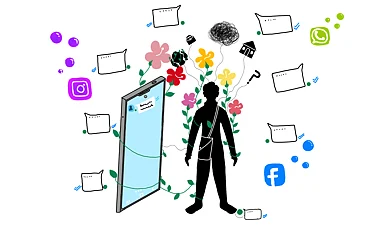
Studies show handwriting boosts memory, focus, and creativity; so put down the phone and pick up a notebook (or five).
From planning your chaotic life with bullet journals to logging dopamine-filled days, media, or wild creative ideas, each notebook becomes a playground for your brain.
Life can’t be planned perfectly. “Ta-da” lists, unshared rants, abandoned books, and scribbled thoughts all matter because sometimes the chaos on paper is the most productive thing you’ll do.
In a recent interview with Outlook, writer and journalist Amitava Kumar exclaimed, “You are not a writer if you don’t carry a notebook.” He came to our studio carrying five different notebooks, each carrying the burden of a separate purpose, a separate responsibility to help this writer, and person, negotiate with life.
I swear I never felt more seen in life than when I second-hand heard of this in the office two floors above, with my three “office” journals strewn around me.
By the way, off topic, did you know there are apps that remind people to drink water?
Then there are hundreds of planner and journal apps on the App Store promising you the successes you always dreamed of and more. But speaking from the statistical evidence of “lived experience,” the joys and dopamine of a physical notebook will never match any “ting” the apps promise.
Having a notebook almost feels like a rebellion today. Though it is the tool of trade for journalists as we cannot be seen without a pen and an excessively harassed notebook, full of loopy scribbles from a thirty-second phone call or reminders to self for stories and projects – people at large have migrated to more “modern” methods of note-keeping or planning.


Writing this, I am reminded of one of my favourite TV shows, Brooklyn 99. When Amy is shamed for “writing things down” and “being a nerd,” she asks, if writing is uncool, how does Rosa remember important things? And the queen of the 99 precinct (in my opinion) replies, “Forget it, like a cool person.”
So if you think writing is nerdy, and forgetting is cool, maybe this one isn’t for you. But if you love being joyful, and want to add an extra source of dopamine in this excessively tech-driven world, maybe read ahead.
A 2014 study from Princeton and UCLA found that writing notes by hand engages neural circuits differently than typing. Memory, comprehension, creativity – your brain actually works better with pen and paper. Another study from the University of California found that handwriting improves focus and retention, while digital note-taking can make your brain… distracted. In short, your brain gets high on ink, low on screen.
Now, the fun part, my journals; my chaotic little ecosystem of productivity, dopamine, nostalgia, and occasional nonsense.
P.S. Ditch the influencers calling for expensive notebooks and stationery and acrylic pens. All you need are basic notebooks with good quality paper, some colours (sketch, water, pastel, or markers), and some pretty pens with colourful ink (or black only, if that’s your aesthetic).
Journal For Planning / Bullet Journal (#Bujolife)
Around 2013, Ryder Carroll was looking for a way to combat ADHD and came up with a method that is now a cult of its own—the bullet journal—and I am a proud member of this ‘cult’.
Yes, there are many “ready-to-use” planners with pre-set lists, but the flexibility of the bullet method remains unmatched. To be transparent, I do not use the original Ryder method exactly. I’ve customised it to my needs, habits, and aesthetics.
Use a dot grid, square grid, or single line. If you go to YouTube, you’ll be overwhelmed by how much effort YouTubers put into making Instagram-worthy bullet journals. My advice? Freak that. Random lines, doodles, stickers – do whatever your brain wants. The point is a system that works for you, not a Pinterest board.
Spreads to include:
Monthly calendar / task overview
Habit tracker (but make it fun, not stressful)
Weekly logs (to organise actual tasks)
Space for “ta-da lists”
You can add vision boards or mood boards
A ‘year in pixels’ page with a 12×31 grid, where each square gets a memento—books read, mood highlights, productive days, art days—with a colour code.
A resolution page at the start of the year, and a “lookback” page to assess the highs and lows of the previous year.
This journal has all I need to remember – random thoughts that would otherwise vanish, and tiny wins throughout the day. Cognitive load theory suggests our brains can only juggle so much at once, so by offloading even the smallest bits onto paper, you free up mental space for the fun, creative, or unexpected stuff that actually makes your day interesting.
Tip: Ta-da lists
We all love ticking off to-do lists. But keep space for ta-da lists because life cannot be planned entirely in advance. You wake up with a plan, and life arrives with six extra tasks and twelve fires to put out. While they may not be on your to-do list, why not acknowledge the effort? Debugged a programme? Interviewed a source? Cleaned the whole bathroom without collapsing? ALL OF IT IS TA-DA. (Credit to a YouTuber I saw years ago – cannot remember the name now.)
Dopamine Journal
Just any random sh*t that made me happy, thoughtful, or strangely proud. Inspired by YouTuber Olly Staniland, I personalised it to my needs.
He begins by asking if you’ve ever spoken to friends who ask what you did, and you can’t think of an answer. Does your life feel boring? Then keep this journal to realise your life is actually quite interesting, by acknowledging the every day miracle of simply being alive.
This form of journaling is different from a planner of wake-up times and schedules.
Method: dedicate a double-page spread to each day’s highlight or gratitude. It could be “napped for 20 minutes,” “ate a croissant without guilt,” “finished a terrible TV show,” or “didn’t curse at my neighbour who keeps leaving her garbage on the staircase today.” (Kidding—add more meaningful things too, like eating ice cream at midnight around India Gate, finally meeting the friend whose schedule always clashed with yours like Romeo and Juliet, or sketching or crocheting.)
I personalised my bullet journal by adding this ‘dopamine days’ spread right after my cover page for each month. Just this week, as the new year began, I flipped through my 2025 journal and revisited my best days, and it gave me an instant dopamine hit to begin 2026.
Pro tip: keep it near your bed if you’re using a separate dopamine journal. Flip through it when your brain screams, “Your life is boring.” Surprise: it’s not.
Media / Reading Journal
For logging my books, films, and shows. Sure, there’s Goodreads, IMDb, Letterboxd – but none of them let me scribble little happy or sad doodles, or scrawl sarcastic comments next to my lists. I want to remember not just what I read or watched, but how it made me feel.
Like my fourth revisit of A Song of Ice and Fire this year, when my thoughts were far more evolved than the first time. Or Klara and the Sun making me weep like a toddler. Or Project Hail Mary having me screaming internally with laughter at every page. And the shows—Sweet Tooth with its heartwarming emotions, the Ruby Franke documentary that scarred me for weeks, or Bodies, which made me refuse to leave my bed until the credits rolled.
My notebook is the only place I can memorialise those tiny, ridiculous, intense emotional reactions.
At the end of the year, flipping through a list of 10 or 20 or 60 books is pure joy. It’s like giving yourself a tiny personal awards ceremony. Imagine your brain doing a little dance, like Arya Stark finally taking down her list, but for every book, show, and emotional meltdown you survived.
Tip: start the year with challenges and goals – number goals, theme goals (each month gets a theme, it doesn’t mean you only read from that theme but you can decorate or plan the monthly spreads according to the chosen theme), A–Z lists, reading more audiobooks, discovering authors from different countries – the possibilities are endless.
My 2025: 56 books, 26 TV shows, 25 films.
P.S. I also keep a DNF (Did Not Finish) spread. Because life is too short for bad or unsatisfying art. And in 2026, we DNF without guilt.
Personal Journal (Kafka-Approved)
If it was good enough for Franz Kafka, Virginia Woolf (and other famous journal-keepers you’ve probably heard of), then it’s good enough for me.
In hustle culture, planning and writing are always ‘hyper’ acts—about gaining something that translates into “value.” But my idea of 'value' is slightly and wildly different than those of the grindset mentality.
Value isn't always transactional, value can also be something that helps you simply be.
There is value in writing down whatever you’re thinking instead of letting it jumble around in an already overstimulated brain. There's value in having 15 minutes of peace each day where you are alone with your journal. Or when a planner requires 10 minutes of prep to allow 10 hours worth of work become streamlined.
There are things you cannot share with anyone. Humans are complicated, and half our emotions are nonsense. It helps to have a burn book like Mean Girls, a philosophy notebook like Montaigne, or a Kafka-style journal where you write about doing absolutely nothing – and celebrate being unproductive.
You never know which senseless thought will spark the next big idea, or which emotional rant will make you sigh with relief.
Tip: If daily writing feels daunting, get some prompts from Pinterest or other blogs and just write that one paragraph each day. Such as – What was the most surprising thing that happened today? Or, What activities or practices help me feel connected to and in tune with my body? Or, What is one fear or obstacle that is holding me back creatively, and what can I do to overcome it?
Story / Idea Journals
Everyone has half-baked ideas floating around. Pen and paper is where they survive. I have two story journals.
The first is my journalist notebook – no decor inside, apart from a pretty cover. It’s a rambling mess some days, an organised planner on others, and a dump diary when needed.
The second is an idea journal. Pretty covers, doodles, sketches, random art – life in notebook form. Mostly for creative pieces or fiction writing. It has characters waiting to breathe into life.
Why it works: a 2017 study from the University of Sydney found that writing by hand improves creative problem-solving. Many writers, including Margaret Atwood, have drafted entire works by hand—proof that mess often breeds brilliance.
Final Tip:
This New Year, forget the apps. Forget AI reminders, digital planners, and notifications screaming “optimise your life!”
Grab a pen. Grab a notebook (or five, don’t lie). Write like a human from 1896. Science backs it up: gratitude, dopamine, memory, creativity—all better with ink.
No hustle culture. No endless optimisation. Just your brain enjoying itself. This year, your resolutions aren’t apps. They’re notebooks.