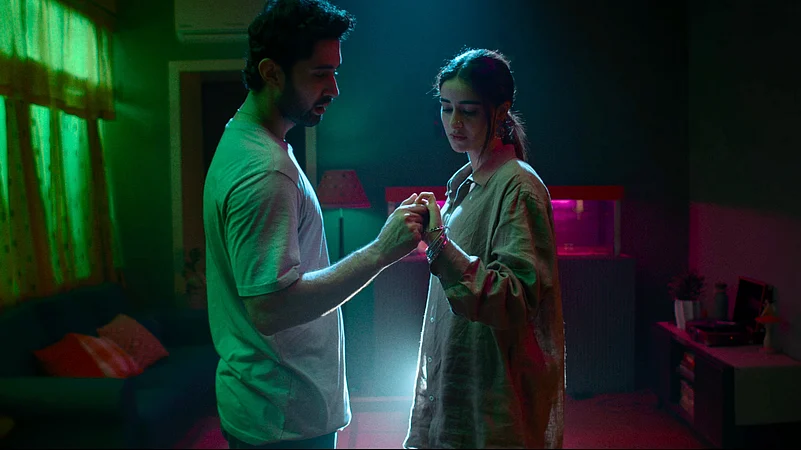
Strong music and visual staging cannot fully rescue the film's uneven emotional writing.
Ananya Panday and Lakshya lead an ambitious but emotionally conflicted relationship drama.
Chand Mera Dil seems unsure whether it wants to remain a dreamy romance or become a more realistic relationship drama.
Love stories work best when they trust emotion more than spectacle. Chand Mera Dil, however, spends so much time chasing cinematic intensity that it forgets to let its heartbreak breathe. What begins as a soft college romance wrapped in attractive imagery and pleasant musicality eventually spirals into a confused relationship drama that struggles to decide what it truly wants to say.
Directed by Vivek Soni and produced by Karan Johar, Chand Mera Dil follows Aarav Rawat (Lakshya) and Chandni Prasad (Ananya Panday), two engineering students whose whirlwind romance stretches across love, marriage, emotional conflict and personal upheaval. On paper, the film promises a layered story about relationships, emotional baggage and growing up. In execution, it becomes far more complicated than compelling.
The first thing that works in the film is its visual language. Soni clearly understands how to stage romance. The film looks polished and carefully assembled. The choreography, music and camera movement often work in harmony, creating sequences that feel aesthetically pleasing even when the writing underneath struggles. Several slow-motion shots and musical stretches carry a certain warmth, and the romantic imagery occasionally lands with sincerity. There is effort visible in how emotions are framed visually.


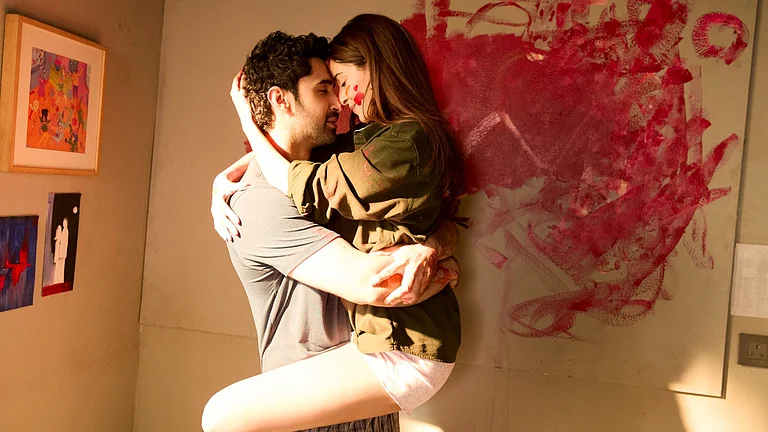

The songs, too, do much of the emotional heavy lifting.
There are moments where the choreography and camerawork genuinely complement one another, creating scenes that feel dreamlike and cinematic. The traditions, celebrations and visual detailing add texture to the world. At times, the film almost resembles a modern romantic drama trying to preserve the softness of older Bollywood love stories.


Yet, good imagery alone cannot hold together a shaky emotional core. The early portions carry traces of films like 2 States (2014), particularly in their portrayal of youthful attraction and cultural tension. Aarav falls for Chandni, and the romance progresses rapidly through familiar beats of young love. But the emotional foundation never feels fully earned. Their relationship develops so quickly that the audience is asked to accept intensity before properly understanding intimacy.
This becomes one of the film's central problems. The screenplay keeps jumping between emotional states without allowing scenes enough room to settle. Abrupt transitions and uneven jump cuts interrupt emotional continuity. Just when a moment begins to feel grounded, the narrative rushes elsewhere. The dramatic weight feels manufactured rather than organically developed.
For nearly half the film, Chand Mera Dil seems unsure whether it wants to remain a dreamy romance or become a more realistic relationship drama. When it finally leans into emotional realism, it arrives rather late.
The film attempts to address heavier themes surrounding emotional trauma, difficult marriages and psychological strain. Without revealing key plot details, it is clear that Vivek Soni explores how unresolved emotional wounds affect relationships over time. The material surrounding emotional exhaustion and post-partum struggles carries potential. The problem is not the intention. It is the execution.
These themes deserve patience and depth. Instead, they often arrive wrapped inside melodrama and dramatic escalation. The emotional transitions feel abrupt, which weakens their impact. Trauma cannot simply appear as a narrative device and disappear once dramatic purpose has been served. The film raises serious emotional questions, but rarely sits with them long enough.
This unevenness extends into the characters themselves.
Ananya Panday's (Chandni) remains one of the film's most frustrating figures. Not because she is flawed, but because the writing struggles to define her emotional centre. Chandni moves between vulnerability, anger and uncertainty, but the shifts often feel inconsistent rather than layered. Her decisions create more confusion than empathy, and the back-and-forth writing leaves the character emotionally difficult to grasp till the very end.

Panday approaches the role with visible commitment, but the performance often leans towards heightened drama.
There are scenes where she finds emotional truth, particularly in quieter confrontational moments, but the overall portrayal feels overstated. Chandni is written as a woman navigating emotional conflict and personal pain, yet the screenplay never fully settles on who she is beyond her instability.
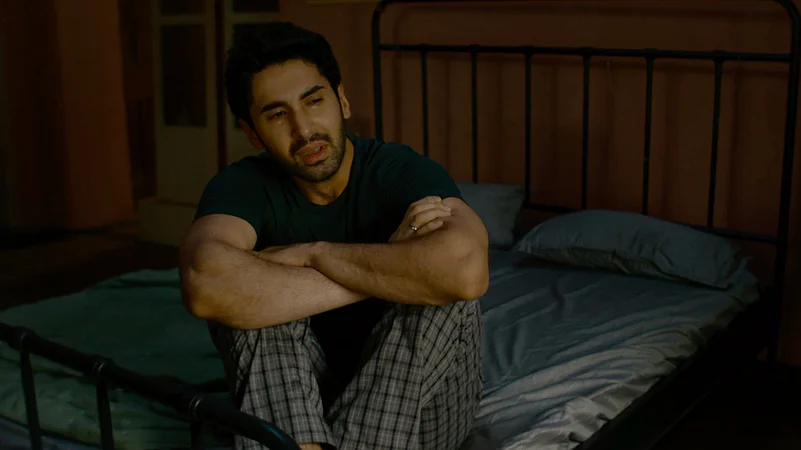
Lakshya fares slightly better as (Aarav). His performance remains restrained and functional, even if not particularly transformative. Aarav is portrayed as a man under emotional pressure and expectations, and Lakshya conveys that burden with sincerity. He does not overplay the role, which works in his favour. However, the character itself feels trapped inside writing that prioritises emotional drama over psychological depth.
There are glimpses of a stronger performance beneath the surface. The supporting cast, including Paresh Pahuja, Manish Chaudhari, Irawati Harshe and Charu Shankar, deliver dependable work despite limited material. Their presence helps ground portions of the film, though none are given enough narrative space to leave a lasting emotional imprint.
Visually, however, the film rarely looks careless. The production remains polished throughout, even if certain VFX choices become distracting. Some visual effects appear surprisingly weak and pull you out of moments that are clearly aiming for emotional immersion. For a film that relies heavily on visual mood, this inconsistency becomes difficult to ignore.
Perhaps the strangest aspect of Chand Mera Dil is how it mistakes complication for depth.
A relationship story does not automatically become profound because it contains suffering or conflict. Nor does avoiding the outright toxicity of films like Animal or Kabir Singh make it emotionally successful by default. To its credit, Chand Mera Dil avoids glorifying cruelty. But restraint alone is not enough. A compelling romance still needs emotional clarity.

Chand Mera Dil is a visually polished film weighed down by confused writing and emotionally exhausting relationship dynamics. The music works, the imagery impresses, and Vivek Soni's visual instincts remain evident, but the screenplay struggles to make sense of its own emotional chaos. What remains is a romance that is not merely complicated but often deeply unhealthy and difficult to emotionally invest in.