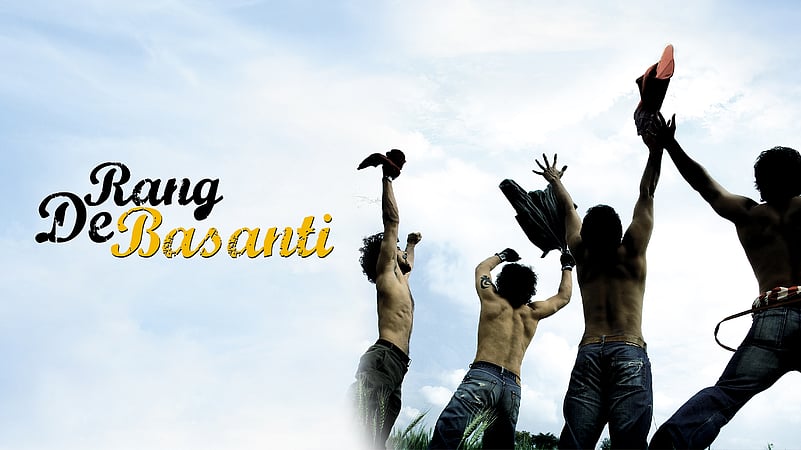
Rang De Basanti (2006), written and directed by Rakeysh Omprakash Mehra, completes 20 years today as a defining film of youthful political awakening.
Starring Aamir Khan, Siddharth, R. Madhavan, Sharman Joshi, Soha Ali Khan, Alice Patten, and Kunal Kapoor, the film reimagined patriotism through friendship, dissent and sacrifice.
Composed by A. R. Rahman, its music became a cultural symbol of resistance and idealism—two decades later, its resonance still endures.
In an anecdote in his autobiography The Stranger in the Mirror (2021), director Rakeysh Omprakash Mehra describes how the climax for Rang De Basanti (2006) was shot. With the help of a crew from NDTV News (who were official partners of the film), his film crew went to colleges in different parts of the country and narrated to them the story of a group of students who were being hounded and shot by paramilitary forces after they confessed to killing the defence minister live on All India Radio. The story, which is the plot of the film, was narrated to the students as true events in order to get their genuine angry reactions. What eventually ends up as a montage of reactions of angry students from across the country, thus, comprised the real footage of angry young voices protesting what they thought was a form of grave injustice.The affective charge of young voices—untutored and raw—forms the soul of the film’s soundscape—whether through the commotion of angry voices, or its songs and music.
The iconic patriotic song“Mera Rang De Basanti Chola” was composed by Indian freedom fighter Ram Prasad Bismil, along with his comrades in1927, as they remained imprisoned in Gorakhpur jail by the British for the Kakori conspiracy case. The song was immortalised by other young freedom fighters such as Bhagat Singh. It has often later appeared in post-independence popular cinema as a memoir of the youths sacrificed for the cause of India’s freedom struggle.
Almost eighty years since the song was composed, Rang De Basanti released to youthful fan following and loud anti-corruption cheers. But unlike the earlier instances of the term being used in various films depicting India’s freedom struggle against the British, this time, it was addressing contemporary youth. Arriving in the middle of the UPA 1 government’s tenure, it was still a few years away from the Anna Hazare-led movement’s rise and fall, and quite a few years away from the Hindu right’s resurgence to power. However, through all these years, the film has survived in popular memory as one that tugs at the nerves of the urban youth. A major part of this popularity was due to the film’s soundtrack and music. Composed by A.R. Rahman and penned by Prasoon Joshi, the soundtrack captured something so fundamental about being young, that the songs have somehow never really aged. A.R. Rahman, in an interview, quipped that the film allowed him to re-connect with his younger audiences—a relationship he had started to feel was weakening in the few years before RDB.
Some of these songs about young chaos, irreverence and awakening, have continued to be reimagined over the years—in studios, on reels, on social media and the streets.
1. Masti Ki Paathshala
In another anecdote from Mehra’s autobiography, he remembers asking Rahman, “What’s the sound of a rebel?” He was then introduced by the latter to rap song writer Blaaze, who wrote the English lyrics for the song. Interspersed with the refrains “I am a Rebel” and “Lose Control,” the song’s English lyrics, “To the Mahal of the Taj/ To the Minar of Qutub/ To the Kumari Of Kanya,” nod to India’s historical landmarks, as the Hindi lyrics speak about the youth’s irreverence towards institutional education. The film’s music was addressing what was often referred to as the “MTV generation”—urban youth who grew up in the pre-social media age, with the television being a major point of their interaction with popular culture. The MTV soundscape comprised English-language popular songs (which this generation was mostly exposed to through the channel)and Hindi popular music—both indie pop and film. This song, sung by Naresh Iyer and Mohammed Aslam, through its rock mixing of English rap and young Hinglish lingo, re-created sounds that perhaps continue to remain a point of sonic nostalgia for people who grew on the sounds of MTV. The film was, in fact, nominated by MTV for its Youth Icon Awards, while its song “Khalbali” was reimagined in the show MTV Unplugged.
2. Khalbali
The quality of capturing young emotions—as they dofor the college students they catch unaware—remains embedded through the film’s music and lyrics. Mehra has described “Khalbali” as one that was meant to capture the storm brewing inside its characters—as they transition from people whose worlds were just about having fun and getting degrees, to ones who wouldn’t mind dying for a cause they believe in.The song, sung by Nacim, Mohammed Aslam, and Rahman, has no distinct choreography either; it follows the actors through shaky cameras as they indulge in free-flowing movements. In the narrative, it features right before their friend Ajay’s (R. Madhavan) death alters their lives forever.“Khalbali”—which literally translates to commotion, or chaos—speaks about the unconfined high of being young. It does so, as it mobilises sounds from across the world to be infused into a lingo that captures the Delhi college-speak. The Arabic part of the song, Ya Ali, was composed by Rahman after he heard a voice at a night club in London. It was then infused with the Hindi lyrics written by Joshi—which talks about the ziddiness of being young. Drawn from Sufi the dhikrand qawwali, the chants of Ya Ali form the spiritual anchor to the sonic chaos of the overlapping vocals and percussion-driven rock music.
3. Rang De Basanti
The film’s title track, though Hindi, is instilled with the energies of Punjabi pop music, brought by its singer Daler Mehndi, and infused by Rahman’s use of the dhol, which does not just exist as background music, but cuts through the mix and announces itself—including in the song’s visuals, where we see the characters enjoying bhangra with a group of performers. As Mehndi is contrasted with a high-pitched K.S. Chithra, the dhol is looped and layered with electronic sounds, thus producing a re-playable fusion that became as popular as the other songs in the
4. Roobaroo Roshni
If RDB’s music was a cultural moment, “Roobaroo” was its soul. By the time we reach the end of the film, the madness has given way to a sense of calm, where the film’s protagonists walk to death with smiles on their faces—reminiscent of the young revolutionaries of the independence movement, whom the film keeps flashing back to. In an interview with Scroll, Joshi described “Roobaroo” as a song of inner awakening. Unlike the percussion-heavy beats of “Masti ki Paathshala” and “Khalbali”, its subtle bass and soft synth pads complement Naresh Iyer’s unstrained singing. The lyrics, which summon the youth to wake up to change, while speaking of the awakening of its protagonists, was an instant favourite with high-school and college students.
5. Khoon Chala
Perhaps the most underrated and least talked-about song in the film, “Khoon Chala”, which literally means “blood flows,”is a beautifully composed song that captures Laxman (Atul Kulkarni) in a moment of disillusionment and anguish, as he comes to terms with the futility of his Hindutva politics, while witnessing his friends being beaten up by the police. Despite not becoming as popular as the dance-readiness of “Khalbali” and “Masti Ki Paathshala”, or the urgency or “Roobaroo”, the song brought visibility to singer Mohit Chauhan, who went on to become one of the most unique voices of Bollywood music.
6. Luka Chuppi
Unlike the others, “Luka Chuppi” is not a song of protest; it is about a mother who loses her son. Rahman has described the song as being inspired from Bob Dylan’s “A Hard Rain’s A-Gonna Fall,” an apocalyptic folk song about a mother summoning her “blue-eyed son.” Rahman uses the theme to produce a lullaby, with Lata Mangeshkar’s soprano voice as the mother, and himself as the son. What could have easily been turned into a moment of jingoistic drumbeats, is transformed by Rahman into a song about a mother’s warm embrace, and the cost of war machinery (something that the film otherwise fails to address in its glorification of the army).
The songs, once released, had affective afterlives of their own, as they kept being sung not just within college festivals and gatherings, but became popular in protest marches as well. In what is often referredto as the RDB effect, the film galvanised urban youth to come out on the streets in protest of injustices taking place around them. One such major protest was the case about Jessica Lal, a waitress who was shot dead in a crowded Delhi nightclub. In the JessicaLal protests, as well as other major protests that followed over the years, including the Nirbhaya rape case, the anti-corruption protests, or the fairly recent anti-CAA protests, these songs have lived through voices of young protesters. Irrespective of whether the film’s politics of governance has aged well or not, the songs have survived mediatic shifts from radio and television to social media reels, still holding on to their relevance for the young taking the streets.
Rini Dasgupta is a Ph.D scholar of Cinema Studies at the School of Arts and Aesthetics, Jawaharlal Nehru University, New Delhi. She works on the relationship between labour and technology in popular Hindi cinema.