
The specialist vs generalist debate is eternal, surfacing every now and then. I have seen a chief of the electricity board, an excellent engineer who managed his power plants and transmission systems extremely well but who was totally clueless in matters relating to power policy. I have seen a first-rate irrigation chief engineer taking over as the secretary of the irrigation department and floundering from day one on administrative issues. On the other hand, I have seen scientists, having long abdicated their scientific work, turn into fine administrators and policymakers. I have also seen IAS secretaries with excellent reputations unable to find their feet in alien departments. There is no hard and fast rule in such matters; the suitability and background of each officer for a post is more relevant than any label he wears.
Management of public affairs, as practised in India, is a highly specialised field. Practitioners have to learn this profession by working in the field, no university or training institute prepares a person to deal with politicians, crooks, public grievances, riots, floods, policymaking in a hundred fields, dealing with the police and the judiciary. Nor does any engineering school or MBA course equip you for the same. Robust common sense, coupled with a sense of dedication, pride, professionalism, experience from years of working in the field and as a junior officer in the secretariat, along with compassion are what you need to make a fine administrator. A person’s label or training at school or university neither prepares him in this regard nor hinders his abilities as an administrator.




Having said that, it has often been found suboptimal to have a specialist head a department—say the ministry of energy or ministry of power, for example. By definition, all specialists focus on their own specific fields, and each technical field has a hundred branches. I would hesitate to consider that an expert on electrical transmission will have better advisory capability in the field of solar or hydrogen energy than a non-engineer with an open mind. Moreover, rapid development has taken place in most fields in the past decades and an expert could well be out of date even in his own specialisation given that he has learnt his speciality years back.
A generalist is also not afraid of asking questions or consulting many experts before taking a position. The specialist, on the other hand, more often than not, tends to think that he is the best judge and hesitates to ask for advice.

The Joshis An I-T raid at the IAS couple’s house threw up disproportionate assets. (Photograph by Vivek Pateria)
The Union Public Service Commission is a key institution, one of the few which has maintained pristine standards; none has seriously questioned its process of selecting the best candidates for the civil services. The IAS cadre is selected through a competitive examination not on pass or fail basis, instead the system is designed to test overall comprehension, analytical ability and optimal responsiveness to situations rather than specialisation. It would not make a difference whether a ‘generalist’ or a ‘professional’ is inducted into the service.
However, the real malaise lies elsewhere. Currently, the upper age limit for appearing in the examination is 27 years for general candidates and 31 years for ‘reserved’ candidates. The structural flaw in the current process is inherent in these limits. While it is certainly not advisable to select candidates at the age of 15 or 16 as the person is too young to know his own mind, their selection at 28 or 30 comes much too late. By this age, a person is too set in his ways, his overall personality has already taken near-final shape and his mouldability is quite limited. He comes endowed with too much baggage to learn a new way of life, which the civil services demand. The ideal age should be 23 or 24 years, with a person getting two or three shots at the examination. Indeed, this will reduce ‘overpreparation’ and encourage spontaneity and test of ability. In the case of reserved candidates, they will have a better shot at senior positions, given that they would not be ‘timed out’ as they are in the present dispensation. By the same token, the induction of engineers, doctors and mbas would get considerably reduced—this would certainly not add to national loss. Nor would it hinder the administrative process. On the other hand, it may turn out be a significant gain for the business, medical and engineering fields—the nation’s economy and society have diversified in the past decades. New fields, unknown in the past have opened up, there is much greater opportunity for young men and women to contribute—the country needs talent in every walk of life.
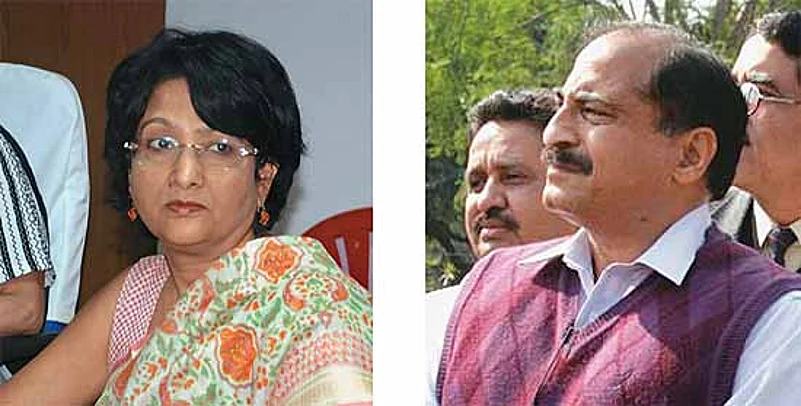
An I-T raid at this IAS couple’s house threw up disproportionate assets
The real issues of bureaucracy relate not so much to the selection process, but to the working conditions in the field. With politics now being a major business (probably the biggest) in India, and not subject to any regulatory authority, the temptation to use civil servants to toe a politician’s line at the district, state and national levels is ubiquitous. The working conditions for the new recruit are quite daunting, a situation that has deteriorated sharply in recent decades. A young officer struggles to retain any idealism that he might have come with; the venal atmosphere does everything to suck him into the mire. If he doesn’t fall in line, he is subdued by the weapons of arbitrary and frequent transfers, adverse remarks on annual reports affecting his promotion prospects and even inquiries based on false charges. Directions are given orally or telephonically, a clear case of authority with no accountability. No wonder many young recruits succumb to the pressures, some fairly early in their careers; others become quite willing to ‘crawl’ when asked to bend. A key instrument for the implementation and enforcement of policy, when civil services start getting used for servicing the political masters, it can only mean disaster for governance, as we can all see.
There is no denying that our civil services need urgent reform. Reduction in the age of entry is one key step. But there are many more that require to be taken. There’s no shortage of recommendations, be it by the Santhanam Committee in 1962 or the 200-odd commissions which have suggested crucial changes which have consistently been ignored by the parties in power.
(The author was a former cabinet secretary.)