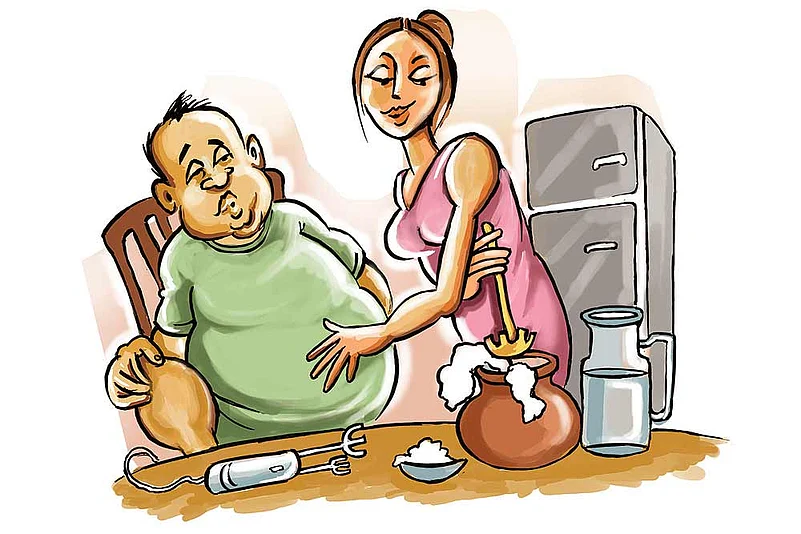

On Janmashtami, I woke up thinking if Krishna’s mum Yashoda lived in 2014 would she be upset about her son stealing makkhan or would she just worry that he was eating too much fat! Would she offer him a low-fat version? Or get his lipid profile checked?
Though the food of gods, butter remains amongst the most misunderstood fats, along with milk and ghee. What’s makkhan? It’s freshly churned butter from milk, an essential step before ghee. The churning itself makes the makkhan special in terms of molecular gastronomy, not just in terms of its unique, ‘melt in an instant’ texture, for it also nutritionally equips it with many special properties.
For starters, it retains the delicate structure between the carbon molecules of the fatty acid chains and retains the potency of the fat-soluble vitamins A, D, K and E, therefore making it a powerful anti-oxidant. Then there is the Wulzen factor, a hormone-like substance only found in freshly churned butter that has the capacity to prevent joint stiffness and ensures that your bones store more calcium. Freshly churned white butter is relished across India with regional delicacies that are fibre- and mineral-rich, mostly coarse grains and legumes, be it makai roti in Punjab, thalipeeth in Maharashtra, ragi adai in the south or noon chai (barley, salt and butter tea) in the Himalayas. The reason here is fibre and the Glycospingolipids, a type of fatty acids found in white butter, which work at protecting the gastrointestinal tract from infections or just from slowing down. Gassy, bloated, burpy? That spoonful of makkhan may just do the trick for you.