
In Calcutta, as in most large cities, the Modi “wave” surges the highest in the gentlemen’s clubs in the evening, its velocity soaring with successive rounds of drinks, hitting tsunami proportions before closing hours. But going by the size of Narendra Modi’s rally in Brigade Parade Ground on February 5, there isn’t much reason for a few extra rounds. Most dispiriting for the enthusiast was the rally’s timing, wedged between a “mega-rally” of TMC leader and West Bengal chief minister Mamata Banerjee, apparently three time larger than Modi’s, and one by the CPI(M)-led Left Front four days later, which could be twice as big.
The Modi show obviously had the largest turnout of Audis and BMWs, not to speak of the 22,000 seats that were sold online, but it was more a managed “event” than the traffic-choking human tornadoes that mark Didi’s roadshows now, or were the hallmark of Left rallies till she trumped it three years ago.
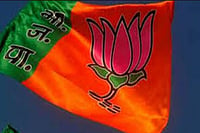
But it’s “okay”, as BJP pointsman for West Bengal Varun Gandhi remarked, leaving party elders red-faced. Known as an Advani acolyte, and cold on Modi, his observation could be both sarcastic and correct. Save for minuscule upper-caste pockets, Bengal is a saffron-neutral state. It bore the brunt of Partition riots, but unlike many areas in west and north India, it yielded no ground to the Bharatiya Jan Sangh, BJP’s ancestor, which opposed Nehru’s policy of allowing special constitutional safeguards for Muslims. Nor could the BJP strike roots here during its post-Ayodhya upsurge in the early ’90s, or even during its years at the helm in New Delhi, from 1998 till 2004. This is despite Bengal’s huge contribution to the Sangh’s Indian nationhood concept, which borrowed heavily from Bankimchandra and his revivalist novel Anandamath, Vivekananda and his mission, and the Bengali militants of the early 20th century who swore by the Gita. Ironically, the state cradled one of the founders of political Hinduism, Shyama Prasad Mookerjee, who established the Jan Sangh. Shyama Prasad, a bitter critic of Nehru, died in detention in Kashmir in mysterious circumstances. Calcutta’s arterial Chowringhee road, partly renamed after Nehru, merges with the next, and busier, segment, carrying Shyama Prasad’s name. Yet the party he grandfathered is a laggard in his state. A handful of MPs that BJP ever got from Bengal were gifts from electoral allies like TMC or the Gorkha Janmukti Parishad. Never has the BJP won a seat from Bengal solo.



Why? The obvious ‘credit’ for it goes to the Left, which was antipodal to the Congress in Bengal. Since the CPI(M) came to power in 1977, it never relented in its hostility to Hindu right-wingism. In 1982, in a broad daylight attack in Calcutta, its workers murdered 17 followers of Anand Marg, an allegedly militant religious outfit. Nobody was punished; indeed, memorials erupted, over the years, to those among the suspected killers who had passed away. The mayhem in the city’s south-eastern fringe had a long after-effect. The RSS morning drills, quite common in Bengal till the early ’80s, soon became a rarity. The city’s Marwari businessmen, big and small, who funded the BJP and generally took keen interest in the internal workings of the RSS, the mother organisation, smelt trouble and stayed away from active involvement in saffron politics. Above all, Jyoti Basu, unquestionably the party’s most powerful leader since its formation in 1964, ratcheted up so much bile at Vajpayee and Advani, calling them “uncivilised” and “barbaric”, that the message spread across the state.
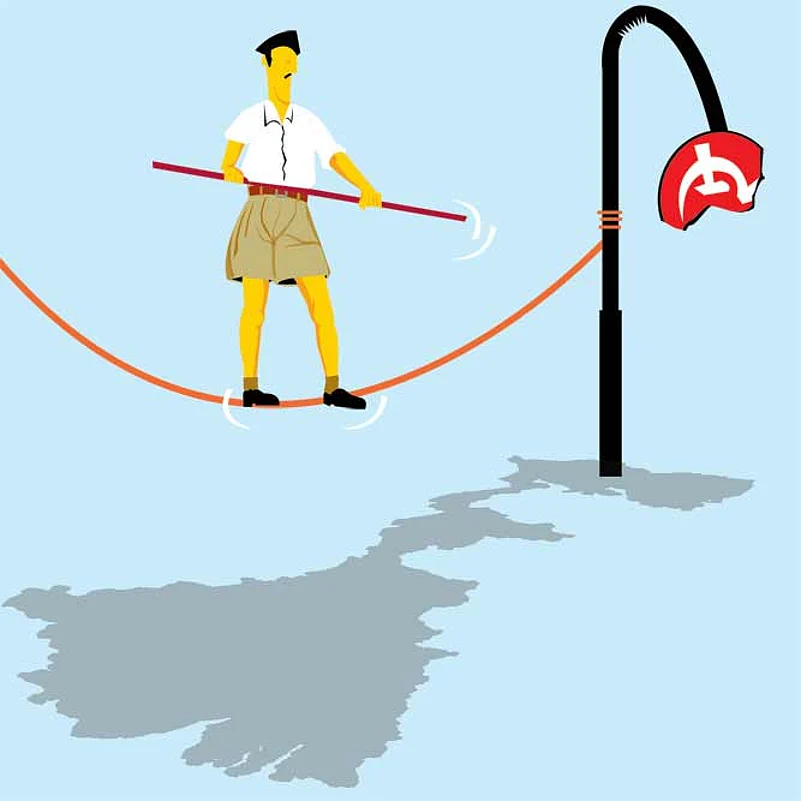
History is poised for a 180-degree turn, though, with men and boys in khaki shorts taking their morning drills having resurfaced in the neighbourhood parks, not only in Calcutta but as far as Santiniketan, poet Tagore’s abode. The CPI(M) was kind on the Congress but treated the BJP much like Tudor England dealt with Catholics. However, Mamata Banerjee’s TMC is different from both the CPI(M) and BJP in its structure; it neither has a cadre base nor a ganglion of decision-makers at the top, like the RSS or the CPI(M) politburo. Nobody in TMC is bothered if some youngsters in khaki shorts play a game at the park called “Kashmir hamara hai”. No wonder BJP membership is skyrocketing in the state, from 3,00,000 in 2011 to 7,00,000 now, according to party sources.
However dissimilar in ideology, the BJP and CPI(M) are cadre-based parties both. They keep workers under constant watch, pay them wages, motivate them, give them tasks and apply on them the same reward-and-punishment principle as in board-run corporations. Marxists hate the BJP because, in some basic functional ways, they are cut of the same cloth. Now facing Mamata’s wrath and internal crisis, the CPI(M) is in disarray. That’s a gilt-edged opportunity for another cadre-based party to fill the vacuum. Come May, the clubs may close late, who knows?