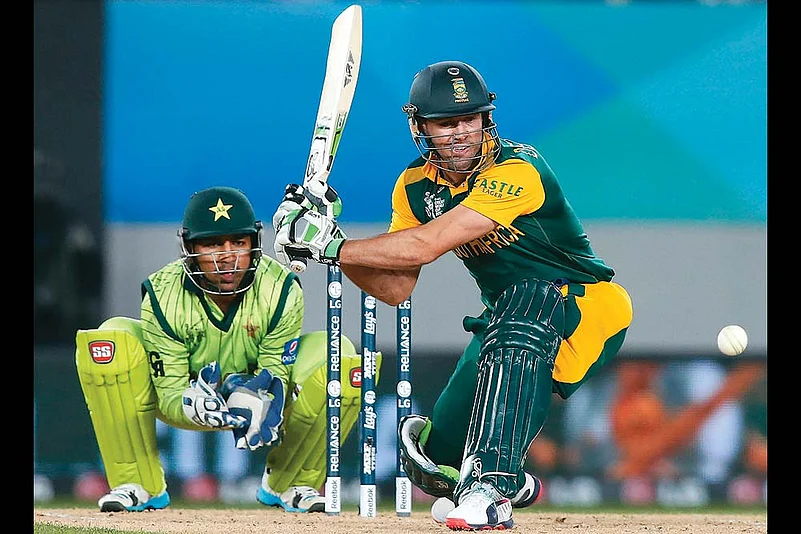

Even in a tournament containing some of the biggest hitters in the game, Abraham Benjamin de Villiers, 31, stands out. He has not merely used the grammar of the game to compose its fastest innings; he has altered the grammar itself. He is a fabulous original.
When Sachin Tendulkar made one-day cricket’s first double century, it was a triumph of the straight and narrow rather than a hosanna to the frenzied flummeries of the shorter formats.
De Villiers has gone beyond the manual and the manic. He is the game’s first post post-modern batsman, the first 360-degree player, as capable of hitting a fast bowler over his head onto the sightscreen as of swinging him over the wicket keeper’s head onto the other sightscreen. To do what he does requires a combination of factors: fitness, flexibility, eye, ball sense, lightness of foot and heaviness of bat. Against Sohail Khan in the Pakistan game, he got into position so quickly, he actually played a straight drive to midwicket. His positional play is as rich and as varied as that of a grandmaster’s in chess. The amazing footwork draws the bowler into following him with the ball, and thus falling into a trap since the ball is always within reach.
De Villiers moves with the certainty of a mountain goat, ensuring he is balanced at all times. Bradman must have moved thus in the Bodyline series, to hit the fast bowlers attacking his rib cage and head past point and cover. Bradman handled the predictable in an unpredictable way. De Villiers handles the unpredictable in an unpredictable way. And an average of over 50 in either form of the game suggests that the South African can switch gears with ease.
He is a natural ball-player, and in an earlier era might have played a host of other sports at the top level.




He was shortlisted for South Africa’s junior national hockey and football teams, and led the junior national rugby team. He was in the national junior Davis Cup tennis squad and the under-19 badminton champion. He holds half a dozen swimming records and the record in the 100m in junior athletics. He is a scratch golfer. And just to make it all so frustrating and irritating for everybody else, he released an album some years ago with Ampie du Preez with nine tracks in Afrikaans and five in English.
In the last few weeks, de Villiers, also one of the world’s finest fielders, broke the record for the fastest 50, fastest century and fastest 150 in one-day cricket.
How do you bowl to such a man who is capable of hitting a yorker for six to any part of the ground he chooses? Where do you place the fielders? His reflexes ensure that he can change his stroke, as he showed against the West Indies. He treated Jason Holder with such violence the bowler might have complained to the icc—the International Criminal Court. This, during his incredible 66-ball 162. After a while, he was challenging himself to play identical deliveries into different sections of the crowd just for fun. He might have been humming a few bars from his favourite musical too; that’s the impression he gave.
With four back-to-back centuries, Kumar Sangakkara is the leading batsman of the tournament; with a double century, Chris Gayle has the top score. Both are examples of players who have stretched the limits of the classical one-day game. What makes A.B. de Villiers different is that he is not just extending the known, he is taking us into the unknown, the untested. Strokes that were thought impossible will become commonplace if de Villiers remains so creative.
Already, when he bats, the reverse sweep, even against the medium pacer, looks less ordinary than it is. The Dilscoop has about it dual elements of risk—miss the ball and you could be either bowled or hit on the face. A.B. de Villiers makes it look the safest shot in the game. All shots in the game carry an element of risk; de Villiers looks comfortable playing the most outrageous of them. Like a tightrope walker, he knows how to retain his balance and convey the thrill of his craft.
Rather like a smartphone fair or a car exhibition, the World Cup is the natural stage for exhibiting the latest in the game. This is the future, and A.B. de Villiers has brought us here.
(Suresh Menon is editor, Wisden India Almanack)