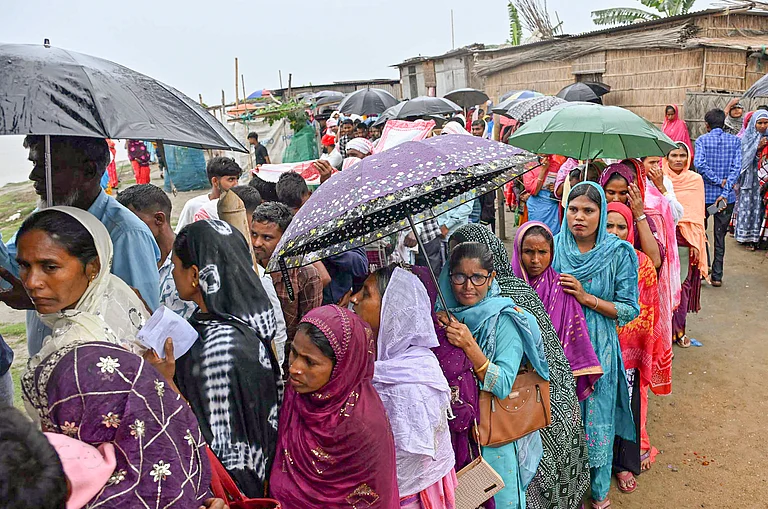
- Study shows that 30-60 per cent funds are being misused or diverted.
- Workers continue to face payment delays or are not paid the minimum wages.
- Erratic work and local caste favouritism means workers still prefer migrating to cities.
- Time lag between project approval, implementation; wasteful, 'duplicated' spending.
***
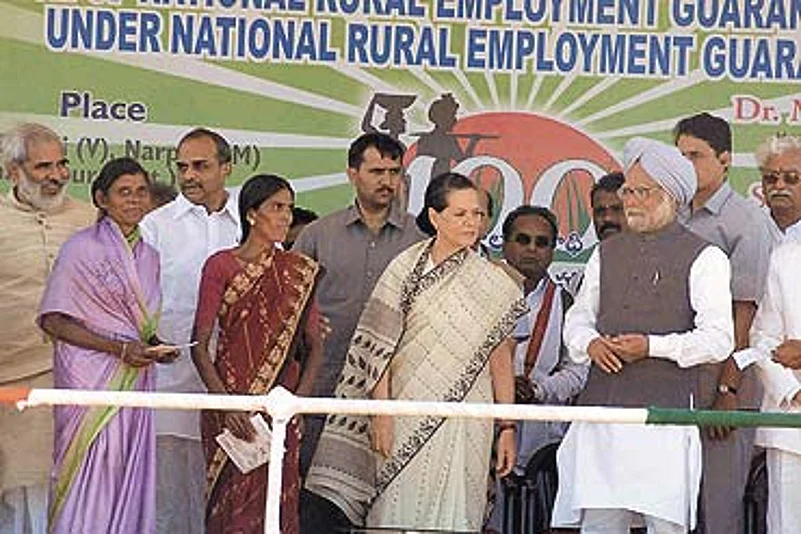

Let's start with the corruption, expected to come down considerably because of theRTI Act and a shift in framework that puts the onus on the panchayats to manage NREGA schemes. Says a categorical Gulab Singh Dhakar, Deen Dayal Antyodaya Samiti president of Badarwas block, Shivpuri, "Our study has shown that at least 30 per cent of the funds are wasted or misused. In some cases, the diversion is up to 60 per cent."
Others contend that in any project, a minimum of 5 per cent of the funds goes to line the pockets of the CEO who oversees the project, 10 per cent goes to the engineering officials, 5 to the zilla panchayat, and another 10 to panchayat officials. The percentages can be much higher in some districts and states. Add to these percentages the fact that in many cases funds are allocated for the same project several times, or shortcuts by the officials lead to shoddy implementation and other irregularities.
A case in point is a pond project in Mathna village in Shivpuri—it was sanctioned funds under three schemes. The first was for renovation, the second for deepening it and the third for widening the water body. Today, the original pond has been categorised as a new water body. And you cannot miss the roads where lakhs of rupees have been spent under NREGA only to be taken up again for improvement under the PM's rural roads scheme. Brijendra Singh of the Badarwas-based ngo Niswarth points towards one such road, shakes his head and ruefully says, "Rs 5 lakh has been buried under it".
Corruption, helped by bureaucratic myopia, has also had other inevitable results: quality in most projects has suffered. Built a couple of months ago, the uneven surface and portions washed away of a mud road in Dhamantook gram panchayat in Badarwas is stark testimony to it. Ramendra Singh, deputy sarpanch, Kota Chabor gram panchayat in Rajasthan's Karauli district, explains how a water gully was built for Rs 5 lakh this year without using any building materials "to ensure that the work is not washed away by rains".
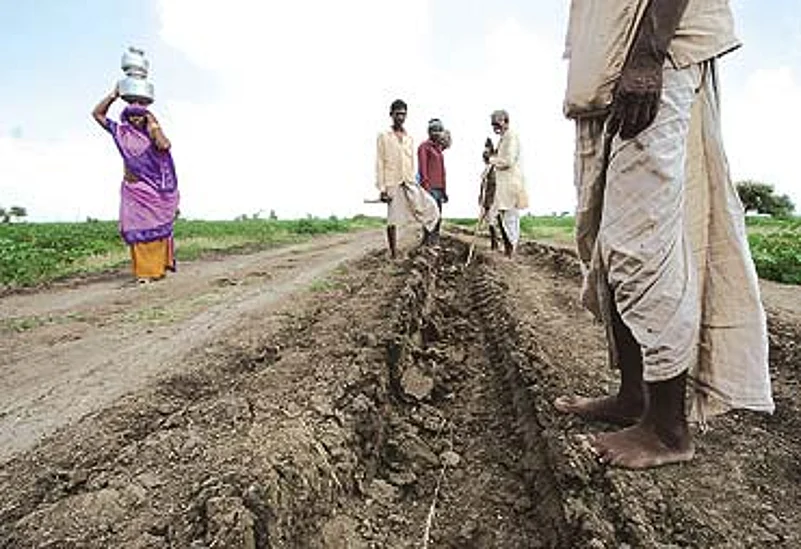
The ‘roads’ built under the NREG programme in Gargatu Sani village
He cites another instance where a water harvesting structure was repaired and enlarged with inadequate materials as the project provided for buying cement at Rs 175 (per 50 kg bag). As the market price at the time was Rs 225, the project used lesser amounts. Shakuntala Meena, pradhan, Sapotara block, Karauli, laments that although Rs 110 crore is claimed to have been spent in her district, there is nothing concrete to show for it. "If the funds had been utilised properly, our area should have become a paradise."
Another major grouse the villagers have is that there is a dearth of projects and, hence, the unemployed don't get enough work. Take the case of Gargatu Sani village in Badarwas, which has around 85 families of the Sahariya tribe, which ranks pretty low on India's socio-economic graph. The average days of employment here is 10-20 and, in some cases, job cards of many families are blank as the lone road project was stopped midway due to the rains.
Although Anil Bhatnagar, assistant programme officer, Badarwas block, claims there are at least 4-5 approved projects per gram panchayat in the area, a quick weekend survey of 18 gram panchayats by Niswarth found work was in progress in only two places. And most of these projects provide employment for only 10-15 days at a stretch. Incidentally, the PRIA report highlights that the time lag between project approval and implementation is a major issue hindering progress on all fronts.
Similarly, in Vinega village under Kota Chabor gram panchayat, around 200 job cards have been issued, but only half of the bpl families have managed to get employment under NREGA, and that too for just 35-40 days. "Only if we get work throughout the year can we manage to stay here. Mostly women utilise the job cards. My husband lives in the city, where he earns Rs 200 per day whenever he gets work," says Draupadi, a resident. Bhagwati, a mother of three minor children, often shifts to distant cities whenever private contractors come with work offers to Gargatu Sani village.
The women bear the brunt for other reasons too. They are shortchanged in terms of wages as there are no standardised yardsticks for the quantum of work done by an individual. Many complain that upper-caste men on the same project don't work and make the lower-caste women slog. Sometimes the men also force the women to part with a share of their wages. Caste politics also plays out in acts of favouritism by sarpanches.
Going through the NREGA records in Barkehdo panchayat in Badarwas, Outlook found that a Rathiram (card No. 47) got 124 days of employment, when the average for most people was 30-40 days. There were also some who did not get any work. "The system of registration for job cards is not without loopholes," says Arun Jindal, director, Society for Sustainable Development. He adds that the current system does not account for the needs of the marginalised families. In Karauli, 2,00,000 job cards have been issued, but there are still around 50,000 families who need the money but haven't got these cards.
Officials, meanwhile, blame the villagers for the shortfall in employment days. Bhatnagar maintains "there is not enough enthusiasm to work under the NREGA programme as they can get better wages elsewhere". S.R. Chordia, CEO of the Karauli NREGA programme, agrees, "The scheme's benefit is that villagers have a choice of work...their importance has increased." In some cases, like in Mandala district of MP, a cash prize incentive of Rs 25,000 has been announced for the best gram panchayat to force faster implementation of projects.
But such half-hearted efforts are unlikely to 'improve' the NREGA schemes. PRIA, in fact, plans to present its findings to the prime minister in an effort to bring out some mid-term course corrections. As Tandon puts it, "Increasingly, villagers are just giving up. Instead of fighting the system, they are opting to migrate. The efficacy of any scheme depends on people's faith that it will deliver the goods. Even if they get 50-60 days of work per year, there is a need to ensure full and timely payments."
So what is the cure? Well, for one, it's time governments, both central and state, stepped in. Abdicating responsibility by pinning hopes on the RTI Act will not curb corruption or improve delivery mechanisms. TheNREG Act has provisions to punish violators, yet no action is ever taken. Governments can keep throwing money, but if the vision is about 'inclusive growth', they are missing the target somewhere. This could just as soon become another nightmare for the administrators.