Contradictions, it seems, continue to dog the evolution of the elite special forces in the country. In the latest orders coming out of army headquarters, the Special Forces (SF) have been shot in the foot. The world over, militaries have recognised the need for lea-ner but meaner forces with comprehensive special operations ability, but the Indian army has chosen quantity over quality. Defence analysts feel the move will impose an immense fiscal burden and threaten the country's ability to employ special forces for strategic operations.
A set of recommendations accepted by army headquarters last month has now sparked off a furious debate. Retired and serving generals are writing to the army top brass forcing the army chief, General N.C. Vij, to remark that "never have so few had opinions so many". He should have known. Just two years ago, when a similar debate had arisen at army headquarters, as the vice-chief, Vij had put it on record that there would be no expansion of the Special Forces. Instead, recognising the changing nature of war, he ruled that the army's 10th Plan would be used to consolidate a tight force that was desperate for a dose of modernisation. By January 2004, Vij, as army chief, reversed his own decision and announced at the Army Day press conference that the Special Forces would be expanded.
On September 13 this year, a study group set up by the army recommended that the army increase its present strength from the existing five battalions of Special Forces to 13 by 2010. The decision will ensure that a cash-strapped government now stares at a massive fiscal burden. A study by the army's military operations directorate in 2001-02 revealed that the army needed Rs 400 crore to modernise the existing five battalions and Rs 590 crore to set up a special operations aviation squadron. In 2004, despite rising costs of weaponry and inflation, the "official" cost to raise and equip 13 battalions has been pegged at just Rs 820.38 crore. Analysts, however, peg it at Rs 3,000 crore.
Interestingly, the army has already started converting two of its conventio-nal parachute battalions to a special forces' battalion without government sanction. The army top brass has also decided that the Special Forces battalions, so far trained and recruited for specific theatres, will be moved out of their areas of specialisation. The move overturns a recommendation—accepted two years ago—that the battalions trained for operating in mountains and deserts continue at their chosen, specialised location.
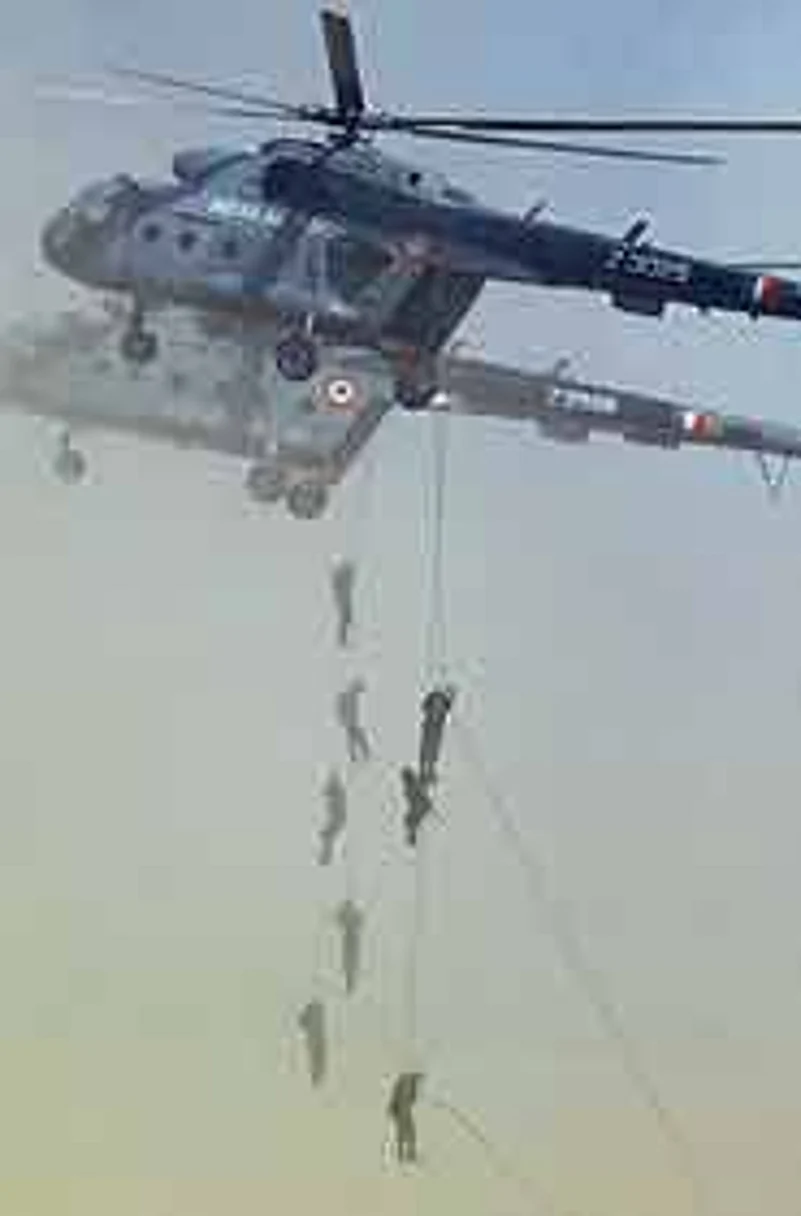

The raising of two army aviation special operations squadrons has also been recommended at a time when a similar proposal for one such squadron made in 2002 is still awaiting clearance. The move reveals the lack of communication between the army and air force. In the absence of a joint doctrine, the army is now raising its own squadron citing "inadequate cooperation" from the air force. Ironically, last year, the air force raised its own SF unit—the Garud Force—citing "inadequate cooperation" from the army!
The inherent contradictions in the latest study and its recommendations had been predicted. Lieutenant General R.K. Nanavatty, who retired as the northern army commander last year, wrote to the army chief early this year pointing out the sorry state of the existing Special Forces battalions. Nanavatty's association with the Indian Special Forces dates back to 1987 when he was part of a committee set up to recommend measures to acquire special operations capability. The committee's recommendations saw partial implementation only to be reversed soon after. "The evolution of Special Forces in India has been, and continues to be, a slow, painful and muddled process," says Nanavatty. A key recommendation of the committee was to separate the Special Forces battalions from the Parachute Regiment considering the fundamental differences between airborne and special operations.
In 1995, then army chief, General B.C. Joshi, agreed to separate the Special Forces battalions, so far yoked to the Parachute Regiment. Joshi ordered the creation of a Special Forces Regiment and a Special Forces headquarters to formulate policies to equip, train and task the regiment. The then Director General of Military Operations (later vice chief of army staff), Lieutenant General Vijay Oberoi, was appointed honourary Colonel of the Regiment to ensure adequate patronage to the fledgling regiment, when tragedy struck. Joshi passed away while in office.



Under pressure from the tradition-bound Parachute Regiment, the new army chief, General Shanker Roy Chowdhury, disbanded the Special Forces Regiment and its headquarters at Nahan, and merged the personnel with the army's military operations directorate. Now, men who had never served in these units, and with no experience of special operations, would take key decisions on Special Forces. Says Oberoi: "In the past, the Special Forces have been stymied by successive Colonels of the Parachute Regiment for short-term gains." Oberoi, instrumental in authoring the first Special Forces doctrine, feels there is no place for "narrow regimental loyalties" in a professional army. Instead, decisions of such strategic importance need to be taken at the highest levels, be it the cabinet secretariat or the national security advisor. Ironically, the committee, which made the recommendations was chaired by the present Colonel of the Parachute Regiment who has never served in a Special Forces battalion. Now, army headquarters has agreed that he be appointed as a "special advisor" to the army chief on special operations.
Even standards of selection are being diluted. In 1995, when the 21st Special Forces battalion was being converted, only three out of 30 officers cleared the gruelling probation. In 2004, when the 4th Special Forces battalion was being converted, only three were rejected! "Our present Special Forces battalions are arguably the best type of infantry units in the army. They are robust, motivated and well-led, but despite their title, they are not special forces and are not capable of special operations which are distinct from special missions, commando operations and specialised operations," says Nanavatty. Oberoi also points out a major anomaly in the present strategic thought in government. "Club all our so-called Special Forces units—be it the Army, Navy, Air Force, National Security Guards and the Special Group—and we have more manpower than what the Americans have and yet we don't even have a tenth of their capabilities".
Even Pakistan's Special Service Group, say analysts, is better equipped and tasked than their Indian counterparts. Meanwhile, the Indian special forces, held hostage by petty turf wars, can only hope that things become better.