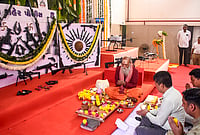
Dera Ballan has been central to the evolution of the Ravidassia religion, especially after declaring a distinct religious identity in 2010, complete with its own scripture, symbols, rituals, and practices separate from Sikhism.
Through sustained initiatives in education, healthcare, literature, and social welfare, and amid widespread Dalit landlessness and marginalisation in Punjab, Dera Ballan has emerged as a major centre of Dalit upliftment.
Dera Ballan formally declared the Ravidassia religion in 2010, later introducing its own sacred scripture, symbols, rituals, and practices, while consistently propagating the bani of Guru Ravidass.
The Padma Shri awarded to Sant Niranjan Das, the fifth Gaddi Nashin (head) of Dera Sachkhand Ballan, known as Dera Ballan, on the eve of India’s 77th Republic Day, along with the scheduled visit of Prime Minister Narendra Modi on 1 February 2026 for the 649th Guru Ravidass Jayanti on its premises, has once again brought this spiritual centre and headquarters of the Ravidassia community into the spotlight.
Earlier, Dera Ballan had featured prominently in national and international print and digital media on two occasions. The first was on 24 May 2009, following a deadly attack on Sant Niranjan Das and his deputy, Sant Ramanand, during their visit to the Ravidass Temple in Vienna. In the attack, Sant Niranjan Das was seriously injured, while Sant Ramanand was killed. The incident triggered widespread protests across Punjab, particularly in the Ravidassia stronghold of the Doaba region, located between the rivers Sutlej and Beas.
The mortal remains of Sant Ramanand were brought from Vienna to Dera Ballan in a chartered aircraft and were accorded a state funeral, attended by the then Chief Ministers of Punjab, Parkash Singh Badal, and Uttar Pradesh, Kumari Mayawati. The second occasion came on 30 January 2010, when the sants of Dera Ballan formally declared a distinct religious identity—the Ravidassia religion (Ravidassia Dharm). A year later, on 30 January 2011, marking the 633rd birth anniversary of Guru Ravidass, the sants of Dera Ballan, led by Sant Niranjan Das, announced their own sacred scripture, Amritbani Satguru Ravidass Maharaj Ji, thereby formally dissociating themselves from mainstream Sikh theology.



Dera Ballan is located in the village of Ballan, approximately seven miles north of Jalandhar city, on the Pathankot Road. It was founded in the early twentieth century by Sant Pipal Das and developed into a significant spiritual and social centre of the Ravidassia community under the leadership of Sant Sarwan Das.
Following the death of his wife, Shobhawanti, Sant Pipal Das left his native village of Gill Patti in Bathinda district with his five-year-old son—later known as Sant Sarwan Das—in search of spiritual enlightenment. He found the outskirts of village Ballan to be a suitable place for his spiritual mission. The father and son spent their days in the surrounding forest and took shelter in a mud house in the village at night. Subsequently, a local landlord, Hazara Singh, donated a parcel of forest land to them, where they constructed a thatched hut. This modest beginning soon evolved into a prominent centre for the veneration of Guru Ravidass.
Sant Sarwan Dass received his early education from his father and later studied Sanskrit under Sant Kartanand of the nearby village of Kishangarh. He was in his early thirties when Sant Pipal Dass passed away in 1928. By then, Sant Sarwan Dass had already established himself as a respected figure, not only in Ballan but also in the surrounding villages. What distinguished him from other holy men of his time, however, was his deep devotion to and veneration of Guru Ravidass—one of the most renowned marginalised saints of the fifteenth and sixteenth centuries, and a leading figure of the Bhakti movement, particularly the nirguna sampradaya or sant parampara, which emphasised devotion to a formless God in later medieval North India.
Sant Sarwan Dass made the propagation of the bani—the spiritual philosophy of Guru Ravidass expressed through poetry—a central mission of his life. His spiritual leadership, combined with a strong commitment to the empowerment of socially excluded communities, transformed Dera Ballan into a major pilgrimage centre for historically marginalised sections of society. Dalit consciousness in Punjab largely emerged in the context of the bani of Guru Ravidass, who creatively used poetry as a medium of non-violent social protest to advocate an egalitarian social order, symbolised by the ideal of Begampura. The sants of Dera Ballan have carried forward this mission, preserving and advancing the teachings of Guru Ravidass.
Moreover, the sants of Dera Ballan have successfully integrated the egalitarian philosophy of Guru Ravidass with the rational and critical thought of Dr B. R. Ambedkar. This synthesis gave rise to a powerful socio-cultural movement aimed at the cultural transformation and spiritual regeneration of Dalits in the region. If Guru Ravidass may be regarded as the prophetic voice of Dalit consciousness within the medieval North Indian Bhakti movement, the sants of Dera Ballan can be credited with revitalising and reasserting Dalit consciousness in contemporary Punjab.
Guru Ravidass, the patron sage of Dera Ballan, held particular appeal for the lower castes for several reasons. He belonged to the Chamar caste and is widely regarded as a pioneer of early Dalit literature. Sant Sarwan Dass, himself a Chamar and a devoted follower of Guru Ravidass, therefore enjoyed immediate resonance among the Chamar community, for whom Guru Ravidass is a spiritual guide. In this sense, Sant Sarwan Dass acted as a true emissary of Guru Ravidass. Under his leadership, the dissemination of Guru Ravidass’s teachings became a core mission of Dera Ballan.
Sant Sarwan Dass personally laid the foundation stones of numerous Ravidass deras that began to emerge across Punjab in the early twentieth century. Over time, the Ravidassia religious presence also expanded rapidly overseas. The foundation stones of nearly all Ravidass deras, both in India and abroad, have been laid by the sants of Dera Sachkhand Ballan. Significantly, these deras have developed not only as centres of spiritual congregation but also as important hubs of social and cultural transformation.

Following the legacy of Sant Sarwan Dass, the successive saints of Dera Ballan continued to enlighten their followers through the bani of Guru Ravidass. To ensure wider dissemination of Guru Ravidass’s teachings, the Dera produced and distributed numerous audio and video recordings, including cassettes, CDs, and video discs of the bani. In addition, Dera Ballan developed a dedicated Gurbani programme based on the teachings of Guru Ravidass, titled Amrit Bani: Shri Guru Ravidass Ji.
This programme holds particular significance for Dalits, who were historically denied access to sacred texts and religious recitations. Its broadcast on national television, alongside programmes of mainstream religious traditions, has been a source of immense pride for the community. It has played a crucial role in strengthening self-esteem and confidence, which in turn has sharpened social and political awareness among Dalits. Alongside spiritual initiatives, primary education and healthcare were key priorities of Sant Sarwan Dass and his successors, further consolidating the popularity of Dera Ballan among marginalised communities.
All the Gaddi Nashins who succeeded Sant Sarwan Dass made significant contributions to his broader projects of social emancipation and empowerment of the most disadvantaged sections of society. In April 2004, Dera Ballan established the Sant Sarwan Dass Model School at Hadiabad (Phagwara) to provide quality education to Dalit children at a nominal fee. The school operates from an impressive, well-equipped building with modern educational facilities and its own fleet of buses for student transport. English is the medium of instruction. What sets the school apart is its holistic approach: alongside formal education across various disciplines, students are also introduced to the teachings of Guru Ravidass and the mission of Dera Ballan. As such, the institution not only delivers quality education in a supportive, Dalit-friendly environment but also serves as a catalyst for nurturing Dalit consciousness.
Sant Sarwan Dass also founded an Ayurvedic medical centre at the Dera to serve the poor and underprivileged who could not afford medical treatment or medicines. This initiative later expanded into a full-fledged hospital, the Sant Sarwan Dass Charitable Hospital, located at Dehpur–Kapoor Village Adda Kathar on the Hoshiarpur–Jalandhar Road in Jalandhar district. The hospital was formally established in 1982 by Sant Garib Dass, then head of Dera Ballan, beginning modestly as a small dispensary in 1984. Over time, it grew into a 200-bed hospital equipped with modern medical technology and gained a reputation for excellence in surgical care within the region.
The hospital provides round-the-clock emergency services and operates an in-house pharmacy offering medicines at subsidised rates. For the convenience of patients and their attendants, it also offers indoor catering facilities and spacious waiting and resting areas.
Patients are charged only a nominal fee to partially cover operational costs, which amount to approximately 2.5 million Indian rupees per month. At a time when public healthcare services have largely become ineffective, the Sant Sarwan Dass Charitable Hospital has emerged as a vital source of relief for those unable to access or afford adequate medical care.
In addition, since 1977 the saints of Dera Ballan have organised annual free eye surgery camps at the Dera every February, with the support of Swarn Dass Banger, a non-resident Indian based in England. Swarn Dass Banger also donated 10 million Indian rupees for the construction of the Sant Sarwan Dass Memorial Eye Hospital in Ballan village, near the Dera. The foundation stone of the Eye Hospital was laid on 10 November 2004 by Sant Niranjan Dass, the current head of Dera Ballan.
The provision of comprehensive medical services in rural Punjab has made Dera Ballan a distinctive religious institution for the marginalised, where spiritual devotion and social welfare are seamlessly integrated.
Another defining feature that placed Dera Ballan at the forefront of Dalit upliftment has been its sustained engagement with literary and intellectual activities. The Dera maintains a well-stocked library containing an extensive collection of books on the life and philosophy of Guru Ravidass, Dr B. R. Ambedkar, the Bhakti movement, the Ad Dharm movement, Dalit literature, and the mission of Dera Ballan. The complete writings and speeches of Dr Ambedkar are available in the library. These books are provided to readers either at a nominal cost or free of charge, and some are also distributed to devotees as souvenirs, along with framed calendars featuring images of Guru Ravidass and Dr Ambedkar, as well as depictions of Dera Ballan and the Ravidass Temple at Seer Goverdhanpur.
In addition to preserving literature, Dera Ballan actively publishes and sponsors works of Dalit literature and honours Dalit scholars for their contributions to social upliftment. To date, twenty Dalit scholars have been awarded gold medals in recognition of their literary achievements. Since 15 August 1991, the Dera has also published a twelve-page trilingual weekly newspaper—Begumpura Shaher (Punjabi, Hindi, and English). Founded by Sant Garib Dass, the fourth head of Dera Ballan, the publication was intended to highlight the issues faced by the marginalised and to promote the teachings of Guru Ravidass. As one of the few platforms representing Dalit voices at a time of severe underrepresentation in mainstream media, Begumpura Shaher has played a vital role in fostering social awareness and self-respect within the community. In recognition of its journalistic contribution, the Bharatiya Dalit Sahitya Academy honoured its chief editor, Sant Ramanand, with the Twentieth National Dalit Literary Award in 2004. The Academy also organised a two-day National Dalit Introspection Camp at Dera Ballan on 9–10 June 2006, focusing on the shared philosophies and objectives of the Buddha, Guru Ravidass, and Dr Ambedkar. In a caste-based hierarchical society, these literary initiatives proved crucial in building confidence among Dalits, who were often marginalised in mainstream literary circles.
Among the many contributions of Dera Ballan, the construction of the Shri Guru Ravidass Janam Asthan Mandir at Seer Goverdhanpur, on the outskirts of Varanasi, stands out as the most significant. The saints of Dera Ballan identified this location as the birthplace of Guru Ravidass, near Banaras Hindu University. The foundation stone of the temple was laid on 14 June 1965 by Sant Hari Dass of Dera Ballan, and construction was completed in 1994. Babu Kanshi Ram, founder of the Bahujan Samaj Party, performed the ceremonial installation of the temple’s golden dome, while the monumental entrance gate was inaugurated on 16 July 1998 by K. R. Narayanan, then President of India. Dalits from India and abroad contributed to the construction of the temple.

Over time, the temple has acquired an importance for Dalits comparable to that of the Golden Temple for Sikhs or Mecca for Muslims. Each year, on the birth anniversary of Guru Ravidass, millions of devotees from India and overseas visit the site. Beyond its religious significance, the temple serves as a powerful reminder of the cultural and social revolution led by Guru Ravidass in Varanasi—long regarded as the centre of Hindu orthodoxy. It symbolises a history of struggle for equality and dignity, as well as a vision for the future. In a society structured by caste and religious hierarchies, the Shri Guru Ravidass Janam Asthan Mandir has emerged as a vital cultural and religious space for the assertion of Dalit identity—a place where Dalits can gather with dignity, free from the constraints of caste discrimination. In this sense, the temple has become a lasting repository of Dalit consciousness and self-identity.
Dera Ballan, along with other Ravidass deras, has a distinct religious insignia known as Har (the Supreme Being). Also referred to as the Koumi Nishan of the Ravidassia community, this symbol clearly differentiates the Ravidassia faith from other religions. By contrast, Sikh gurdwaras are identified by the khanda, a double-edged sword encircled by a quoit with two crossed sabres beneath it.
The Har insignia consists of a sun-like circle edged with forty rays, symbolising the forty hymns of Guru Ravidass. Within the larger circle is a smaller one, inside which the word Har is inscribed in Gurmukhi script, topped by a flame. This flame represents the naam (the divine word) that illuminates the world and extends into the outer circle. Between the two circles is inscribed a couplet from one of Guru Ravidass’s hymns: Naam tere kee jot lagayi, bhaio ujiaaro bhawan saglaare (“Your name is the flame I light; it has illuminated the entire world”). The insignia symbolises the essence of Guru Ravidass and his teachings. It also draws on the name of the Guru himself—Ravi (sun) and Dass (servant)—thus signifying “servant of the sun”.
Dalits, particularly the Chamar community in Punjab, proudly display flags bearing the Har insignia on their religious sites and vehicles during processions marking Guru Ravidass’s birth anniversary and other festivals. Over time, the insignia has become a powerful marker of a distinct Dalit identity. This distinctiveness is also evident in the form of Ardas (formal prayer) recited in Ravidass deras. Unlike the Sikh Ardas, it consists of a shalok (couplet) and one of the forty hymns of Guru Ravidass and concludes with the invocation: Bole So Nirbhay, Sri Guru Ravidass Maharaj Ki Jai (“Fearless is the one who proclaims: Victory to Shri Guru Ravidass”). In contrast, the Sikh Ardas ends with Bole So Nihal, Sat Sri Akal (“Blessed is the one who proclaims: True is the Immortal One”). The emphasis on nirbhay (fearlessness) in the Ravidassia prayer has become a central theme of Dalit consciousness, reflecting both a history of oppression and a resolute determination to confront it.
Similarly, the Aarti ritual performed by the saints of Dera Ballan differs from that of Hindu temples. Instead of waving a platter with burning wicks, the saints blow a conch shell and strike gongs, followed by the recitation of a hymn from the bani of Guru Ravidass. Distinctive forms of greeting further reinforce this independent religious identity. While Sikhs greet each other with Sat Sri Akal and Hindus with Jai Ram Ji or Jai Sita-Ram, Ravidass deras use greetings such as Jai Gurudev or Jai Guru Ravidass, to which the response is Dhan Gurudev (“Blessed is the divine Guru”). A shorter form, Jai Santan Di (“Victory to the saints”), is also commonly used.
Through these distinctive practices—Ardas, Aarti, salutations, and religious symbols—Dera Ballan has established clear markers of a separate Dalit religious identity. In effect, it has evolved into a fertile ground for the creation and dissemination of symbols, rituals, and narratives that shape and affirm Dalit consciousness and self-assertion in the region.
Given the large concentration of SC population in Punjab, Dera Ballan assumes further importance beyond its spiritual domain. In the absence of landownership and their share in local structures of power, not only the Ravidassia community, but all other segments of SC population in the state look toward Dera Ballan as their spiritual and social saviour. Nowhere in India, are Dalits so extensively deprived of agricultural land as in Punjab. Despite having the highest proportion of Dalit percentage (about 32 per cent, census of India 2011) in the country, less than 5 percent of them were cultivators.
They shared only 4.82 per cent of the number of operational holdings and 2.34 percent of the total area under cultivation (1991 census). Consequently, till recently their landlessness, along with the absence of alternate job avenues, pushed a large number of them into farm labour to work on the land of landowning communities.
The relationship between Dalits and landowning communities has traditionally been one of landless agricultural workers and landlords, which has given rise to persistent tensions. In Punjab, Dalits are engaged in an ongoing struggle over land and other resources with landowning groups. Their substantial numerical strength, combined with their marginal economic position, has drawn them towards Ravidass deras, particularly Dera Ballan. As a result, beyond its spiritual significance, Dera Ballan’s large following among the Scheduled Caste population has enhanced its importance in the arithmetic of numbers within an electoral democracy.
In this context, the Padma Shri to Sant Niranjan Dass testify to the growing assertion of the Ravidassia community and its rising political significance.
The writer is a Professor Emeritus, Institute for Development and Communication (IDC), Chandigarh (India) was formerly Shaheed Bhagat Singh Chair Professor of Political Science and Dean (Faculty of Arts), Panjab University, Chandigarh.