Supreme Court takes suo motu cognisance, issues contempt notice to NCERT Director and School Education Department.
Blanket ban on printing and circulation; all physical and digital copies to be withdrawn within two weeks.
Bench says content may be a “calculated move” but clarifies proceedings are not meant to curb legitimate criticism.
The Supreme Court on Thursday commenced suo motu proceedings over a contentious portion in an NCERT Class 8 Social Science textbook that flagged “corruption in the judiciary” as one of the challenges before the institution, directing that the book’s distribution be stopped immediately and all available copies — both print and digital — be withdrawn from public access.
A three-judge Bench headed by Chief Justice of India Surya Kant, and comprising Justices Joymalya Bagchi and Vipul M. Pancholi, registered the case titled “In Re: Social Science Textbook for Grade-8 (Part 2) published by NCERT and ancillary issues.” The court also issued notices under the Contempt of Courts Act to the Department of School Education and the NCERT Director.
Calling for a thorough inquiry into how the content came to be included, the CJI said, “We would like to have a deeper probe. We need to find who is responsible and we will see who are there. Heads must roll! We will not close the case.”

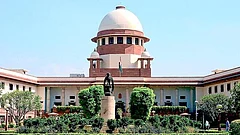


The Bench ordered a complete prohibition on the printing and circulation of the textbook and placed the onus on the NCERT Director to retrieve copies that had already reached schools. It further directed Principal Secretaries of State education departments to submit compliance reports within two weeks. Details of the National Syllabi Board members associated with drafting the chapter, along with the minutes of the meetings where the text was approved, have also been sought.

The court was critical of the NCERT’s earlier communication after the issue surfaced, observing, “Instead of filing an introspection of what has been written in the book in an extremely contemptuous and reckless manner, the NCERT director wrote back defending the contents.”
According to the Bench, the wording of the disputed section did not appear to be a mere oversight and seemed to be “a calculated move to undermine the institutional authority and demean the dignity of the judiciary.” It added that if the act was found to be deliberate, it could amount to criminal contempt for “interfering with administration of justice besides scandalising the institution.”
At the same time, the court said that its intervention was not aimed at curbing fair criticism. “We hasten to add that we do not propose the suo motu proceedings to stifle any legitimate critique or exercising the right to scrutinise the judiciary… The necessity of judicial intervention is not from a desire to suppress criticism but to uphold the integrity of education,” the Bench said.
The issue had been flagged a day earlier by senior advocates Kapil Sibal and A. M. Singhvi, who mentioned the matter before the CJI and described the text as scandalising the judiciary. The CJI had then remarked, “I will not allow anyone on the earth to taint the integrity and defame the entire institution,” noting that members of the judiciary were “perturbed.”
Subsequently, the National Council of Educational Research and Training issued a statement expressing regret over the inclusion of the passage, terming it an “error in judgement” that had “inadvertently crept” into the chapter. It said the book’s circulation had already been put on hold and that the content would be revised through consultation before the 2026–27 academic session.
The court said it may consider setting up a panel to fix responsibility after reviewing the compliance reports. The matter will be taken up again after four weeks.