India's Permanent Representative Parvathaneni Harish criticised Pakistan for making unwarranted references to Jammu and Kashmir at the UN General Assembly.
Harish reaffirmed that Jammu and Kashmir is and will always remain an integral and inalienable part of India, calling Pakistan's assertions baseless.
The Indian envoy reminded Pakistan that its non-permanent seat on the Security Council is a responsibility and not a forum for peddling false narratives.
India strongly criticised Pakistan at the United Nations on Friday after Islamabad referenced Jammu and Kashmir during a session on the "Annual Report of the Security Council", according to the Press Trust of India.
The diplomatic clash began when Pakistan’s Permanent Representative to the UN, Asim Iftikhar Ahmad, raised the issue during remarks at the UN General Assembly.
India’s Permanent Representative to the UN, Parvathaneni Harish, delivered an immediate response, defending the country's territorial integrity and challenging Pakistan's conduct before outlining the need for structural changes at the global body.
"The unwarranted reference by Pakistan to a matter strictly internal to India, the Union Territory of Jammu and Kashmir, has compelled me to respond," Harish told PTI. Harish said in the UNGA hall that Pakistan has decided not to spare this forum either from their characteristic misuse of august UN platforms for their divisive political interests.

Rebuking Council misuse
Pakistan currently serves as a non-permanent member of the UN Security Council, with its tenure ending this year. The nation constantly raises Jammu and Kashmir, along with other internal Indian topics, at various UN platforms.



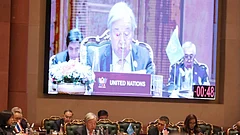
Making it clear that Jammu and Kashmir was, is and will always remain an integral and inalienable part of India, Harish said that any assertions to the contrary are baseless, devoid of and inconsistent with historical facts, according to PTI.
"Abuse of its presence on the Security Council by Pakistan, including through the circulation of several misinformed and misleading communications also testifies to this counter-productive approach. I would like to remind Pakistan that being a member of the UN Security Council is a huge responsibility. It is not a forum for peddling biased and false narratives," Harish said to PTI.
"Empty rhetoric and hollow claims by Pakistan would not change this fundamental reality. In the interest of time of the wider UN membership, I would not delve any further into this," the Indian envoy told PTI.

Push for UNSC reform
Harish said there is a pressing need for UN Security Council reform to handle contemporary global challenges effectively.
"The current structure reflects geopolitical realities of 1945. Retaining the staus quo has so far not enabled effective functioning of the Security Council and cannot do so in future," Harish said to PTI.
He said that the "marginal" reform in the 1960s, which expanded only the non-permanent category, has not changed the fundamental mode of functioning of the Security Council in any meaningful way, according to PTI.
"Expansion of both permanent and non-permanent categories is central to implementing real and meaningful reform," Harish told PTI.
To address the imbalance, the G4 nations — India, Brazil, Germany and Japan — have proposed increasing the council's membership from 15 to 25 or 26. This reformed structure would include 11 permanent members and 14 or 15 non-permanent members, according to PTI.
Currently, the powerful UN organ consists of five veto-wielding permanent members — China, France, Russia, the UK and the US. The remaining 10 members are elected to sit at the horseshoe table for two-year terms as non-permanent members. India last sat in the Council as a non-permanent member in 2021-22, according to PTI.