
IN the end, it took a sheaf of pamphlets to shatter the peace. But the communal violence which rocked Muslim-dominated pockets of Hyderabad on June 5 after an eight-year lull should not have come as a surprise. In fact, police commissioner R.P. Singh admitted as much. Pointing out that the police should have given more credence to intelligence reports and the discovery of pamphlets in the Old City lampooning the religious beliefs of Muslims, he said the "complacent" police force must shoulder part of the blame.
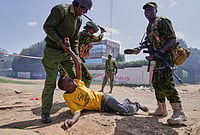
Once the storm warnings were ignored, rioters let loose on a Black Friday, killing eight and injuring over a 100. The violence and arson seemed to have been well-planned and has broken the thin fabric of communal harmony in the city. The violence was ignited by an irate mob which stormed out of a mosque after offering prayers and went berserk, attacking passersby and damaging public and private property alike, including a temple. The Hindus retaliated the next day, further stoking communal fires and bringing Hyderabad to a halt.
The police has not come up with any explanation for ignoring the "mischievous" anti-Muslim pamphlet which had a visual of Lord Ganesha trampling upon Muslim places of worship. The pamphlet was in circulation from June 2 itself but the police did not attempt to identify the people who had printed it—nor did it try to arrest those responsible for its distribution. Even now, the source of the offending literature remains a mystery.
If the police chose to ignore the signals out of sheer apathy, policemen on duty failed to act when they saw the mob running amok outside a mosque near the historic Charminar monument. The cops remained mute spectators and didn't even use mild force to keep the arsonists in check. Even more surprising was the fact that the police failed to take any precautionary measure to prevent the violence from escalating the next day.


This, despite the fact that there were repeated messages from intelligence officials of possible violence. The Hyderabad police force appeared to have underestimated the effect such a "controversial" and "mischievous" pamphlet would have on the minority community. The police took it so lightly that it didn't even post additional forces in sensitive areas. The intelligence input, it is learnt, was specific and a copy of the offensive pamphlet was also provided to the local police.
If the last riots in 1990 were well organised only to unseat then chief minister M. Chenna Reddy, allegedly by his own partymen, the latest bout of violence is believed to be the handiwork of some hardcore fundamentalist out-fit. The state police does not rule out ISI involvement either. In fact, the ISI connection was established with the arrest of Sheikh Mahboob Ali, the brain behind the rioting who is known to have links with the Pakistan intelligence outfit. Says police chief Singh: "Ali is the founder of the Darzgah Jeehad-O-Shadath, a city-based militant group which was formed some 15 years ago." This Muslim group's main objective is to recruit and train youth in self-defence. But the police is yet to lay its hands on any concrete evidence to identify the culprits of the communal bloodletting.
Ali apart, the police have also arrested another group of youngsters, who allegedly tried to torch a state-owned Road Transport Corporation bus last Sunday. For now, the police is working on the ISI nexus and is following up leads in that direction. That the ISI is active in the city is an open secret—the killing of an SP rank officer a couple of years ago by militants is testimony to this.
But the police are not leaving the other theories unprobed. One of them is that some fundamentalist outfit, enjoying the backing of one political party or other, may have been used to settle scores with the ruling party. Admits a senior police official: "We are not blind to the fact that one of the legislator's sons is acting as an ISI agent in the city. But we have no concrete evidence to nab him."
Such a theory gains strength when one takes into account that political parties, such as the Majlis-e-Ittehadul Muslimeen (MIM) and the Majlis Bachao Tehrik (MBT), representing the Muslim community, have been very vocal in recording their ire against Chandrababu Naidu's decision to back the Vajpayee government during the trust vote. Points out another senior police official: "We are also probing the involvement of other major political players, either directly or indirectly in the violence."
The suspicion that the ISI's involvement with a city-based fundamentalist outfit may have been responsible for the riots was first revealed by Union minister of state for urban development B. Dattatreya, who quoted some senior police officials to this effect. But, chief minister Naidu chose to be cautious. "Why jump to conclusions? We got clinching evidence against those who indulged in violence with the help of video cameras. We have already taken some people into custody. Investigations will help bring the culprits to book," he told the media.
It is true that Naidu spared no personal effort to defuse the tension. He visited the affected areas soon after hearing the news amidst the celebrations following the TDP's good showing in the assembly byelections. In a bid to soothe ruffled feathers, the chief minister announced the government's decision to set up special courts to try the culprits. He ordered separate rehabilitation camps for Hindus and Muslims and granted compensation for the victims. To ensure more effective policing, Naidu has plans to set up video cameras in all sensitive areas of the Old City.
BUT the Congress is in no mood to spare either Naidu or the police. PCC president Y.S. Rajasekhara Reddy,whose father was killed in a bomb attack by Telugu Desam activists last month, has demanded a CBI probe into the communal flareup. His party also feels that as the law and order situation is deteriorating in the state, it would be proper for the Centre to impose President's rule.
The Congress high command too has been active in its effort to nail the TDP government. A three-member committee con -sisting of N.K.P. Salve, Nawal Kishore Sharma and Ghulam Nabi Azad, after visiting riot-hit areas, blamed the government for its inefficiency to contain violence.
The Opposition parties see in the June 5 violence echoes of Coimbatore and argue that the Centre should take serious note of the ground situation in Hyderabad and that effective steps must be initiated to ensure that the violence does not spread to other parts of the state. However, BJP leader and Union minister Dattatreya feels otherwise. While expressing his dissatisfaction at the manner in which the police failed to act, he made it clear that there was no need for a CBI probe. He is obviously trying to bail out Naidu. Any detailed investigation into the incident would also expose some Hindu groups which allegedly took part in the second round of violence.
Naidu's woes are not confined to the Old City alone. The outlawed People's War Group (PWG) has stepped up violence and the Madiga Porata Samiti (a Scheduled Caste group) has declared war against the government, which is pressing for categori-sation of SCs into four groups. While the PWG in its latest outburst killed as many as 10 policemen in a landmine blast in Waran-gal, the Madiga Porata Samiti activists destroyed government property, protesting against Naidu's decision to categorise SCs.
With assembly elections due early next year, the communal flare-up spells trouble for Naidu. The minorities which are already upset by the TDP chief's truck with the BJP will be further alienated. The Muslim vote-bank has always supported Naidu, and wooing it back will be top priority for the Andhra Pradesh chief minister.