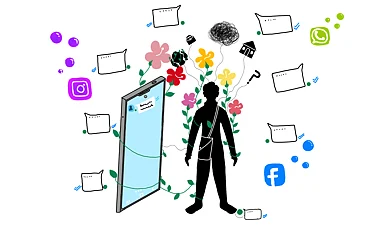
Most thoughtless interventions in public life come from highly educated, articulate, and well-informed people.
Apathy rarely remains stable. It often mutates into something more volatile: antipathy.
The most troubling consequence of this transformation is the disappearance of the 'neighbour', notes the writer.
In an age of speed, metrics, and constant reaction, something vital is quietly slipping away. Drawing on philosophy, psychology, and contemporary Indian and global realities, this essay reflects on how thoughtlessness breeds apathy and hostility—and why learning to think again has become a moral necessity.
An Unsettled World and a Quiet Failure
We live in anxious and unsettled times. The sense of disquiet is not confined to one nation or political system. Wars rage on multiple fronts, alliances fracture, borders harden, and economies feel increasingly fragile. Yet beneath these visible crises lies a quieter, more insidious problem: a widespread failure of thinking.
Public life today is noisy, reactive, and polarised. Opinions are formed instantly, judgments delivered without hesitation, and outrage travels faster than understanding. We speak constantly, yet listen poorly. We respond endlessly, yet reflect rarely. What appears to be disappearing is not intelligence or access to information, but something more essential: moral attentiveness.
It is this loss that gives our present moment its distinctive unease.
When Calculation Replaces Thought
Nearly six decades ago, the German philosopher Martin Heidegger offered a warning that now feels uncannily prescient. In a 1966 interview with Der Spiegel, published posthumously in 1976, Heidegger was asked whether humanity lacked anything in an age of growing prosperity. His answer was unexpected: we have not yet learned to think.



Heidegger was not questioning human intelligence. On the contrary, he acknowledged that modern societies excel at what he called calculative thinking — the ability to plan, measure, predict, and optimise. This form of thinking is indispensable. Without it, modern economies, technologies, and institutions would collapse.
The danger, Heidegger warned, arises when calculative thinking becomes exclusive. When all thinking is reduced to efficiency, metrics, and outcomes, questions of meaning, responsibility, and moral consequence are crowded out. We ask what works, but not what is right. We ask what benefits us, but not who it harms.
Life becomes faster — but thinner.
Thoughtlessness Is Not Ignorance
Thoughtlessness is often mistaken for stupidity or lack of education. In reality, many of the most thoughtless interventions in public life come from highly educated, articulate, and well-informed people. Thoughtlessness is not the absence of knowledge; it is the erosion of reflection.
To be thoughtless is to respond without pausing, to judge without considering consequences, to act without attending to the human cost. It is thinking reduced to reaction.
In India, this dynamic is painfully familiar. News cycles are relentless. Political loyalties harden quickly. Social media platforms function as permanent courts of instant judgment. Citizens are rapidly classified as patriots or traitors, insiders or outsiders. Doubt is mistaken for weakness; restraint for indifference. In such a climate, thinking itself becomes risky.
Globally, the same pattern unfolds. Wars are consumed as spectacle. Civilian deaths become scrolling numbers. Refugees are discussed as “flows” or “burdens”. Entire populations are flattened into slogans. When suffering is distant, constant, and mediated through screens, our capacity to respond humanely begins to erode.
The Rise of Apathy in an Age of Overload
This erosion often manifests as apathy.
Apathy is frequently described as moral laziness, but this is misleading. More often, apathy is a response to overload. The modern human mind is exposed to more suffering, injustice, and catastrophe in a single day than previous generations encountered in a lifetime. Faced with such relentless exposure, emotional withdrawal becomes a survival strategy.
We mute notifications. We scroll past distress. We move on.
But apathy has consequences. When we feel less, we imagine less. The neighbour — once a concrete presence — becomes abstract. Suffering becomes background noise. We may express opinions loudly, but we are no longer deeply affected. Moral imagination shrinks, not because we are cruel, but because we are exhausted.
This is how indifference becomes normalised.
From Apathy to Antipathy
Apathy rarely remains stable. It often mutates into something more volatile: antipathy.
Antipathy is not numbness, but hostility. It channels the frustration and fatigue produced by apathy into anger. Someone must be blamed. Someone must be opposed. Complex realities are reduced to binaries — us versus them, good versus evil.
Antipathy feels energising. It restores a sense of agency and moral certainty. But it is corrosive. It legitimises contempt, justifies exclusion, and erodes empathy. The neighbour is no longer someone beside us, but someone to be defeated, silenced, or erased.
We see this daily — in communal tensions, online abuse, political polarisation, and the casual dehumanisation of those who think, speak, or live differently. What once shocked us now barely registers.
Living Only Visible Lives
One reason this shift has accelerated is that we increasingly live visible lives.
Modern culture rewards what can be measured, displayed, and monetised. Productivity, performance, popularity, and visibility are celebrated. What cannot be counted quietly loses value. Silence, contemplation, moral struggle, empathy — these invisible dimensions of life struggle to justify themselves.
Yet it is precisely these invisible practices that sustain humane societies.
When reflection is crowded out by speed, and attention by distraction, ethical life becomes procedural rather than personal. We follow rules, repeat slogans, and outsource judgment to systems and ideologies. Life continues efficiently, but meaning thins out.
As Heidegger warned, human beings risk becoming cogs in systems they neither question nor fully inhabit.
The Disappearing Neighbour
Perhaps the most troubling consequence of this transformation is the disappearance of the neighbour.
The neighbour is not merely the person next door. It is the one whose presence interrupts our self-absorption, whose vulnerability makes a claim upon us. When thinking is reduced to calculation and feeling dulled by overload, the neighbour fades from view — not physically, but morally.
We no longer ask, Who is affected by this?
We ask, What side are they on?
In a diverse society like India, with long traditions of coexistence and dialogue, this erosion is especially dangerous. A civilisation shaped by pluralism risks losing its moral centre if speed, certainty, and spectacle dominate public life unchecked.
Thoughtlessness as a Geopolitical Risk
The danger is not confined to personal ethics or national politics. In a world armed with powerful technologies and fragile political arrangements, thoughtlessness becomes a geopolitical risk.
Wars do not begin only with weapons. They begin with simplified thinking, hardened identities, and the erasure of the other’s humanity. When empathy collapses and nuance disappears, violence becomes easier to justify. Indifference to distant suffering today becomes complicity tomorrow.
In such a world, the inability to think ethically is not merely unfortunate — it is dangerous.
Thinking as a Moral Act
This brings us to a crucial point: thinking is not morally neutral.
To think — in the deeper sense — is not simply to process information or analyse data. It is to pause before judging, to dwell with complexity, and to resist the seductions of certainty. Thinking becomes a moral act when it refuses to erase the other for the sake of convenience, ideology, or speed.
Such thinking demands courage. It requires us to tolerate ambiguity, to listen when it would be easier to dismiss, and to remain open when outrage promises quicker rewards. In a time when apathy numbs, and antipathy inflames, thinking itself becomes an act of resistance.
Recovering the capacity to think does not require withdrawing from public life or rejecting technology. It requires restoring spaces for reflection within it. It means asking not only what works, but what harms. Not only who wins, but who pays the price.
In an unsettled world, learning to think again may be the most quietly radical act we can still perform.
Recovering the Courage to Think
Recovering the capacity to think does not require withdrawing from public life or rejecting technology. It requires restoring spaces for reflection within them. It means asking not only what works, but what harms. Not only who wins, but who pays the price.
In an unsettled world, thinking itself becomes a civic responsibility.
It is how apathy is softened, antipathy resisted, and the neighbour restored to view. And in an age obsessed with speed and certainty, learning to think again may be the most quietly radical act we can still perform.
Dr George John is a retired British Emeritus Consultant Psychiatrist from London, formerly in private practice in London and the southeast of England, now living in Kochi, India. His special interests include interpersonal conflict, Human Flourishing and the Philosophy of Psychiatry.